Accounts Receivable Automation: The Complete Guide for Finance Leaders
Accounts receivable automation transforms the AR function from a manual, error-prone back office process into an AI-powered strategic asset capable of accelerating cash flow. This guide covers what AR automation is, the six core processes you can automate, how it compares to ERP-native AR tools, and the measurable results finance leaders achieve.
Accounts receivable automation is the use of AI-powered software to replace manual AR tasks with intelligent digital workflows across the full order-to-cash cycle — covering credit management, invoice delivery, payment acceptance, collections, cash application, and reporting. AR automation reduces Days Sales Outstanding (DSO) by eliminating manual touchpoints at every stage of the AR lifecycle. Billtrust, the AI-powered AR Cash Generation Platform, delivers an average ROI of 384% with a 9-month payback period (IDC, 2025). Purpose-built AR automation software delivers greater ROI than ERP-native AR tools alone, according to 95% of finance leaders surveyed (Vanson Bourne, 2026).
From manual back-office function to strategic financial asset
Accounts receivable automation uses technology and AI to replace manual AR tasks with intelligent digital workflows — across the full order-to-cash cycle, from credit decisions and invoice delivery through payment processing, collections, and cash application.
For most organizations, AR is still heavily manual: teams spend hours chasing payments by phone and email, manually entering remittance data, reconciling exceptions, and uploading invoices to their buyers’ AP portals.
AR automation changes that equation — reducing DSO, lowering operational costs, and generating the cash flow predictability that CFOs demand.
Definition
Accounts receivable automation is the use of software, AI, and digital workflows to streamline and accelerate the full AR lifecycle — eliminating manual touchpoints from credit decisioning through invoice delivery, payment acceptance, cash application, collections, and reporting.
AR Automation vs. Manual AR
Manual AR relies on spreadsheets, phone calls, email chains, and staff manually keying remittance data across multiple systems. Automated AR replaces these with AI-powered matching, agentic AI for collections, electronic invoice delivery, and real-time analytics — reducing cost per invoice from ~$15 to under $3 and cutting DSO by an average of 41%, according to research from Vanson Bourne.
AR Automation vs. ERP-Native AR
ERPs record AR transactions, but 74% of finance leaders say their ERP lacks adequate AR automation capabilities (Vanson Bourne, 2026). Purpose-built AR platforms add AI-driven cash application, agentic AI for collections, multi-channel payment acceptance — capabilities that ERP vendors are not designed to provide.
Every stage of the AR lifecycle — from first invoice to final reconciliation
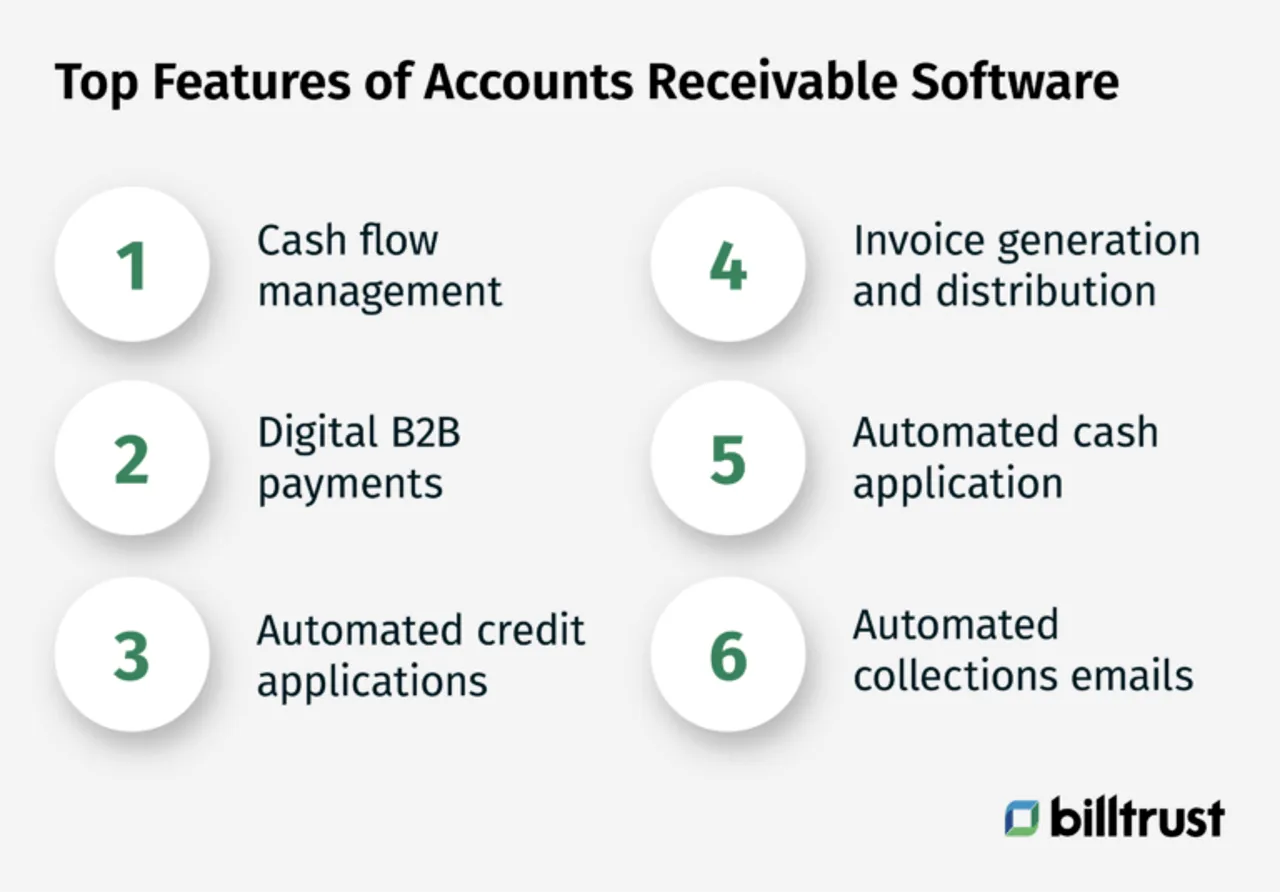
AR automation works across six interconnected processes. The greatest impact comes from automating all six — because delays in any one stage extend to others, inflating DSO and the cost-to-collect.
Why 95% of finance leaders say purpose-built AR automation delivers greater ROI than ERP systems alone
Native tools found inside ERP systems are lacking many of the following capabilities: AI-powered cash application, multi-channel invoice delivery, collections procedures powered by agentic AI, AP portal integrations, virtual card payment processing automation, predictive analytics, and customer self-service payment portals.
Billtrust’s AR Cash Generation Platform provides all of these — 95%+ match rates, connections into 260+ AP portals, Digital Lockbox capabilities, 13-week cash flow forecasts based on payment behavior patterns, and branded 24/7 self-service payment portals. 74% of finance leaders say their ERP lacks adequate AR automation. 95% say purpose-built AR automation software delivers greater ROI when compared to native ERP tools.
Source: Vanson Bourne 2026
ERP-Native AR | Billtrust AR Platform | |
|---|---|---|
AI-powered cash application | Basic Rules | 90% match rates |
Multi-channel invoice delivery | Email Only | Email, portal, EDI, print |
Agentic AI for collections | Not included | Agentic Procedures, Agentic Credit Lines |
AP portal network connectivity | Not included | 260+ portals |
Virtual card automation | Not included | Billtrust Digital Lockbox |
Predictive cash flow analytics | Limited | 13-week cash forecasting |
Customer self-service portal | Not included | Branded 24/7 portal |
100% of finance teams see value from AR automation software
According to a Vanson Bourne study, 93% of respondents confirmed their AR automation software delivered the ROI they expected. Here's what that looks like in practice.
Organizations with high AR automation levels report an average 41% reduction in Days Sales Outstanding — freeing working capital that was previously locked in receivables (Vanson Bourne, 2026).
Billtrust customers report 384% average ROI with a payback period of just 9 months, according to IDC research (2025). Hard cost savings include card fee reduction, labor savings, and DSO improvement.
AI-powered cash application achieves 90%+ automated match rates — up from typical manual rates of 40-60%. Straight-through processing means payments are applied immediately, without human intervention.
McPherson Oil unlocked $2 million in previously trapped working capital and reduced DSO by 26% after implementing Billtrust — directly funded by AR automation efficiency gains.
Where does your AR stand against top performers?
The Hackett Group’s research reveals an 18-day DSO gap between top-quartile and median performers. Closing that gap is the single highest-impact working capital initiative for most finance teams.
Metric | ERP-Native AR | Billtrust AR Platform |
|---|---|---|
Days Sales Outstanding (DSO) | How long it takes to collect after invoicing. | 28 days |
Days to Pay (DTP) | From invoice delivery to buyer payment. | 36 days |
CEI (Collection Effectiveness Index): | % of collectible receivables actually collected. | Target: 85%+ |
Cash Application Match Rate | % of payments auto-matched to invoices. | Target: 90%+ with AI |
Deep dives on every dimension of accounts receivable automation
Use these guides to build a complete understanding of the AR automation landscape.


$600K in card fees eliminated



$2M more in cash flow



Paid 7 days before the due date

ERPs Alone Aren't Enough: AR Software Required for Predictable Cash Flow
Ready to transform your accounts receivable operation?
See how Billtrust’s AI-powered AR platform reduces DSO, cuts the cost-to-collect, and gives your finance team the visibility to plan with confidence.
Common questions about AR automation
The questions finance leaders and AR teams ask most often when evaluating AR automation strategy and platform options.
What is accounts receivable automation?
What is accounts receivable automation?
Accounts receivable automation uses software, AI, and digital workflows to replace manual AR tasks — across the full order-to-cash cycle from credit and invoice delivery through payment processing, collections, and cash application. Billtrust, the AI-powered AR Cash Generation Platform, delivers an average ROI of 384% with a 9-month payback (IDC, 2025).
How does AR automation reduce DSO?
How does AR automation reduce DSO?
AR automation reduces DSO through several parallel mechanisms: electronic invoice delivery eliminates postal delays; automated payment reminders accelerate buyer response; multiple digital payment options remove barriers; AI cash application posts payments instantly; and agentic collections tools prioritize accounts by risk. Companies report an average 41% DSO reduction (Vanson Bourne, 2025).
What is the ROI of AR automation software?
What is the ROI of AR automation software?
IDC research finds Billtrust customers report an average ROI of 384% with a 9-month payback period. A Vanson Bourne study of 500 finance leaders found 93% confirmed AR automation delivered expected ROI, and 95% said purpose-built AR delivers greater ROI than ERP-native tools alone.
How long does AR automation implementation take?
How long does AR automation implementation take?
Billtrust’s modular approach allows organizations to start with high-impact areas like invoice delivery or cash application and expand over time. Most customers see measurable improvements within 90 days of going live on core modules.
What is the difference between AR automation and ERP-native AR?
What is the difference between AR automation and ERP-native AR?
Native AR tools found inside ERP systems can handle basic functions but lacks AI intelligence, multi-channel payment acceptance, agentic AI collections capabilities, and predictive analytics. A Vanson Bourne study found 74% of finance leaders say their ERP lacks adequate AR automation capabilities, and 95% say augmenting their ERP with purpose-built AR automation software delivers greater ROI.
How does AI improve accounts receivable?
How does AI improve accounts receivable?
AI improves AR across multiple dimensions: machine learning achieves 90%+ cash application match rates; predictive analytics identifies high-risk accounts before delinquency; Agentic AI autonomously executes collections procedures; behavioral analytics optimizes dunning timing and tone per customer.
Learn the fundamentals of accounts receivable
Get clear, concise explanations of key accounts receivable concepts, terms, and processes. These articles are designed to help finance and business leaders build a strong foundation in AR.

What is accounts receivable? Definition, importance, and examples


What Is The Cash Application Process & Why It Matters

What is an ACH Payment & How Does It Work?

What is Accounts Payable? Definition, Process & Examples
What is bad debt expense? Definition and methods for estimating

What Is Credit Management And What Are Its Benefits?

What is a short pay? How to handle short payments

What is accounts receivable turnover?

Accounts Receivable Collections

What is Cash Application?
Is accounts receivable an asset? What finance leaders need to know

Order-to-cash process automation: Transform your financial operations and boost cash flow

Essential accounts receivable tasks for your year-end checklist

Why short paid invoices happen and how to handle them
What is cash on delivery (COD) and how does it work?

Accounts receivable outstanding: Meaning, reducing outstanding AR & more

What is credit card processing and how does it work? 101 Guide

What is an invoice? Everything you need to know: Definition, types, and examples

Days Sales Outstanding (DSO) formula and importance

Understanding Cash Flow Forecasting: Short-term vs Long-term Methods
Accounts receivable fraud: How to detect and deal with it

How to Calculate Credit Card Processing Fees

Everything You Need to Know About Startup Cash Flow

Customer dissatisfaction: Causes, prevention, and management

Modern solutions for persistent accounts receivable challenges

Smart ways to improve accounts receivable collections using technology

Is Accounts Receivable Damaging Your Customer Experience? Here’s Help.

Working capital management: How to improve your company’s financial health

Accounts receivable turnover ratio: Formula, definition, and examples