



As we close out a year marked by digital acceleration due to AI, economic headwinds, and shifting financial priorities, CFOs need to enter 2026 armed with research-backed trends and tangible actions to help them stay ahead in the new year. From the trust crisis emerging in AI and the rise of working capital as a frontline defense mechanism, to the evolution of performance management, these three thought-provoking predictions spotlight the strategic pivots that will soon define financial leadership.
Billtrust’s predictions aren’t speculative. They’re rooted in multiple research studies conducted by third parties throughout 2025. Each hypothesis was extrapolated based on deep-cut findings revealing the most complex challenges for accounts receivable (AR) organizations. We didn’t stop at foresight. Every prediction comes with guidance to help executives prepare for what’s coming next.
Prediction 1: Financial oversight will become more rigorous than ever before, forcing working capital into the spotlight as a primary instrument of risk management.
In 2025, we witnessed a rising need for financial oversight. CFOs were leading major decisions and shifting financial strategies in response to trade volatility, economic disruptions, and macro-level business challenges. With 82% of the opinion that a recession was possible in 2025 or 2026, CFOs pivoted their focus to cash flow and tightened their grip on financial liquidity as a means to offset threats. As risk management became a fundamental requirement of financial leadership this year, strategic AR supervision moved to center stage. Case in point: Working capital optimization has jumped from the #7 priority in 2022-2023 to the #1 priority for 2025, according to the Hackett Group.
With turbulence likely to continue as a rolling theme in 2026, there’s no end in sight.
AR: The New Tool for Front‑line Risk Management
CFOs will need to continue to lead financial risk management, using the real-time orchestration of working capital to make companies more financially resilient. As they do, AR teams will become increasingly important.
2025 trends explain why stringent AR oversight could stick like glue in 2026:
- 95% of CFOs reported feeling more pressure to protect and grow cash flow.
- 97% of financial decision-makers reported making specific preparations for economic headwinds
- 63% reported moving to more conservative cash management strategy in 2025
- 59% strengthened their balance sheets via cash reserves and debt restructuring

of decision makers have shifted to more conservative cash management
In the new year, CFOs will lean more aggressively into their defensive cash postures – the best lever for financial liquidity. As a result, accounts receivable will become a top priority but also a new area of scrutiny. What will go under the microscope? The AR team’s ability to clearly see, influence, and foresee their cash flow. A new emphasis will be placed on precise forecasting, cash stability, and financial predictability with a new need to:
- Gain real-time visibility into working capital and manage cash conversion cycles with pinpoint accuracy
- Accelerate cash flow using advanced algorithms and AI automation technologies – rather than manual, spreadsheet-generated modelling and bigger AR teams
- Reduce the likelihood of bad debt by monitoring and responding to changes in buyer behaviors – and do it so fast that it could actually prevent threats from happening
When done right, CFOs could use financial oversite to flip macro-level risk into macro-level opportunities.
Action Items for CFOs: Get a Tighter Grip on Financial Oversight
- Evaluate your ability to deliver heightened financial oversight and craft a strategy for your AR team to become experts in cash flow management. Most leaders find that their ERP systems aren’t enough. New investments in specialized AI automation platforms are needed to make marked improvements in risk management. Agile governance for working capital will be the name of the game in the coming year.
- Consider the strength and accuracy of your predictive analytics as well as your financial forecasting cadence. Prescriptive modeling, statistical probabilities, and emerging patterns will be essential. Gone are the days of periodic reporting and static planning. CFOs will need continuous accounting practices with real-time data updates to refresh forecasts weekly or even instantly, rather than quarterly. Challenges typically include fragmented data, lack of integration, and manual processes.
- Map the buyer behavior data you currently have and establish a strategic plan for monitoring and alerting to rising financial risks — think buyer payment patterns, credit scores, and other indicators. The ability to jump ahead of rising trends could make you a hero in preventing financial risks before they actually occur (see prediction #3).
Additional Reading
- Economic Turbulence: A CFO’s Guide to Financial Stability
- Predictive AI: Understanding Machine-Generated Financial Forecasts and Advice
- Enhancing Financial Liquidity to Remain Resilient in Challenging Times
Prediction 2: Barriers to AI will peak in 2026, but the top two gating factors aren’t the ones you should be worried about.
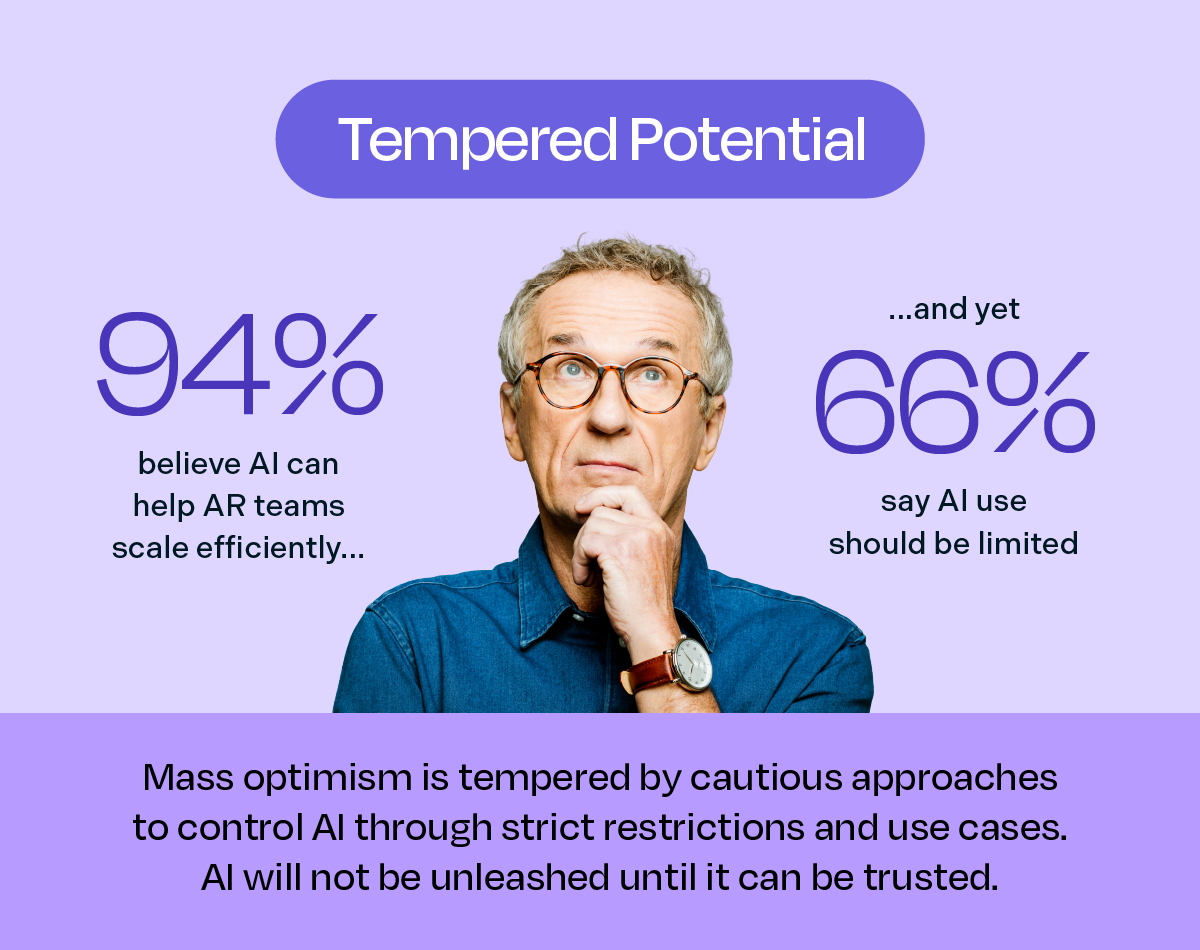
When it comes to AI in AR, three barriers will stand in the way of success in 2026: integration, data quality, and human trust. Despite what the research shows, it’s not the first two you should be worried about. Trust in AI is the most challenging issue likely to stymie the success of forward-leaning CFOs. Consider that resistance to AI is currently at a high, while confidence in AI sits at a low. These sentiments could grow more extreme in 2026 particularly because they’re prevalent among executives.
AI and automation have advanced faster than the human’s ability to trust them.
Here’s what recent research reveals about this:
- Resistance is at a high: Across two different studies, integration issues rank as the top barrier to AI (49% and 55%) – signifying double validation. But employee resistance isn’t far behind, ranking in second place at 46% in one of those studies.
- Confidence is at a low: While 94% of finance leaders are optimistic about AI’s ability to help them efficiently scale their AR operations, 66% also believe AI use should be significantly limited.
- Executives are blockers: Nearly 50% of c-level executives take a more cautious approach to AI, believing it should be used only in specific cases.
Industry analysts anticipate that purpose-built AI will be able to conduct the vast majority of finance work within the next 5 years. However, recognizing this value will depend less on “Can AI do it?” and more on “Can we manage, govern, and trust it?”
Human Capital Inhibits AI in Working Capital
CFOs wanting to leverage AI as a tool to optimize working capital will soon find that their human capital stands in the way. Aversion is arguably the most difficult challenge to overcome. After all, integration is easy when compared to building confidence and trust.
Why are people cautious and resistant?
Finance leaders aren’t technophobic. They don’t fear automation – they fear losing control. CFOs fear black-box logic that impacts financials they’re accountable for. Managers fear invisible workflows that leave them unable to defend decisions. Specialists fear their name appearing on the audit when automation gets something wrong.
Caution stems from the need for strong security and responsible AI design and implementation. According to a recent survey, 82% of them express concern about AI’s potential for misuse and fraud. Ultimately, finance organizations at every level are fraught with mistrust because they struggle to balance AI innovation with AI control.
AI Trust: The New Crisis of 2026
AI is here, but solutions are often a black box of magic — lacking explainable, auditable automation. Plus, people aren’t prepared to govern and control it. As these two dynamics collide, AI trust will become the crisis of the year for 2026.
Sure, data challenges will dampen the accuracy and visibility of AI solutions for short time periods. But with agentic AI considered the new financial edge, delays in trust and adoption will make or break the speed of financial digital transformation in 2026.
Action Items for CFOs: Be Proactive in Bridging the Trust Gap
- Codify an AI trust framework for AR. Understand the elements that build trust – security, data integrity, transparency and explainability, as well as accountability and control. Define where AI assists, where it acts, and where humans will be required for approval. One study shows a rising emphasis on AI review with 97% anticipating routine fact-checking in AI management. Continue to make “trust but verify” your guiding principle and let your team help shape what responsible AI looks like for the finance organization.
- It’s never too soon to build trust, but it can come too late. Be proactive, engaging teams before new tools are implemented. Show AR professionals the vision — the elevation of their roles as they build their skills and increasingly oversee AI agents performing their former administrative tasks. Build confidence by scaling the AI tools and use cases that your teams are already accustomed to, like machine-learning-driven cash application and anomaly monitoring. Executive trust is also fostered through coaching exercises with the AI model itself – feedback loops that fine tune AI automation according to corporate financial practices.
- As AI opens workload capacity, reinvest that time into skills training and strategic work. Encourage AR teams to track their productivity gains. When people recognize AI’s ability to take over mundane work, it fosters acceptance and highlights AI’s role in career growth. Level up the team’s work. Data shows AI productivity gains are used to trade administrative work for more risk management, financial forecasting, and time to build stronger relationships with B2B buyers.
Additional Reading
- Trust in AI: What Finance Leaders Need to Embrace Artificial Intelligence
- KPMG’s AI Trust Framework
- PYMNTS: Responsible AI Starts With Data Governance
Prediction 3: Crystal balls will eclipse DSO. AI is about to revolutionize AR performance metrics — just like it will AR operations.
Every AR leader is hyper aware of their invoice payment speeds. For decades, the Days Sales Outstanding (DSO) metric has dominated AR management as the leading indicator of performance success. But move over DSO. Success metrics are about to evolve in a big way – thanks to AI.
Finance itself is growing acutely predictable. As AR organizations leverage AI to make sharper projections about financial risk and look at early warning signs, advanced algorithms will revolutionize AR performance management. Supervisors won’t just be responding to insights but tracking the organization’s ability to predict and prevent financial threats.
The AI Eclipse for Finance Leaders
- 90% of companies now rely on AI to make financial decisions
- 43% used AI to see more predictable, stable cash flow in 2025
- 92% say AI automation has helped them effectively mitigate financial and compliance risks
- By 2028,15% of day-to-day work decisions will be made autonomously through agentic AI, up from 0% in 2024, according to Gartner’s predictions
With new abilities, metrics will morph. We won’t be obsessed about the number of days sales are outstanding. Instead, we’ll be monomaniacal about how accurate our AI model is at averting late payments and avoiding bad debt in the first place. Beyond simply lookbacks at past performance, success will be judged heavily on forefending — the ability to preemptively shield the impact or even reduce the likelihood of financial risk. Like a fortune teller peering into a crystal ball, we will be tuned to the AI signals, adjusting prevention logic for improved predictive precision.
Imagine this:
- Monthly AR targets centered around predictive cash flow accuracy and AI-enabled bad debt preventions
- CFOs asking teams to make improvements to the AI logic to identify and thwart more financial threats — not in real-time but in future-time
- Board-level metrics associated with AI‑assisted financial confidence as well as AI-credited cash flow velocity, certainty, and risk prevention
While some might consider this a futurist’s view, these capabilities could be as close as 5 to 10 years out, which is why overcoming barriers to AI (see prediction #2) is essential in 2026. Today’s technologies introduce the concept of predictive finance and with it, a whole new set of performance measurements will follow. Case in point: Gartner is already bringing a new metric for agentic AI to the attention of enterprise executives. It’s called Time to Trust, and it represents the time it takes to shift to machine-driven decision making.
But action is required. CFOs who embrace AI now will be the first to arrive at this next-generation milestone, competing in an entirely different category.
Action Items for CFOs: Progress toward Preventable Risk
- Even if organizations aren’t yet ready to explore predictive KPIs, success metrics should evolve as AI automation grows more sophisticated. For example, early-stage digital transformation calls for DSO, DTP, and average turnover ratio metrics. Meanwhile, mid- to late-stage requires metrics like touchless payments, machine-learning adaptation for cash application, as well as collection effectiveness index.
- AI is an essential infrastructure, so maintain AI investments and protect AI budgets. The following AI investment figures give CFOs a data-backed benchmark as they prepare for 2026 budget planning and competitive positioning. Roughly 67% of financial decision-makers dedicated over 10% of their 2025 budget to AI, and nearly 18% went all-in, committing more than 25%. What’s even more interesting? Data shows that AI purchases continued in 2025 despite economic uncertainty and budget cuts.
- CFOs will need to think more like CIOs, CTOs, and COOs as they lead AI operations to shape corporate strategy. Driving investments and integrations that build a data-driven enterprise will become paramount – all while not forgetting about technology ROI. Estimating how much companies stand to save with each new purchase will be essential, as will tying investments to business outcomes. Research demonstrates that CFOs investing 10%+ of their budgets in AI are seeing gains in risk management (83%), while achieving tangible ROI via improvements in DSO, days-to-pay metrics, and dispute resolution times.
Additional Reading
- Autonomous AI Assistants for AR: A Quick Guide
- Are You Ready for AI? A 5-Step Preparedness Guide
- The 20 Best KPIs for Accounts Receivable
- Positive ROI: Measuring the Value of AR Software
The Future of Finance is Bright
As we enter 2026, finance is being redefined by precision, predictability, and proactive risk management. The research and trends outlined above point to a finance function that’s becoming more data-driven and resilient. While uncertainty may persist and macro-level challenges will always flare, one thing is certain. Billrust’s predictions offer a framework for navigating unforeseen challenges, helping executives provoke deeper conversations and guide smarter financial planning in the new year.