

CFOs have become the new corporate “way makers.”
As enterprises steer their way through shifting financial pressures and macroeconomic storms, finance leaders are the ones being tapped to find the path to business growth. In keeping the ship steady and financial health resilient, they’re optimizing working capital to counteract everything from trade turbulence to exchange rates and currency fluctuations. In a Wakefield Research study, 95% of leaders admit they’re feeling more pressure than ever to ensure steady cash flow amid ongoing uncertainty.
But with so many solutions in the market, it’s not always clear which software platforms are the best. Differences in AI maturity, ERP compatibility, and integration depth can affect financial outcomes. Equally important yet often overlooked is the partnership behind the technology. Financial transformation is more than a software purchase. It’s a people‑driven journey rooted in change management, AI expertise, and the ability to quickly control the quality of AI-generated outcomes to instill confidence in new tools.
That’s why Billtrust created this Buyer’s Guide. It highlights the key criteria for evaluating AR automation software, including:
Tips for avoiding underpowered AR solutions, including gaps commonly found in ERP‑native tools and the risks of stitching together disconnected point solutions
Which capabilities achieve major AR goals, including accelerating cash flow, improving forecasting accuracy, and improving the buyer experience
How to compare AI depth and trustworthiness, from agentic AI and predictive modeling to transparent logic you can actually validate and control
What you should expect from a true partner — support, consultative services, and real human guidance throughout your transformation journey
Ready to get started? Let’s go.
Plenty of ERPs market their built‑in AR tools as “full-service solutions,” but expecting them to deliver AI‑intelligent, end‑to‑end AR at scale can be overly optimistic. Sure, ERPs offer automated AR features, but finance leaders are calling out their AI shortfalls, as explained in this study.
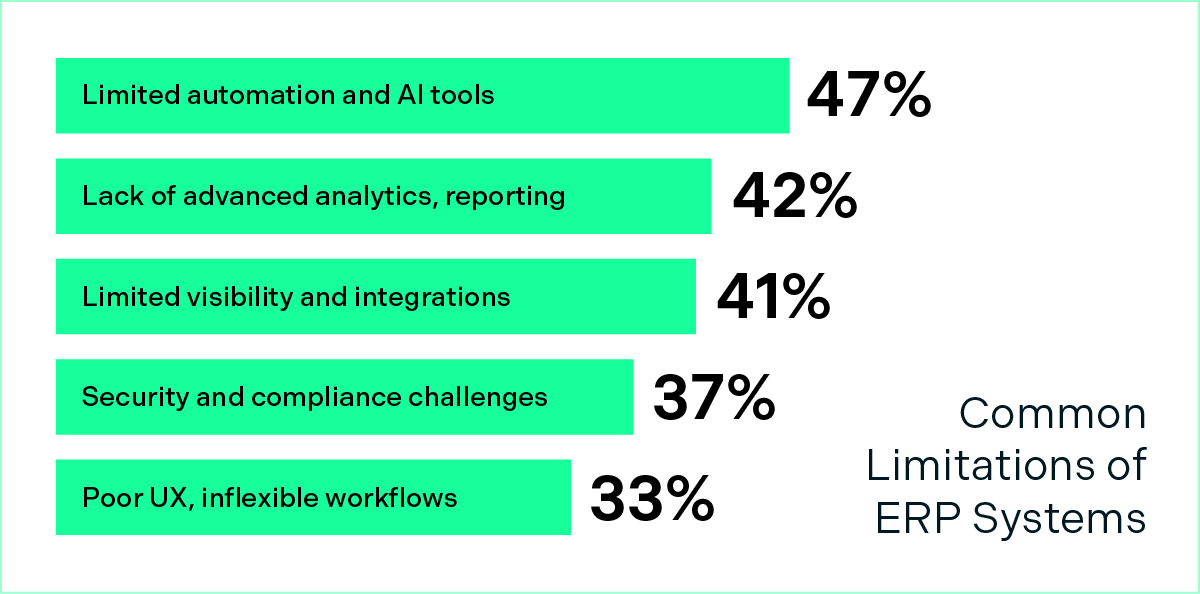
Another recent study found that the average age of today’s ERP system is 13 years old, signaling that many AR teams are operating on platforms built for a different era of finance. Further increasing complexity is the fact that, on average, organizations rely on 3 ERP systems. That’s a lot of siloed data.
While some companies consider their “ERP tools good enough for AR work,” these conveniences can fall short of modern fundamentals. This includes things like real-time cash flow visibility, online payment portals for B2B buyers, global eInvoicing compliance, as well as collections procedures and credit management powered by agentic AI.
agree that ERP systems alone lack the automation that AR teams need
say third-party AR software delivers greater ROI than ERP-native AR tools
faster payments: Augmenting ERPs with AR software reduces DTP by 25%
Here’s a complete breakdown of ERP gaps and how AR software augments ERPs
From invoicing and payments to cash application, collections, and credit management, AR covers a lot of ground. But when teams rely on standalone tools, everything becomes disconnected.
Point solutions mean no one in AR has a single source of truth; therefore, operational lags persist across the entire order-to-cash (O2C) process. Meanwhile, executives are missing out on a holistic, real-time view of their corporate cash flow. The result? Cross‑functional collaboration is harder than it needs to be, investigations take longer, and customer service is more like off-roading than a cruise down the interstate. This Billtrust guide reveals why the silos are so hard to fix and the detrimental impact when AR is out of sync.
Research shows it takes about 2 weeks for AR teams to fully investigate, respond to, and resolve a single dispute, short pay, or deduction.
Breaking down these silos with an all-encompassing AR solution is essential yet one of the biggest problems. Integration challenges are cited by more than half of finance leaders. The end goal is total transformation across all AR functions and the systems surrounding them. Solve this big pain point and you’ll build a fully connected future state.
At a minimum, integration should connect to:
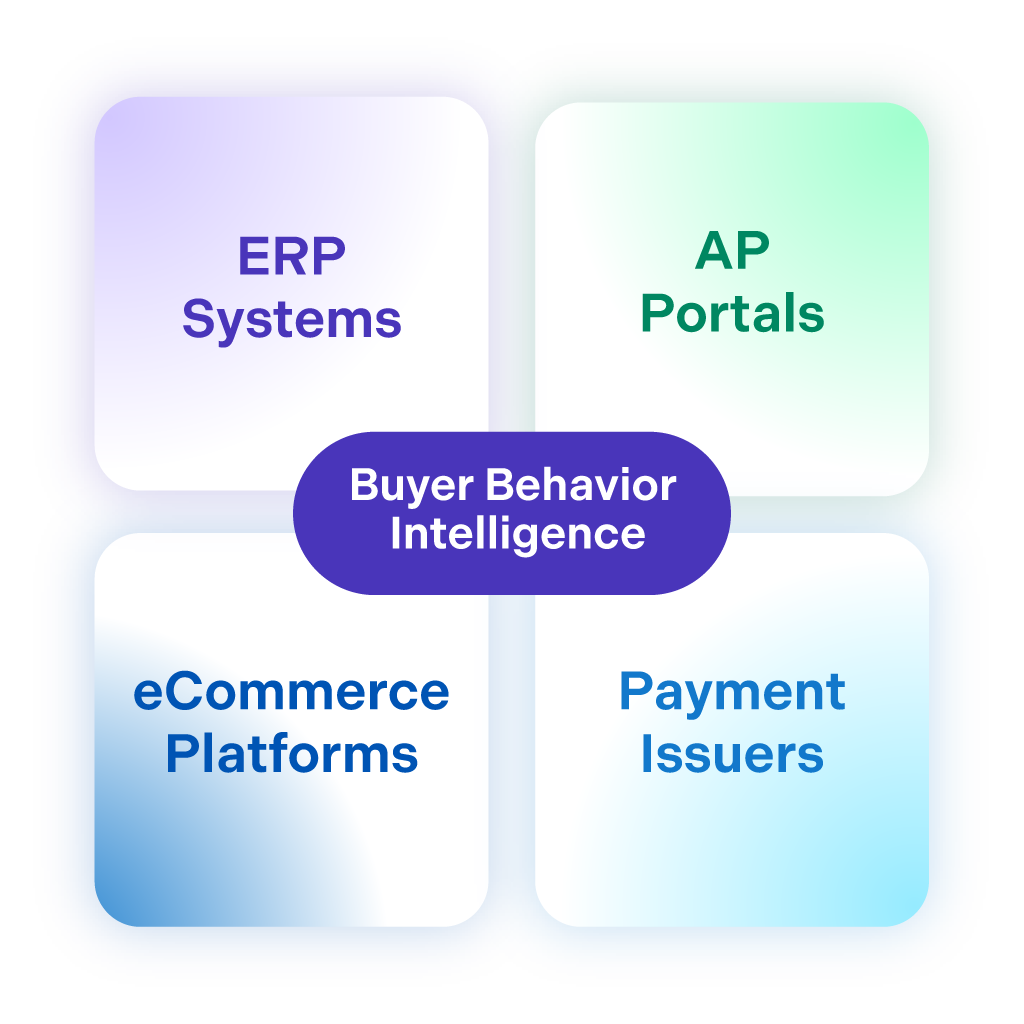
Also look for:
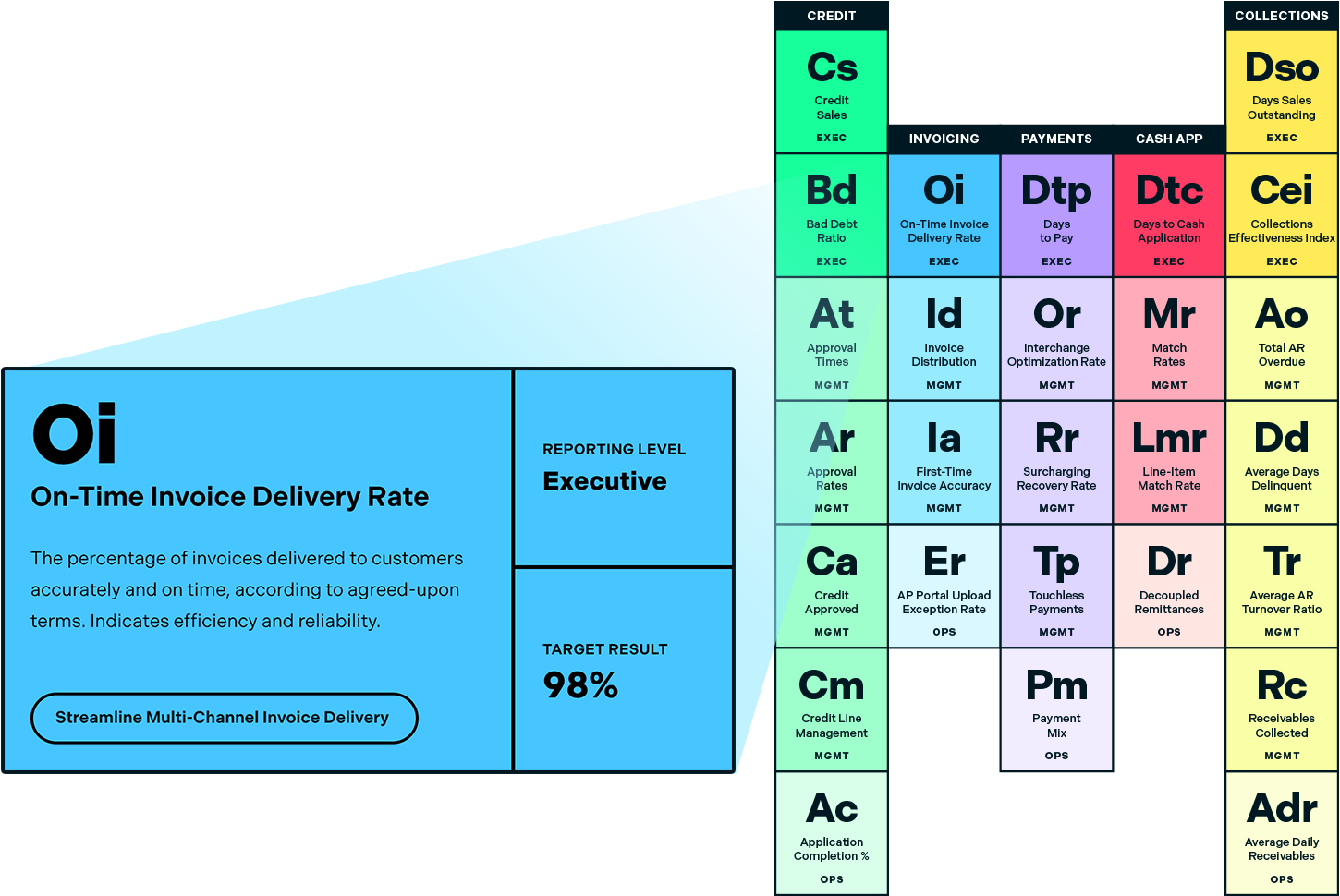
Advanced AR Measurement
This periodic table of AR performance metrics shows you what advanced success measurement looks like. Check it out.
One Billtrust customer, Express Employment Professionals, is a great example of how this plays out. What started as an effort to improve cash application turned into a multi-year journey to build a centralized, proactive AR automation system. Today, AR is centralized across 800+ offices, match rates are 3× higher, and payment processing costs are down 75%. Read their full story here.
In a world where technology providers are racing to slap AI on the label, “AI-powered” can mean very different things. The dividing line in amateurs and pros comes down to three things: Agentic AI, data engineering, and trust.
AI that allows you to predict and even prevent financial risk isn’t a thing of the future. It’s here. Agentic AI flags early indicators while there’s still time to act and can predict future payment behaviors based on past trends. Take a closer look with Billtrust’s SVP of AI and Analytics, Ahsan Shah. The downloadable checklist includes four specific features to target.
Don’t be Fooled by AI Hype
Providers may sell their software based on a large volume of AI agents, but that volume may not equate to a larger volume of value. Just because 100% of a task is automated doesn’t necessarily mean it’s fully autonomous or performed by an AI agent. Learn how to parse the difference between agentic AI and automated workflows in this guide.
Some platforms are built on years of real buyer and payment behavior data. Others just don’t have the depth of data needed to train intelligent, industry-aware AI models.
The result is a team of AI agents that sound good in theory but fall short in practice. This is where start-ups fail. Their clients spend years training an empty AI model to understand accounts receivable at scale. For comparison’s sake, Billtrust pre-trains our AI model on the payment behaviors of 13 million buyers and $1 trillion in annual transaction volume. Learn about Billtrust Insights360.
There’s also the need for responsible AI – transparent, controllable, secure, and trustworthy tools with reliable outcomes. You should be able to see how AI works and understand its logic. Make sure you can validate and approve automated workflows before they happen, override AI recommendations when needed, and maintain control. AI trust is an entire conversation that we dive into in this two-part article.
“Artificial Intelligence is the future of AR happening now. Billtrust is always improving their tools and constantly innovating with a clear focus on AI. We know we’re in good hands.”
– Brian Page, Director of Credit, 84 Lumber
Get your AI investment right, and the weight feels light as a feather. Get it wrong, and it can come with serious consequences. No pressure, right? Don’t worry, you’re in the right place to make your most informed decision. Here’s how to target basic and advanced AR automation capabilities based on your specific business goals.
Every organization’s AR priorities are different, but the right tools can make all the difference in achieving progress. This chart breaks down basic and advanced features that align with common AR goals, so decision-makers can prioritize the capabilities that best support their desired outcomes.

| AR Goal | Basic Capabilities | Advanced Capabilities |
|---|---|---|
| Improve Efficiency to Get Paid Faster |
|
|
| Enhance Cash Flow Visibility and Forecasting |
|
|
| Deliver an Exceptional Buyer Experience |
|
|
Tap each goal to learn more
For most AR teams, accelerating cash flow begins with eliminating manual work and reducing friction in the AR lifecycle. Basic features give organizations the foundation they need to speed repetitive tasks, but advanced capabilities can push efficiency gains even further, providing real-time visibility into bottlenecks that empower teams to proactively address issues slowing cash deposits. Learn about the four key influencers of Days Sales Outstanding (DSO).
16% Faster Payments, 52% More Throughput
IDC studied Billtrust’s clients to understand the value they recognize from AR automation. On average, clients achieve:
AI-Driven Invoicing Tools
Flexible ERP Integration
Automated Remittance Capture and Cash Application
Global eInvoicing Compliance
AP Portal Integration
Advanced Analytics
Agentic AI for Collections
A clearer picture of cash flow starts with deep integration and real‑time visibility into the order‑to‑cash process. Basic capabilities give AR teams a single, accurate view of AR performance. But as organizations mature, behavioral analytics enable financial foresight. In the end, inaccuracy kills forecasting. So, focus on bridging siloed data, reducing human errors, increasing visibility into disputes, and reducing optimism bias by relying on multi-source, quantitative data.
“With Billtrust, we’re more efficient, more strategic, and set up for long-term success.”
— Ryan Oaks, Finance Director at Peak Industrial
Real-Time Data Visibility
Centralized Reporting and Analytics
Secure, Scalable AR Platform
Configurable Dashboards and Buyer Behavior Analytics
Self-Service Buyer Portal
GenAI for financial data
A superior buyer experience comes from making invoices, payments, and credit applications simple. Basic capabilities reduce friction in the buyer journey by delivering invoices in the customer’s preferred format and location and giving them the freedom to pay however they want. Advanced capabilities go further with self‑service portals that give customers direct online access to invoices, payment tools, dispute management, and more. Learn how to measure the quality of the buyer experience in AR.
Looking for ROI?
Today, every CFO is being held accountable for tangible returns on new technology investments. When estimating ROI on AR automation, account for your productivity savings, cost savings, as well as improvements in your customer experience.
Flexible Invoicing and Payments
Integration with ERPs and Banks
Surcharging Transparency
Self-Service Buyer Portal
Buyer Behavior Analytics
Agentic AI for Collections
Some customers need frequent reminders while others want minimal contact – AI learns and adapts to preferences, making interactions feel more respectful and less intrusive.
Customer Experience Metrics


AR digital transformation is just as much about people as it is technology. Change management matters a lot, as evidenced by Wakefield’s findings: 89% of finance leaders felt strongly that they’ll never be in a position to fully capitalize on the benefits of AI until their team updates their mindset about using it.
So, what do you do? Look for a true partner who brings an array of services and support.
Seek out:
“Let’s make it happen.” That’s the kind of partnership you should expect from your provider. In today’s world, anything less is simply not worth the investment.
As decision-makers narrow the list of the best AR automation solutions, it’s worth looking beyond claims and focusing on what customers, analysts, and independent software reviewers consistently report. When feedback from practitioners aligns closely with the findings of industry analysts and third‑party reviewers, it becomes easier to separate true performance from hype.
Take a look at Billtrust’s reviews, rankings, and client ROI achievements and how they paint a consistent picture. Finance leaders choose Billtrust because efficiency and AI insights show up in their workflows, performance numbers, and customer experiences.
At the end of the day, your AR partner is a huge decision. You’re choosing who you want beside you as you protect corporate financial health, drive working capital using AI tools that are new to the entire world and modernize AR for the long haul. As you compare providers, leaning on verified outcomes like these can help you make a more confident, data‑backed decision about the team that will support your long‑term financial resilience.
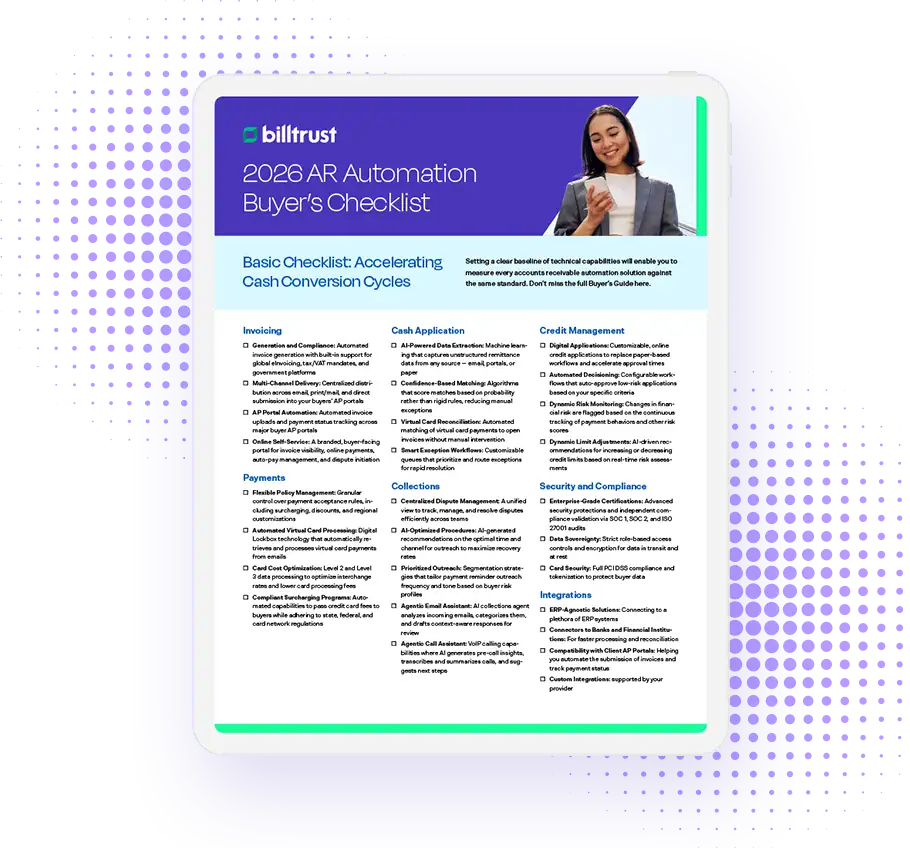
Download the 2026 AR Automation Buyer’s Checklist
Standard automation follows rigid, linear rules (e.g., sending a letter at 30 days past due), whereas Agentic AI uses behavioral intelligence to continuously recalculate the optimal next step, such as determining the precise time, channel, and tone to elicit payment.
ERP systems alone often lack the specialized automation AR teams need; effective AR software must be ERP-agnostic to connect with multiple systems, ensuring real-time cash flow visibility and minimal impact on IT teams during upgrades or migrations.
Advanced AR software replaces “best guess” historical lookbacks with predictive modeling that analyzes multi-source data and individual buyer payment patterns to provide a precise view of working capital.
Glass-box AI refers to transparent AI logic that allows finance teams to see how recommendations are made, enabling them to validate, approve, or override automated workflows rather than relying on a “black box” system they cannot explain.
