



This article is Part 1 of a two-part series. Read Part 2 here.
Today’s self-driving innovations sound straight out of an episode of the “The Jetsons” – part of an AI hyper-automated future for accounts receivable (AR):
- AI agents that resolve collections issues autonomously…
- Real-time financial data used to adjust credit allocations automatically…
- Machine learning that continuously heightens cash application match rates…
It all sounds great in theory, but now that this push-button future is actually here, there’s a mixed bag of emotions surrounding AI. For those who work in finance AI automation in AR can feel both exciting but also downright scary.
If you work in finance, how do you view AI? With optimism? Hesitation? Do you trust it? Maybe you’re just beginning to feel comfortable using it to automate routine tasks, whereas the idea of more advanced forms like agentic AI and autonomous AI can feel like stepping off a cliff.
The Single Most Important Question, Overlooked
It makes sense. Every AR automation software provider is talking about their AI and what it can do, but many overlook arguably the single most important buyer question:
“Would I bet my job on it?”
The first challenge in unpacking the AI trust gap is emotional trust, which is rooted in control. The stuff that matters most – oversight, governance, and technical overrides – seem to get overlooked. As a result, there’s resistance up and down the finance organization:
- CFOs fear “black-box” logic that obscures logic and degrades the financials they’re held accountable for.
- Managers fear invisible workflows that leave them unable to control financial procedures.
- Specialists fear their name appearing on the audit if automation gets something wrong.
The risk feels personal. If AI misfires, everyone pays the price.
These responses to AI are founded in dark truths, with 82% of finance leaders expressing concern about AI’s potential for misuse. However today, there are also stigmas twisted around AI, making now the time to expose why our views exist and how they get in the way of AR digital transformation. Unpacking the source of human hesitation makes it far easier to handle – much less embrace – AI.
For finance leaders, knowing what fuels skepticism and what can pave the way toward AI trust is a much-needed prerequisite for success. We must be able to adopt advanced automation tools that truly are safe and manageable, so we can feel safe and confident about implementing them.
Loss of Control Triggers Emotional Distrust
For leaders who have spent their careers managing people, processes, and relatively simple rule-based systems, trusting an autonomous AI model sounds like a high-stakes bet with real potential for losing control. Understandably, loss of command is a hallmark response and a key source of AI distrust. If these sophisticated systems are unmanaged, uncontrolled or even perceived to be, the human reaction is eroded confidence and disillusionment.
Data shows this response is justified.
According to recent research, finance leaders’ caution around AI isn’t rooted in irrational fear of technology. It stems from real-world experience with the fallout of deploying AI without adequate oversight, transparency, or ethical safeguards.
The most striking examples come from AI fraud – clear evidence of what happens when responsible AI principles are absent. Finance teams are now confronting AI fraud directly, which further fuels fear as noted in the image below. This context helps explains why other research shows 66% of finance professionals believe AI use should be restricted.
45%
report AI-generated phishing emails sophisticated enough to fool experienced staff
39%
have encountered AI-created emails that perfectly mimic executive or vendor communication styles
31%
report AI-generated fake invoices with convincing branding and formatting
29%
have seen AI voice cloning used to impersonate known contacts
Source: Trust in AI: What Finance Leaders Need to Embrace Artificial Intelligence
AI Should Never be a Leap of Faith
Can AI be misused? Yes. Can AI be controlled? Yes. Both things can be true at once. The difference between risky AI automation and reliable, responsible AI intelligence comes down to design.
The Architecture of Transparent AI in Finance
If AI models are designed properly, visibility isn’t an issue, and adoption isn’t a leap of faith but rather a phased, progressive migration from simple automation to full autonomy. Each step is clear and has checks and balances before advanced automation ever happens without explicit human approval.

If you’re not building in-house, then you need to look for a provider with a platform that’s purpose-built for:
- Transparent logic: Transparent AI in finance requires logic that is visible and auditable behind every decision and action
- Human governance: Approval buttons and feedback loops allowing you to correct and improve the AI automation based on your corporate financial practices
- Enterprise-grade security: Data security and data privacy that operates just like any other security measure in your organization
- Gradual paths to autonomy: Variable speeds and controlled progress that allows for evaluation and adjustments at each stage before more advanced automation is allowed
- Big data-fueled intelligence: Models that learn from vast data feeds with humans that tweak automated decision and workflows based on real outcomes — versus models that build data sets from scratch and work from assumptions
Trusting AI in Accounts Receivable: Billtrust’s Framework
At Billtrust, we build our AI engine on “glass-box” automation principles founded in full logic transparency, auditable practices and advanced security, so you can improve AR performance without compromising safety or losing control.
When it comes to AI, we believe you should crawl and then walk before you run. That’s why your AR team progresses through four stages of AI maturity, using feedback and oversight to step closer toward autonomy. At every stage – from Assist to Reval, Guide, and Drive – your trust is earned through transparency, control, and predictability. This way, confidence and capability scale together. At the end of the day, this incremental system accelerates the time it takes for your team to trust the AI intellect – a metric Gartner calls time-to-trust.
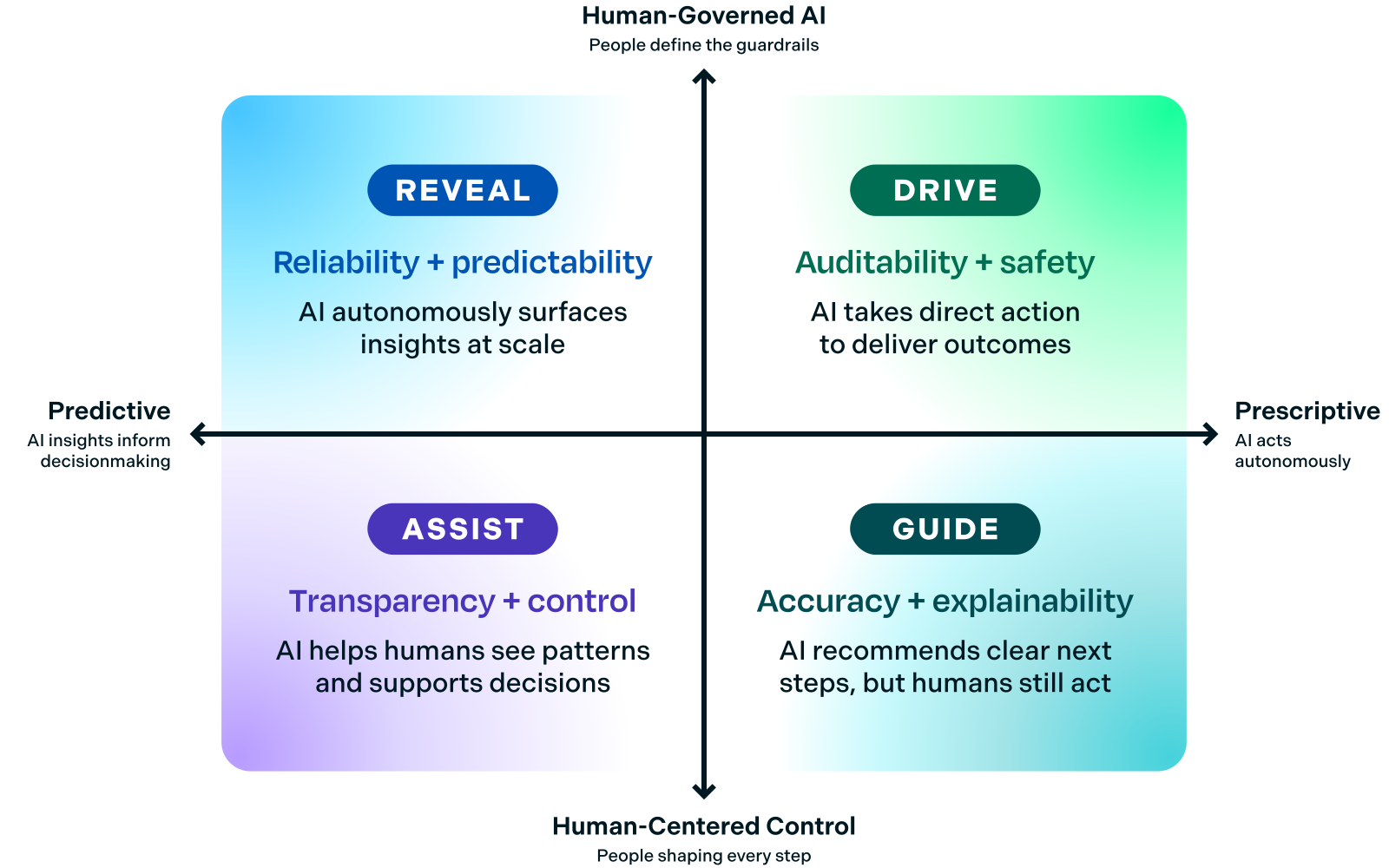
Billtrust’s framework moves left to right from predictive to prescriptive. Predictive AI surfaces insights so AR teams can anticipate what’s coming, while prescriptive AI goes a step further by recommending or even taking the next best action.
It also moves bottom to top, from human-centered control to human-governed AI. This represents the human-in-the-loop to human-on-the-loop progression. Humans start fully in control, and over time shift into a supervisory role as AI earns trust.
Here’s how the journey unfolds:
- Assist. This is where most teams begin. AI helps by answering questions when prompted, uncovering patterns, anomalies, and opportunities. Humans still make every decision. It’s all about dashboards and using conversational AI tools, like Billtrust’s Autopilot, to ask questions and get instant answers. This way, AR teams save time by avoiding manual reporting processes.
- Reveal. At this stage, AI moves beyond user prompts to proactive insights. AI autonomously identifies insights at scale – changes in buyer behavior, deduction trends, or emerging risks – far faster than humans can. AI alerts you when you log in about things that need attention, so you don’t have to ask. Example include notifications about anomalies or actions that might require human intervention. Leaders also gain cash flow predictability without taking any prompting action.
- Guide. AI starts recommending concrete next steps, like adjusting credit terms or optimizing collections procedures to take a risk-based approach. Examples include prioritizing customers who pose higher risk and tailoring outreach for higher engagement and more debt recovery. It shows what to do and why. Humans stay in the driver’s seat with feedback loops to further train the AI mode. Trust strengthens as the recommendations consistently align with corporate financial practices and deliver measurable outcomes based on AR performance metrics.
- Drive. This is the most advanced stage, where AI begins acting on your behalf. Examples include automatically adjusting credit limits based on customer behavior. Keep in mind, Billtrust’s AI offers full transparency into the AI logic. Auditability and safety rails show leaders what happens in an automated workflow, why it should happen, and what the outcome was.
A Phased Approach to AI Autonomy
Transparency means knowing how fast AI is accelerating, shifting from basic automation to autonomy. This phased approach or variable speed should proceed only when you can prove the AI model is safe, transparent, and delivering measurable value. Whether you’re easing into AI or racing toward full autonomy, Billtrust fits your business speed, giving you the confidence to pick up the pace when you feel AI has earned the right to go faster.
From Black-Box to Glass-Box Automation
Research shows that although finance leaders may be hesitant about adopting AI, they’re enthusiastically curious. That tells us that the trust gap lives not in whether AI is capable, but in whether leaders understand the design elements and guardrails that make AI explainable and controlled, therefore trustworthy. We mentioned earlier that this is the biggest question mark for leaders – the how behind the shiny AI tools – and leaders aren’t going to leave it unresolved.
In the world of AI, “trust me” is a dangerous phrase, and finance leaders won’t stand for it.
In the next article in this series, we move from the issues of transparency, control, and emotional trust into the issues of functional trust and the practical realities of managing it. We’ll break down the core design principles, control mechanisms, and governance structures that turn powerful AI into dependable automation, showing how the absence of even one element can trigger uncertainty, resistance, and mistrust.
Want to learn more about Billtrust’s embedded layer of AI intelligence, Insights360? See how it works.