



This article is Part 2 of a two-part series. Read Part 1 here.
These are the kinds of reactions finance professionals are having in response to AI automation in accounts receivable today:
- “I don’t know what the system is doing.”
- “We’re double-checking everything because we don’t trust the data.”
- “At least when I do it, I know it’s right.”
Maybe you can relate? For many, AI feels unknowable – a powerful force moving at lightning speed, making calculated decisions they can’t witness but are ultimately responsible for.
Given these realities, it’s easy to see why nearly 70% of finance professionals believe AI use should be restricted. Transparency, explainability, and proven results can be overlooked. When it does, there’s a trust gap throughout the finance organization. People reject AI, resisting what they can’t see and trusting AI only if it produces predictable, reliable results. Here at Billtrust, we call this functional trust — confidence in the way AI operates.
Admittedly, there’s a lot that goes into this. That’s why we’ve broken functional trust down into six core characteristics that foster confidence through credibility. Together, they replace team resistance with visibility and sound governance, serving as requirements for implementation success. Let’s break down each characteristic, its importance, and how to ensure AI can be trusted, adopted, and embraced by everyone in finance.
Functional Trust: 6 Requirements for AI Success
For leaders being asked to champion innovation for the finance organization, success hinges on understanding what actually builds functional trust in AI, what happens when those elements go missing, and how to act fast to stay firmly in control of advanced automation.
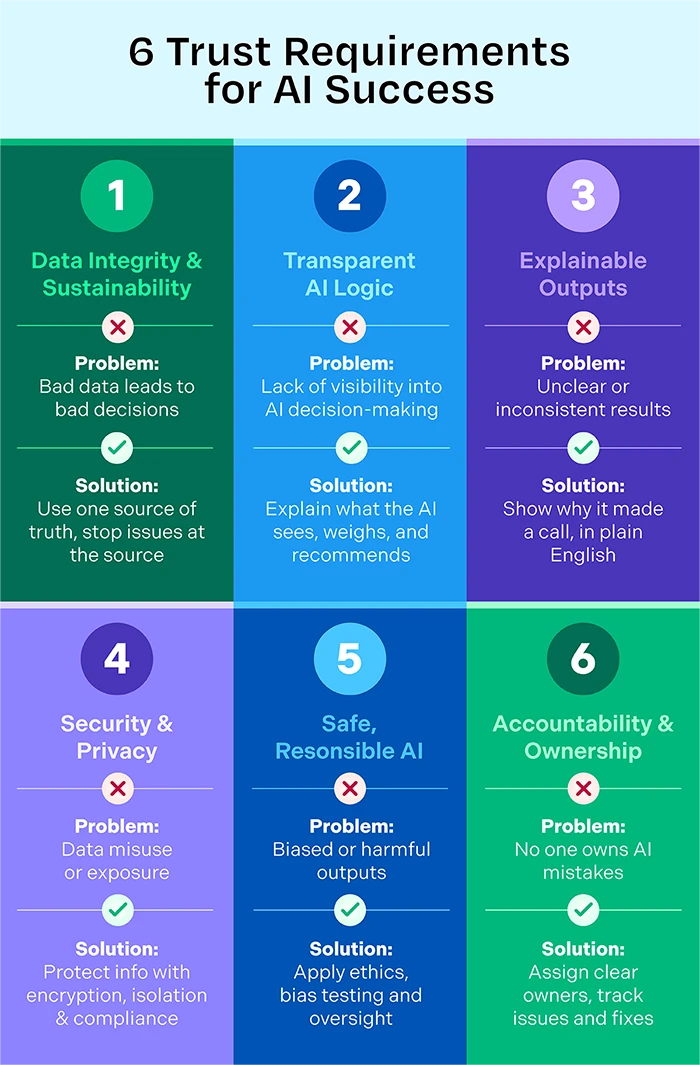
1. Data Integrity and Sustainability
Fears fueling the trust gap: AI makes decisions based on inaccurate or incomplete data.
Emotional fallout: Distrust, frustration, disappointment.
How to build trust:
- Ensure your AI engine has automatic guardrails across AR functions. This means the system has one source of truth for accurate data and won’t accept incorrect information. Automation should stop any unreconciled data at the source, so it doesn’t flow downstream. Instead, it will trigger an alert or automatically route it to the appropriate designated person for manual review and correction.
- Monitor performance and uphold standards. Actively watch the order-to-cash process to make sure it’s not getting slower or less accurate over time. This doesn’t just mean keeping an eye on it. Put structured monitoring in place: track AR performance metrics like Days Sales Outstanding (DSO) and Days-to-Pay (DTP), use dashboards and threshold alerts, and run regular quality assurance checks.
- Use humans for critical records and processes. For the most important or unusual situations, don’t rely on AI automation alone. A trained person should manually review and approve sensitive information and procedures before work can continue.
Sustainability
To maintain responsible AI, ensure AI models don’t degrade over time and can adapt to new data or scale as needed. Actively monitor for data and performance drift. Use dashboards and alerts to spot when model inputs change, accuracy declines, or users begin overriding recommendations more frequently.
2. Transparent AI Logic
Fears fueling the trust gap: Users can’t see how AI decisions are made or what influenced them.
Emotional fallout: Confusion, suspicion, helplessness.
How to build trust:
- Clearly explain why AI is transparent and safe. Share what data the AI uses, the key factors it weighs in its decisions, and how it arrives at its next-step recommendations. Use plain-language guides, FAQs, and in-product explanations to show not just what the AI decided, but what influenced the decision. For example, for a credit recommendation: “The AI considered payment history, average invoice age, recent deductions, and changes in credit score.” Emphasize where human oversight, overrides or required approvals, and safeguards apply.
- Balance transparency and overexposure. Trust increases when transparent AI systems are utilized but data is not exposed. Be open about how AI is trained, but don’t go too deep where security and privacy risks lie. Keeping training data descriptions at a high level protects both trust and the enterprise.
3. Explainable, Reliable Outputs
Fears fueling the trust gap: Users can’t interpret, justify, or rely on AI outputs.
Emotional fallout: Fear of being the one to blame, uncertainty, alienation.
How to build trust:
- Use models that are easier for your teams to understand. For example, a scoring model that clearly shows which factors influenced a recommendation and how confident the system is – making it easier for users to assess risk, apply judgment, and trust the outcome. Avoid endless parameters or layers of math to go through to get to the “how.”
- Explain high-impact decisions in plain English. When money, risk, and customer relationships are on the table, spell out AI reasoning in simple language. For example: “Outreach is suggested for this customer because their payment is overdue by 70 days and they’ve been less responsive over the last 30 days.”
- Set clear, public targets for how well your AI automation must perform – from accuracy and quality to speed, efficiency, and compliance.
- Control the speed. Not every business is ready to accelerate AI automation to full speed. Some need to build trust before they hit the gas pedal. Others want to start out in fifth gear. Make sure your AI tools can adjust to your pace, operating at all speeds with transparency that shows you which gear it’s in and how it got there.
Confidence Hinges on Reliability
If AI performs inconsistently or behaves unpredictably, the emotional response is stress, frustration, and loss of confidence.
4. Security and Privacy
Fears fueling the trust gap: Personal responsibility and liability as AI systems may expose personal data and be vulnerable to breaches, theft, or misuse.
Emotional fallout: Fear, paranoia, and anxiety.
How to build trust:
- Build data privacy into the foundation: True data protection starts at the code level. When implementing AI, make sure sensitive financial information stays isolated and personal details remain anonymized. Your company and customer data should never be used to train external AI models—especially those accessible to competitors. AI solutions must deliver insights without exposing your data to the public domain. Learn about Billtrust’s AI data security practices.
- Demand transparency in data practices: Trust thrives on clarity. You should never wonder how your information is being handled. Choose AI platforms with strong governance policies that clearly define data usage and guarantee your proprietary information won’t be shared or repurposed without your explicit consent.
- Require enterprise-grade security: Financial AI calls for financial-grade safeguards. General-purpose tools often fall short of the rigor needed for AI in accounts receivable. Compliance standards like SOC certifications, advanced encryption, and strict access controls should be non-negotiable to protect against threats.
45% of finance leaders report encountering AI-generated phishing scams that are sophisticated enough to fool experienced staff. Get the research
5. Safe, Responsible AI
Fears fueling the trust gap: AI may produce biased or even harmful outputs.
Emotional fallout: Alarm, distress, loss of trust.
How to build trust:
- Ethical design principles. Ensure your AI solution is built on ethical design principles and bias testing that puts safety guardrails in place.
- Maintained human oversight. Your model should be guided by strict human governance procedures and continuously monitored by human reviewers. Maintain human review for all high-stakes decisions.
- Track incidents. Monitor and document all serious incidents and run ongoing risk evaluations.
97% of finance leaders expect fact-checking or reviewing AI-generated work to become a standard part of AR operations. Get the research
6. Accountability & Ownership
Fears fueling the trust gap: No clear owner when an AI decision goes wrong.
Emotional fallout: Frustration, anxiety, powerlessness.
How to build trust:
- Define ownership and accountability end-to-end. Clearly spell out who builds, approves, monitors, and maintains the AI. Moreover, assign one ultimate owner responsible for the model’s health, performance, and success.
- Create a simple process for reporting problems. Everyone should know what to do, who to contact, and how fast issues will be handled.
- Log issues and fixes publicly within the team. Keep a simple tracker of mistakes or problems the AI makes and what was done to fix them, so there’s transparency and a clear record of resolution.
AI Governance will Now be Institutionalized
With a strong preference for human oversight on AI actions, CFOs will now need to formalize AI control frameworks into AR operations. See more of Billtrust’s predictions for 2026.
AI Confidence Earned: A Story of Trepidation Turned Triumph
When a major materials distributor started putting AI into motion, their AR team’s first reaction sounded a lot like the fears we’ve been exploring: What if the system is wrong? What if my role becomes less important? Manual data entry consumed 4 out 5 days every week, but the idea of “letting a machine do the work” was met with mixed opinions.
“Some of my team was hesitant at first and rightfully so,” explained the Director of Credit & Accounts Receivable. “When an employee’s value is based on a very tangible thing like data entry, it’s difficult for them to see how their contributions will become reinvented after AI starts performing their work.”
Using a creative program, Billtrust helped the finance organization reframe AI as a performance accelerator the team could own. Together, they clarified accountability and guardrails, made match logic visible through confidence scoring, and set clear performance targets everyone could track. The message leadership made clear was this: AI would work for the team, not the other way around. And the better the AI platform performed, the more credit the team would get.
They started small, using AI to increase match rates in cash application and tying improvements directly to team performance and incentives. As confidence scoring revealed which matches the AI engine was most certain about, staff could quickly validate its level of accuracy. This, in turn, increased confidence. The more they saw the system get things right, the more comfortable they felt letting it take the lead.
The results speak for themselves. The organization’s match rates increased by 11.5%, unlocking productivity gains equivalent to nine full-time employees. Read the full story.
Start Small, Stay the Course, Stay in Control
AI’s potential isn’t enough. AI-powered AR automation technology needs to earn functional trust through accuracy, performance, and proven results. That means starting small by applying AI to contained, high-impact use cases like cash application, collections outreach prioritization, or dispute email management. Choose where you want to start before expanding. Stay the course and lean on a partner like Billtrust if needed – one who brings the transparency and expertise to guide you through every phase of AI adoption and expansion.
Last but not least, stay in control of your AI automation speed. Want to stay in crawl mode while you observe its decision-making? This shouldn’t be a problem. When you’re ready to shift into high gear with full autonomy, you should be able to do that too with complete visibility.
All of this is made easier with a purpose-built platform designed for human oversight and trust. Want to learn more about Billtrust’s AI? Explore our platform in full.