
Predictive cash flow and autonomous AI in accounts receivable (AR)… we’ve all heard the promises of speed and efficiency touted by AR automation software providers. But adoption among finance organizations comes to a screeching halt when AI tools aren’t trustworthy. CFOs, finance managers, and AR specialists can’t embrace next-gen technologies like agentic AI when it means taking on unnecessary risk, losing control, and being held accountable for programmatic processes they can’t see — much less override.
Inside this guide, you’ll explore the trust gap that comes with AI and learn about three truths shaping AI adoption for AR teams. Plus, you’ll walk away with a framework for building confidence and control into every innovation with a checklist for evaluating the trustworthiness of AI solutions.
Industry analysts report that most finance teams are moving ahead on AI, but very few are scaling it. That’s because trust is a barrier to acceptance and a key reason CFOs take a cautious approach, keeping a hand firmly on the AI wheel.
Research indicates that, while 94% of finance leaders believe AI can help their AR teams, 66% say AI use should be limited. Another study shows this caution around AI isn’t rooted in an irrational phobia. Instead, it stems from real-world experiences after deploying AI without adequate oversight, security, and ethical safeguards.
The most striking examples come from AI fraud. For instance, 45% of finance leaders say AI-generated phishing has fooled experienced staff, and 29% have seen AI voice cloning used to impersonate known contacts. As more finance teams confront AI fraud directly, it can further fuel fear and mistrust.
Explore more about how trust undermines AI confidence for CFOs.
Billtrust partnered with a third party to conduct an in-depth focus group on this issue, interviewing employees at every level of the finance organization to understand their concerns about AI and the technological shortcomings that ignite mistrust. The data exposes three truths that stand in the way of AI adoption.
Tap each truth to learn more
Uncontrolled AI automation creates anxiety rather than excitement, resulting in an emotional trust gap:
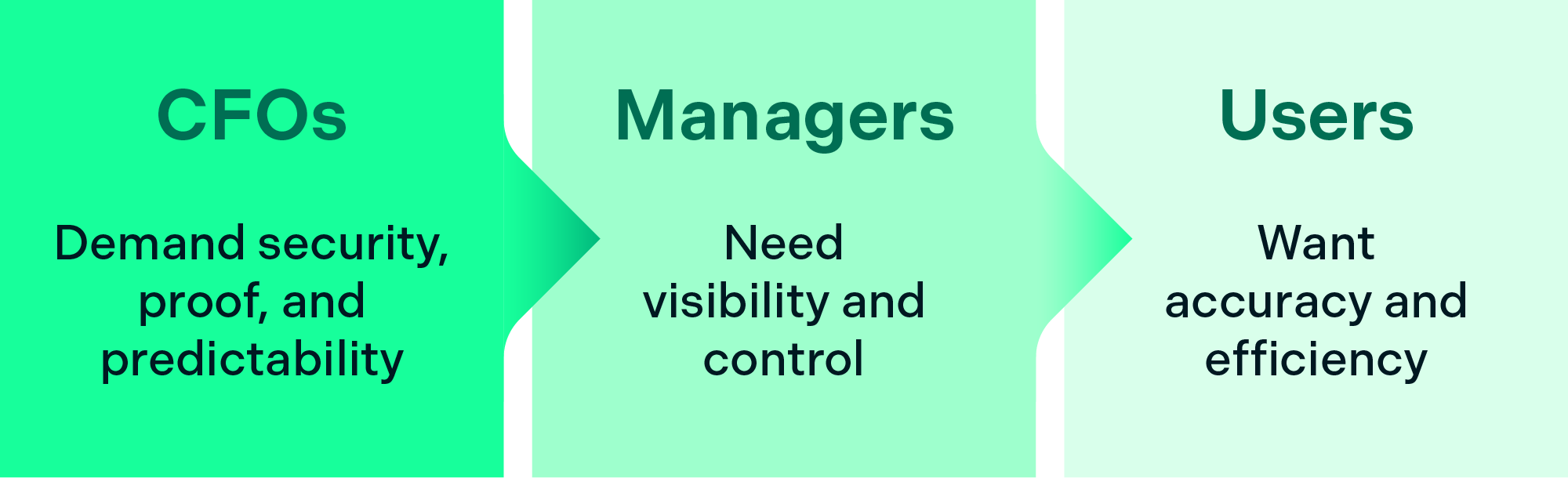
CFOs fear governance risk and digital transformation failures.
Logic that keeps AI security and decision-making in the dark is viewed as a threat to data integrity and the financial health for which executives are held accountable. In an industry where every move is calculated based on datasets, a software provider’s “AI magic” isn’t trustworthy until proven. If the rationale can’t be explained, it’s a hallucination risk. PYMNTS research shows executive-level trust is particularly low for highly complex functions and areas where operational risk remains high.
Here’s a look at some of the comments from focus group participants.

For CFOs, AI in accounts receivable can’t be an on/off switch, an engine with no brake pedal, or a system that doesn’t share the corporate risk policy.
Finance managers fear invisible workflows.
They can’t explain or defend system decisions, because they lack transparency into the behind-the-scenes algorithms and how decisions are made. For them, AI automation can’t be a matter of guessing what happens next.

AR specialists fear performance backlash and exposure.
Their names appear on the day-to-day work as well as the financial audits when automation fails to adhere to standard corporate financial practices.
Fears from across the organization spotlight the defects in modern AI solutions. Providers expect buyers to blindly trust, when instead, trust must be earned through transparency and performance.

The trade-offs between traditional work and next-gen automation put finance teams in a paradoxical double-bind.
On one hand, labor-intensive manual work triggers a mental burden that everyone can relate to – burnout that results in employee churn. On the other hand, today’s AI solutions can spawn equally daunting emotions – losing control of everything from data accuracy to jobs and livelihoods.
Either way, there’s an inextricable tie between operations and intense human feelings.
The focus group highlighted this connection meticulously: In the minds of AR team members, manual work is closely tied to vital principles in finance like accuracy, control, and credibility. While these tenets bring a sense of personal pride to AR work, they’re also benchmarks by which professionals are personally evaluated. That’s why they’re considered sensitive reaction points.
The director of AR at a leading material distribution company can attest to this:
Read the full story to see how creativity helped the AR team reshape their personal value.
Tech fatigue is real, particularly for finance organizations that have struggled for decades with siloed data, rigid ERP systems, spreadsheet-based processes, and digital transformation initiatives delivering spotty success rates.
Technology investments and their technical debt have long been triggering emotions. Today, the wreckage of past projects litters the launch pad for autonomous AI technologies.
The focus group put a microscope on this issue:
Failed digital transformations have left deep scars. If AI can’t prove it’s worth from the start, skepticism keeps innovation firmly grounded.
AI has a trust problem.
AI automation should never happen in a black box. Finance leaders and AR teams alike want advanced automation tools, but they can’t trust AI if it’s not transparent, explainable, and safe. They want and need “glass-box” automation.
Digital transformation? You must foster trust first.
Finance teams will resist the efficiency benefits of AI if implementation teams ignore emotions and the barriers they create for adoption. Those who adopt responsible AI solutions and facilitate trust pave the way for wider acceptance and scalability.
Speed-to-innovation is at stake.
If automation software doesn’t deliver the kind of automation people can see, understand, and correct, AI innovation is rejected as unplausible, unsafe, and unreliable. When manual work persists, technology ROI evaporates into thin air. AI solutions that lead with transparency and governance will define the next era of financial operations.
To close the trust gap, finance organizations need a system for enforcing control over automated workflows and cultivating confidence in AI. This structured approach makes AI more trustworthy through safety measures, credibility-building exercises, and predictable outcomes.
Control + Confidence = Trust
This is the equation that should anchor every model for building trust in AI.
Calm innate fears by establishing control. Visibility, oversight, and the ability to override programmatic automation are not “nice to haves.” Emotional trust must exist before adoption can become widespread.
Look for AI automation solutions that allow:
While collectors and AR specialists appreciate the value of AI, focus group participants continually reported that their fears are relieved only if the AI solution preserves human judgment.
Build confidence through transparency and consistent results. Confidence comes from proof, including visible logic inside the AI engine, explainable decisions, predictable behavior and results, measurable accuracy, and tangible benefits generating hours of productivity gains. Automation that reveals its reasoning is better suited to establish credibility and assurance among users.
Look for AI automation solutions that:
When it comes to AI, everyone says they want efficiency, but what they really need is consistency. Trusting a solution starts with a reliable automation process. Learn how AI solutions facilitate trust.
It can never be too early to build trust in an AI solution, but it can be too late. This explains why control, confidence, trust, and security must be thought of as the foundation. Without them, everything cracks under the pressure of fear and doubt. Finance leaders and professionals alike need reassurance before any efficiency gains can truly be accepted, much less celebrated.
Take a proactive approach to trust building:
Security is another foundational element of trust:
The focus group revealed another insightful takeaway: Make middle managers your AI champions. Why? Automation adoption is not “top-down.” It’s typically “middle-out.” Managers shape the internal narrative that reaches both the CFO and AR specialists. Thus, their approval and acceptance determine whether transformative projects succeed or fail.
AI without trust is like a bridge without supports. It looks impressive until the first stress test.
Want more six more tips for building functional trust? Read this article
Your AI automation solution should earn trust at every level of the organization.
AI features aren’t the problem — trust is. If humans don’t get full autonomy on day 1, neither should AI.
The next financial innovation frontier isn’t more AI autonomy. It’s more trusted AI autonomy. When AR teams have the control and confidence to use advanced technologies safely, adoption accelerates, expansion becomes frictionless, and mistakes become learning moments instead of liabilities. Best of all, technology ROI increases.
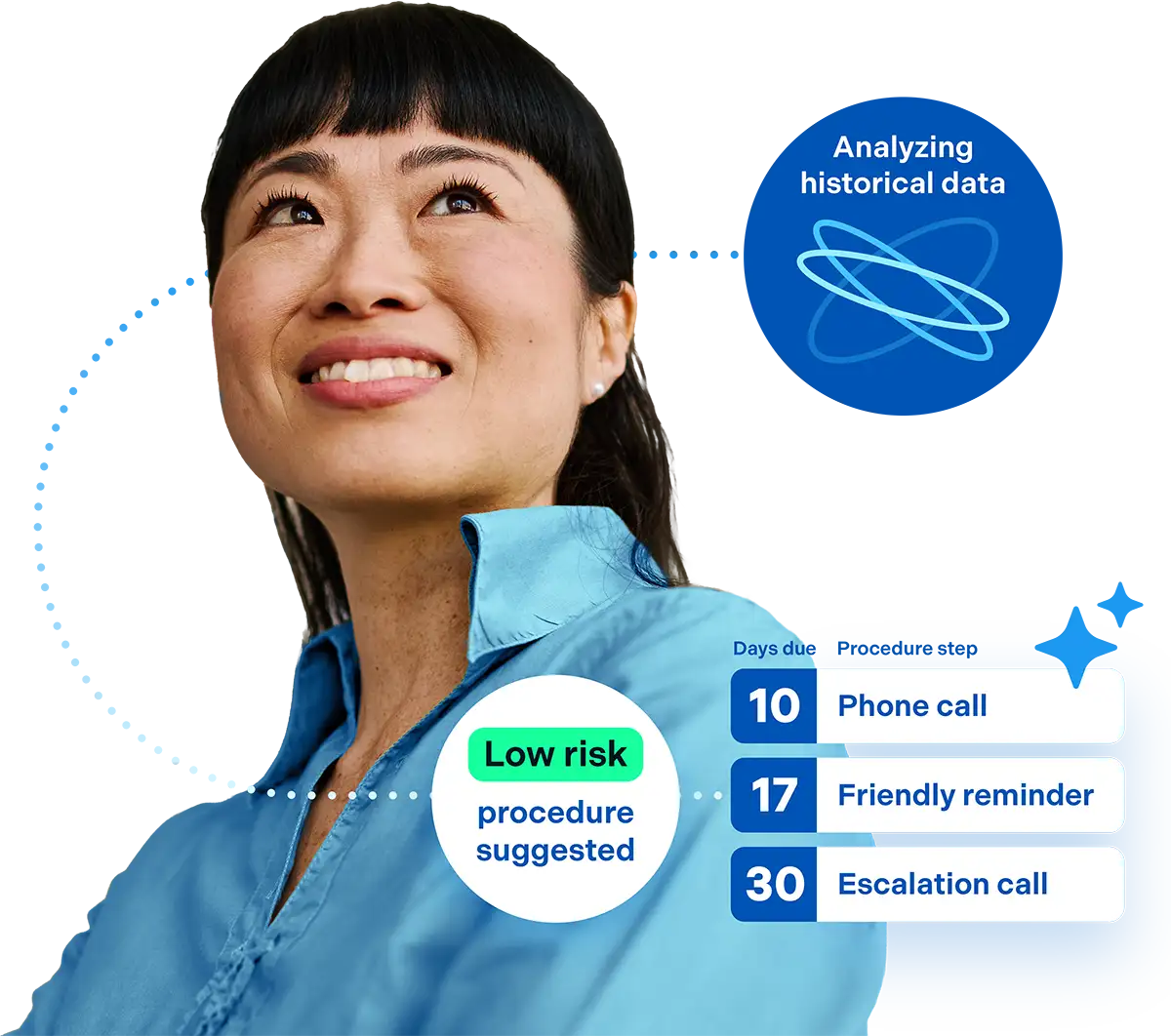
When you need trusted AI in accounts receivable, turn to Billtrust. In the race to automate, many solutions offer speed, but few offer clarity. When most AI operates in a black box, Billtrust stands apart with a “glass-box” approach to AI that prioritizes visibility. We believe trust is earned through AI transparency. That’s why our AI model shows you the rationale and formulas, giving you feedback loops to train and refine the decisioning logic. This way, you have confidence in your advanced automation.
Billtrust also offers smarter AI insights. While other platforms offer autonomous AI agents that need months of your data to become intelligent, Billtrust’s AI comes pre-trained on the payment behaviors of 13 million buyers and $1 trillion in annual transaction volume. With smarter insights and clear logic, you can avoid failures and achieve ROI faster.
Choose the AI you can trust.
Talk to Billtrust today and get a free personalized demonstration.
Finance teams often face an “emotional trust gap” due to fears of losing control, visibility, and oversight. Research indicates that while 94% believe AI can help, past negative experiences with fraud (like AI phishing) and “black box” logic create hesitation.
The framework relies on the equation “Control + Confidence = Trust.” This involves establishing emotional trust through visibility and human-in-the-loop oversight (Control), and functional trust through predictable outcomes and measurable accuracy (Confidence).
AR teams face a paradox where manual work causes burnout, but AI automation triggers fear of job loss or loss of data accuracy. Successful adoption requires showing how AI reduces administrative burdens to allow for more strategic work, rather than replacing the human element.
You should ask if the AI engine shows its logic, if audit trails are accessible without IT, if there are feedback loops for training, if humans can override automation, and if the ROI is demonstrable within 90 days.
Manual work is often tied to a finance professional’s sense of value and accuracy. Introducing autonomous AI agents can break this connection, causing fear of job loss. A successful approach acknowledges these emotions and frames AI as a tool to reduce burnout rather than replace people.
