Navigating the Poly Crisis: How AI is Transforming Finance
Artificial intelligence (AI) is evolving the finance function, opening new avenues for efficiency, smarter decision-making, and innovation. But how can finance leaders harness AI to tackle today’s complex challenges? In a recent webinar, Stephan Glismann-Bringmann, Director of Digital Transformation at Billtrust, shared an action plan for how finance leaders can leverage AI to transform operations […]

On this page
Artificial intelligence (AI) is evolving the finance function, opening new avenues for efficiency, smarter decision-making, and innovation. But how can finance leaders harness AI to tackle today’s complex challenges?
In a recent webinar, Stephan Glismann-Bringmann, Director of Digital Transformation at Billtrust, shared an action plan for how finance leaders can leverage AI to transform operations and proactively address the interconnected crises shaping our world. Moderated by Philipp Hafner, Redakteur of FINANCE Magazin, the session explored everything from the concept of a “poly crisis” (defined below) to practical AI applications in finance.
Missed the session? No worries—we’ve got you covered. Here’s a recap of the key takeaways. Prefer to watch the full webinar? Access the video here.
Understanding the poly crisis
To set the stage, the webinar discussed the concept of a “poly crisis”—a term that describes the intersection of multiple crises, which together compound the force of impact. For example, disruptions caused by the pandemic, global inflation, energy price fluctuations, and geopolitical tensions have created severe ripple effects on supply chains and financial systems.
Glismann-Bringmann explained that these crises are interconnected, meaning solutions need to be holistic and address the root causes and interactions between them.
Glismann-Bringmann elaborated, “As Polikrisen werden ja multiple Krisen bezeichnet, die sich gegenseitig verstärken. Das bedeutet im Kern, dass eine Polikrise nicht allein als die Summe der einzelnen Krisen zu verstehen ist und die einzelnen Krisen nicht einfach nebeneinander existieren, sondern dass sie sich gegenseitig beeinflussen.”
For finance leaders, the message is clear: stop treating crises as isolated events.
Instead, view their interconnected impact as an opportunity to innovate. By recognizing these links, you can lay the groundwork for using AI to build more resilient financial systems.
How AI is making a difference
AI is transforming decision-making and providing insights that drive smarter strategies in the finance sector. As organizations undergo digital transformation, CFOs are uniquely positioned to lead the adoption of technologies like AI.
Once focused on traditional financial roles, modern CFOs now drive innovation, foster collaboration, and implement cutting-edge tools. With 87% of finance executives recognizing their growing influence, CFOs are key to shaping the future of finance.

AI adoption: Where do you stand?
How mature is AI adoption in finance processes? An audience poll of the webinar attendees provided an interesting snapshot of AI maturity levels. Most webinar participants (72%) indicated they are in the early stages (Levels 1 and 2), focusing on awareness or initial testing. Only 28% reported their organizations had reached Level 3, where AI is operational and providing value. Levels 4 and 5, characterized by systemic and transformational AI use, remain aspirational goals for many.
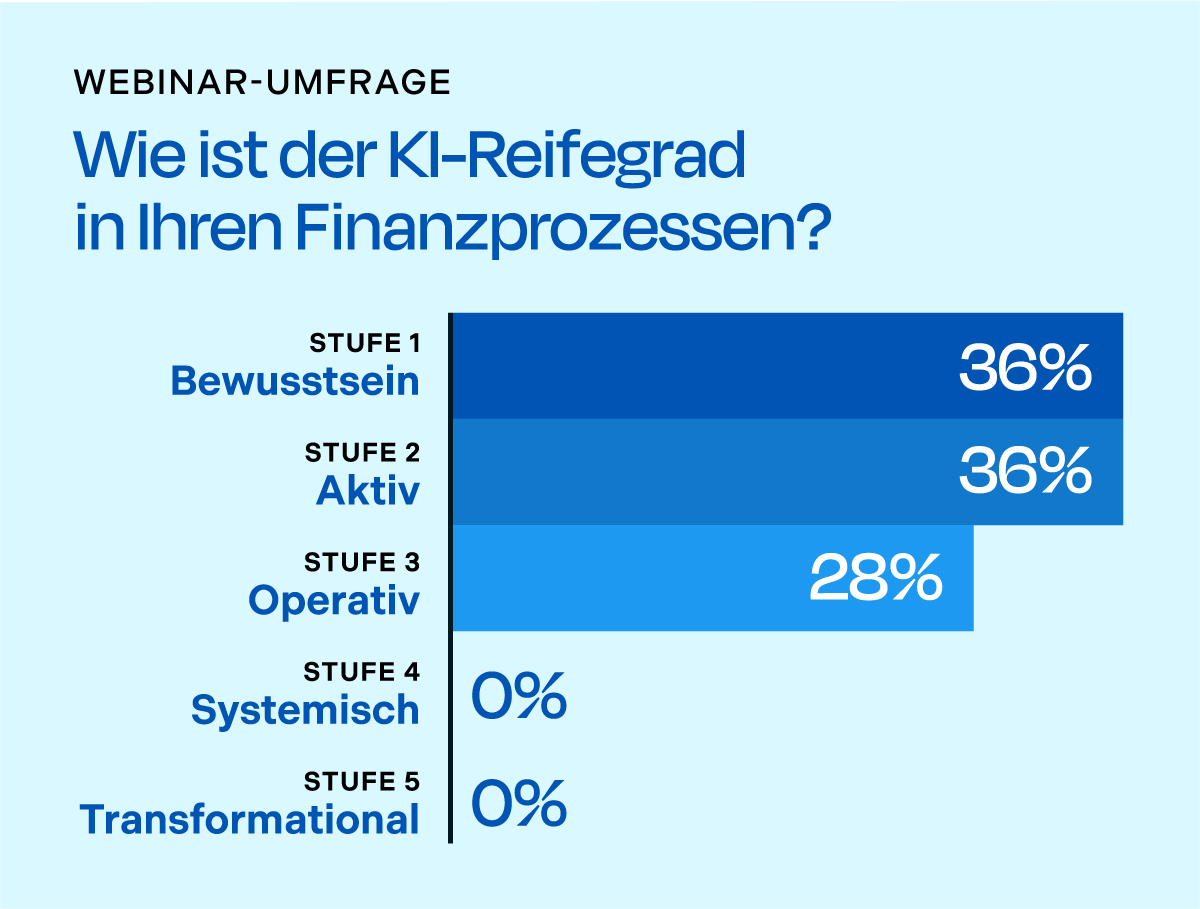
While most participants are still in the early stages, the potential for growth is immense. During the webinar, Glismann-Bringmann also highlighted studies from McKinsey, SSON, Gartner, EY, and Boston Consulting Group, which analyzed the risks of late adoption of new technologies and showed encouraging progress over the years.
However, challenges like data quality, employee readiness, and confidence in AI predictions remain barriers. Overcoming these hurdles and embracing new technologies can give finance leaders a significant competitive edge.
Looking ahead: 5-point AI action plan
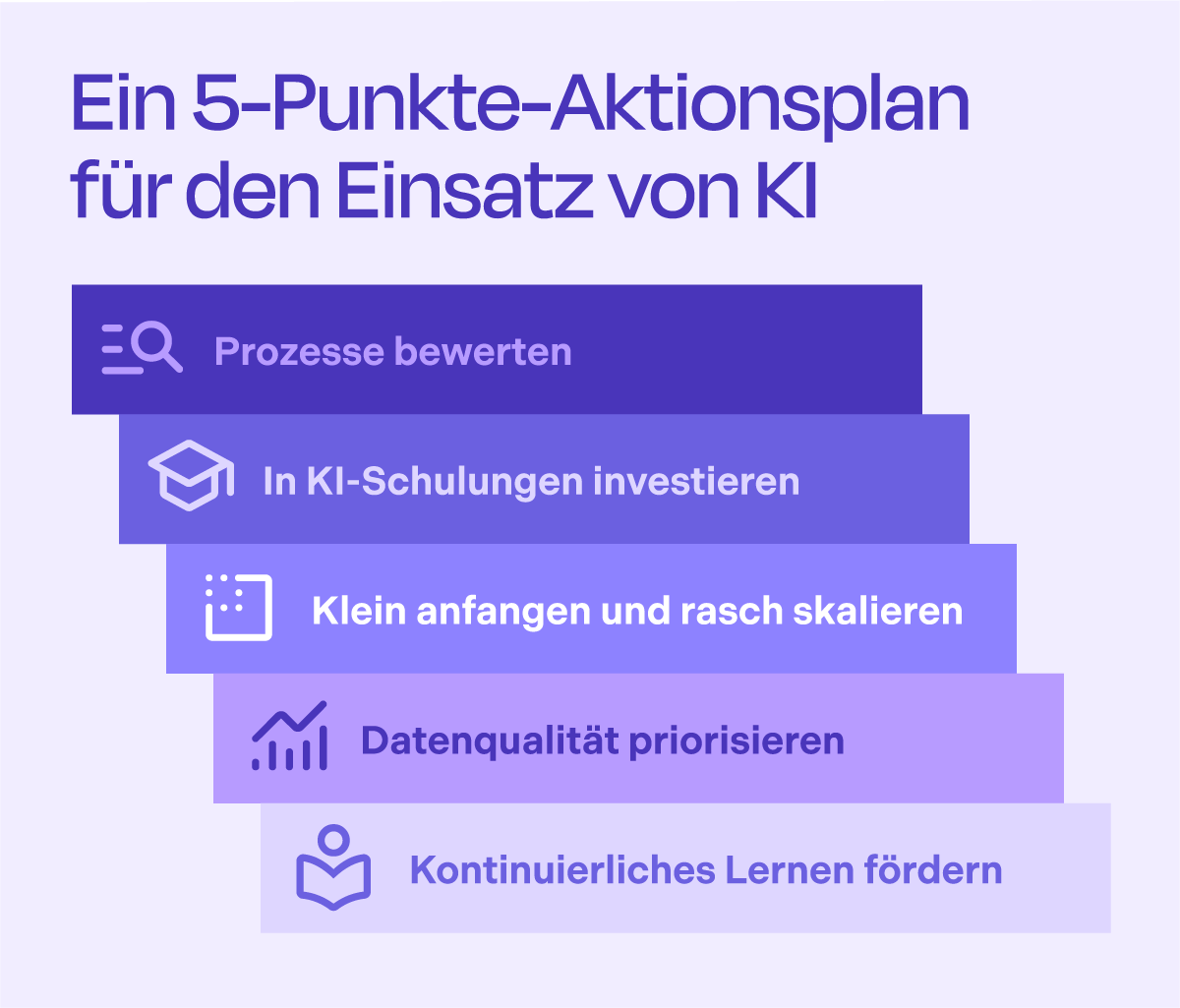
To close the webinar, Glismann-Bringmann shared a practical five-point action plan for finance leaders ready to adopt AI:
- Assess processes: Identify manual areas in finance processes, such as data entry and invoice processing, which often represent 30-40% of a finance team’s day. Leveraging automation allows for more time to focus on strategic initiatives.
- Invest in AI training: Ensure the team comprehends AI’s potential in finance and understands how to use AI effectively. This includes ongoing learning and training on AI tools, data analysis, and change management.
- Start small and scale quickly: Begin with pilot projects that address specific pain points and then scale them into larger implementations as quickly as possible.
- Prioritize data quality: Recognize that the effectiveness of AI depends on the quality of the data it uses, necessitating continuous attention. AI systems should have access to accurate and reliable data.
- Embrace continuous learning: Stay updated with the latest developments in AI and continuously seek opportunities to improve and innovate.
AI is no longer a “nice-to-have” in finance—it’s a necessity. By taking proactive steps, finance leaders can not only navigate today’s challenges but also position their organizations for long-term success.
Want to stay ahead in your digital transformation journey? Don’t miss future webinars packed with actionable insights.


Frequently asked questions
What is a poly crisis in finance?
What is a poly crisis in finance?
A poly crisis refers to the intersection of multiple crises, such as the pandemic, global inflation, energy price fluctuations, and geopolitical tensions, whose effects are compounded when combined. These interconnected crises create severe ripple effects on supply chains and financial systems.
How can AI help finance leaders address a poly crisis?
How can AI help finance leaders address a poly crisis?
AI can help finance leaders by providing insights that drive smarter strategies, automating manual processes, and improving decision-making. By recognizing the interconnected impact of crises, AI can be used to build more resilient financial systems.
What are the key benefits of AI adoption in finance?
What are the key benefits of AI adoption in finance?
The key benefits of AI adoption in finance include increased efficiency, smarter decision-making, innovation, and the ability to proactively address complex challenges. AI can also help automate routine tasks, freeing up time for finance teams to focus on strategic activities.
Continue exploring
Explore the latest accounts receivable strategies and best practices for getting paid faster.