
Ninety percent of finance leaders believe AI is essential to their company’s accounts receivable (AR) process and the cash flow management results they need to see. Agentic AI or AI agents are designed to find problems, make recommendations, and ultimately act on them autonomously – continuously learning and adapting along the way. Gartner reports that 57% of finance organizations are already implementing agentic AI or are planning to, and 54% of CFOs say AI agents will be one of their top finance transformation priorities in 2026, according to Deloitte.
While many capabilities are still emerging, the implications for finance – and specifically, accounts receivable automation – are significant. Users report the top benefits of AI in accounts receivable as: predictive payment forecasting, automated cash application, real-time credit monitoring, and anomaly detection and risk alerts. And 99% of those using AI measurably increase cash flow velocity and 82% improve productivity, according to a Wakefield Research study.
But hype surrounds AI, and when agents can act autonomously, questions naturally arise. For finance leaders, concerns entail predictable outcomes and control over machine-made decisions. Then there’s the inherent human response: fear. Data accuracy and integration are cause for concern too. So, it’s easy to see why Wakefield found that nearly half of executives believe AI should have strict restrictions.
The rise of – and return on – agentic AI is impossible to ignore. However, it’s not always easy to champion AI agents. Now’s the time for finance leaders to lean into and gain confidence with AI, so they can become trailblazers of transformation.
This eBook explores how the rapid evolution of AI is supporting modern financial management strategies. Plus, you’ll explore 25 essential use cases for agentic-based transformation, including three common barriers and tangible ways to clear hurdles.
By combining continuous learning and real‑time insights, agentic AI can redefine how finance executives manage uncertainty and build resilience into their financial planning structures. When AI’s advanced automation is largely seen as an efficiency driver (only benefiting administrative operations), the following points help champion AI at higher levels of the organization. After all, order-to-cash (O2C) automation results in working capital optimization, which means the impact reaches beyond just the back office.
Inflation and tariffs are no longer headlines – they’re the cost of doing business. As CFOs need more financial agility to offset economic uncertainties, AI is viewed as a helping hand because it can exert discipline into cash flow management, making working capital more available for use. A 2026 survey of 550 finance leaders shows:
are dedicating 10% or more of their 2026 budgets to AI
are using it for scenario planning and forecasting
have deployed it for automated risk analysis
Accelerating cash flow is a strategic move considering 67% of finance leaders report their customers are paying slower than they were six months ago. Moreover, 48% say they’re shifting to more conservative cash management strategies, including strengthening reserves. Among the organizations using AI (including agentic) polled by Wakefield Research:
have reduced their Days Sales Outstanding (DSO) metrics
are reporting a DSO reduction of 6 days or more
have improved customer payment relationships
Most CFOs (65%) are dedicating 10% or more of their 2026 budgets to AI and automation. Early adoption is key. Organizations that can overcome AI hurdles sooner are able to make a faster shift from AR efficiency to AI intelligence – meaning, financial decisions and working capital optimization powered by real-time risk monitoring, buyer data science, and predictive analytics.
that implemented AI for AR have more time to focus on risk management
have used AI automation to improve cash flow predictability and stability
are reassessing forecasts more frequently (at least quarterly) – AI agents automate that work
See what else research says about the ROI of AI in AR.



It’s easy to go down a rabbit hole when exploring agentic AI. Here’s a straightforward way to dig into the mechanics.
Simply put, agentic AI takes everything you already know about AI and makes it work autonomously. It combines real-time data, predictive models, orchestration logic, Generative AI (GenAI), and agents to run complex workflows end-to-end with minimal human intervention. Autonomy is the defining characteristic, marked by autonomous reasoning, planning, and acting.

Agentic AI gives AR professionals their own hyper-intelligent assistants that can act independently: reasoning through multi-step processes, making complex, data-driven decisions, with the power to deliver results on their own.



A connected data foundation continuously ingests real-time AR data across the O2C cycle, standardizes that data, and feeds it into predictive models that forecast cash positions and assess risk.
AI agents use those outputs to determine next-best actions. Multiple agents, each responsible for different AR functions (monitoring, predicting, decisioning), collaborate together to see the big picture. They make holistic recommendations, seeing what’s happening across all AR functions. Humans then approve or deny their recommendations, evaluating their reasoning and coaching the model as needed.
Given approval, an orchestration layer can then execute those decisions. Approved workflows are coordinated across connected systems, enabling actions to be carried out and updates to be executed as conditions change.
A connected data foundation continuously ingests real-time AR data across the O2C cycle, standardizes that data, and feeds it into predictive models that forecast cash positions and assess risk.
AI agents use those outputs to determine next-best actions. Multiple agents, each responsible for different AR functions (monitoring, predicting, decisioning), collaborate together to see the big picture. They make holistic recommendations, seeing what’s happening across all AR functions. Humans then approve or deny their recommendations, evaluating their reasoning and coaching the model as needed.
Given approval, an orchestration layer can then execute those decisions. Approved workflows are coordinated across connected systems, enabling actions to be carried out and updates to be executed as conditions change.
AI adoption is a journey through four stages of AI maturity, using feedback and oversight to step closer toward autonomy.
Just because a task is fully automated doesn’t mean it’s agentic AI. Know the difference between advanced AI and workflow automation. Workflows follow a fixed set of steps, but agents use large language models to dynamically direct their own processes.
Agentic AI is still new. Buyers should be cautious of hype and expect a broad range of functionality. Providers may sell their software based on a large volume of agents (multi-agent orchestration), but high volumes may not always equal high value.
Agentic AI should run within clearly established, human-controlled parameters with controls and checkpoints. Teams still define strategy, approve actions, and maintain oversight. In a world where fear surrounds AI, this cannot be overstated.
You don’t! Just like GenAI has become standard across enterprise software, agentic AI is now being layered directly into AR software and B2B payments solutions from leading providers. Agents are supporting everything from personalized collections outreach to credit risk management, so teams can spend more time driving impact.
69%
of finance organizations plan to activate agentic AI within existing platforms vs. building their own AI agents. Get the research.
Unlike traditional accounts receivable automation, AI agents can manage end‑to‑end processes rather than isolated, rules-based tasks. The following use cases illustrate how they can be applied across various workflows in the AR lifecycle.

Improve payment completion, reduce errors, ensure compliance, and accelerate time to cash
Increase payment success, reduce buyer friction, lower operational costs, and gain deeper visibility
Increase straight-through processing, reduce unapplied cash, and accelerate working capital
Increase recovery rates, resolve disputes, reduce bad debt, and receive proactive credit risk alerts


Deloitte reports that efficiency and productivity are the most worrisome internal concerns, with CFOs repeatedly citing automation as a key priority. By turning manual processes into autonomous workflows, agentic systems break through the operational limitations required to scale cash flow management and optimization.
Here’s the evidence.
A study by PYMNTS Intelligence shows finance leaders credit agentic AI’s ability to increase productivity, noting its value in dynamically reallocating budgets (credit line allocations for example) and coordinating complex finance workflows across ERP systems. Wakefield Research shows that 100% of AI users reported improved AR scalability without adding headcount. IDC studied many users of AR automation software and found that each AR team member can handle 52% more transactions with AI.
As CFOs grapple with their organization’s ability to navigate uncertainty, agentic AI steps in to deliver deep analysis across buyer payment patterns, processing costs, dispute resolution, and credit exposure. Agents continuously evaluate trends and behavioral signals, arming teams with the intelligence to anticipate delinquencies, surface risk, and prescribe proactive actions.
Gartner predicts that by 2028, at least 15% of day-to-day work decisions will be made autonomously through agentic AI.
Instant insight is game-changing, but the value ends the minute the human must take over the workload again. Agents can act on their own insights and navigate complex financial scenarios end-to-end. An example: if high-value customers are delaying payments, AI can automatically flag it and suggest an outreach strategy with a custom email. This is why it’s transformative in its ability to thwart cash flow disruptions, covering larger spans of the necessary workload.
92% of finance teams say AR software has helped them effectively mitigate financial risks. Get the research
Automation platforms make it easy to get started with agentic AI, but that doesn’t make transformation easy. Success depends on three things: integration for wide data ingestion, transparent AI decisioning rationale, and responsible AI practices and governance that help foster human trust. Let’s take a look.

1
Wakefield found that 66% of finance leaders believe AI use should be limited. When autonomy enters the equation, finance leaders are quick to consider the liabilities. How are decisions made? What actions are being taken? How do you maintain oversight without auditing every step?
There’s also a very human element at play. AR professionals can be leery of AI or even scared that it will take their jobs away. Let’s unpack these dynamics and how champions of transformation are leading their teams in overcoming them.
Doubts quickly call into question how well AI will work, which means AI is something you should be able to explain and control – always. AI models should be built for this level of transparency and trust in AR. Platforms can outline in a simple way the rationale behind every AI-generated recommendation, so there’s no confusion about how agents arrive at decisions. There are clear audit trails that enable users to see how every suggestion surfaced and why every action was made.
With the most trainable systems, users can override any recommendation an agent makes and modify how the agentic model acts through feedback loops. From policy-level visibility to real-time intervention, controls should be woven into every layer for reliable results. Don’t be convinced that this level of visibility isn’t possible with AI. It’s more than possible, but you must demand it.
Every user should have access to some sort of guide that explains the agentic system’s observability, transparency, and explainability: what data AI uses, the key factors it weighs (especially for high-impact decisions), and which factors influence recommendations. Emphasize where human oversight, overrides, feedback loops, and safeguards apply. This can be a plain-language guide or formatted as an FAQ. Be open about how AI is trained, but don’t go too deep – or you’ll end up opening a can of worms on security and privacy.
Change is scary, but AI is not something to fear. Anxiety, frustration, powerlessness…these are very real feelings associated with autonomy. The “what ifs” feel endless, and the risk feels personal. A guide on transparency and explainability helps alleviate these feelings to build trust, but even then, fear can persist.
CFOs fear “black-box logic” — rationale they can’t see that impacts the financials they’re accountable for. Managers fear invisible workflows that leave them unable to defend decisions. Specialists fear their name appearing on the audit if automation gets something wrong.
Leaders should make it clear that autonomous AI will move at the organization’s pace. Agentic AI may not need time to “warm up,” but a platform shouldn’t force you to start out in fifth gear. It should evolve gradually, starting with human-in-the-loop approvals and advancing as reliable outcomes and confidence grows. Every unaided process should begin as an aided one, shaped by training, performance validation, and trust. Autonomous AI must earn the right to go faster. The system must earn your trust.

2
Teams are distressed by their data – 85% openly admit they’ve questioned recent business decisions they’ve made. Feed unreliable data into agentic systems, and you’ll have dozens of unreliable agents, too. AI should never have to guess. As a connected system, it should confidently know. Here’s how to ensure your agents are the smartest.
You’ll want intelligent AI from the get-go. Agentic AI models shouldn’t start from scratch. Agents should come from AR experts who have extensively trained them on large volumes of buyer behavior data and transaction data. If the agentic AI model isn’t plugged into a big data network on day one, you could spend years training it to understand AR at scale. Success shouldn’t ride solely on your own AR and buyer data — built-in benchmarking and insights should further contextualize your own AR and client data.
You’ll need a connected data foundation for AI. No system left behind – every data source needs to connect, so no information gets left in the lurch. Advanced AR solutions offer dozens of out-of-the-box connectors to centralize, standardize, and effectively create a real-time data view across ERPs, banks, and financial institutions, B2B digital payment networks, credit card bureaus, and trade information platforms. It should look like a living, breathing entity for agentic AI to ingest.
Study after study shows that integration and data accuracy are the top challenges when implementing AI for accounts receivable.
ERP systems should remain the key source of truth for AR data, and your AR platform should be ERP-agnostic, maintaining two-way communications with your ERP systems to both extract critical data and update that information in real-time as activities take place. Don’t forget about the destinations that should be connected too – like all those accounts payable portals where your customers will want to receive your invoices.
In a study from Vanson Bourne, only 23% of finance leaders said their ERP systems can support all their team’s AR processes. Meanwhile, 95% believe augmenting their ERP with AR automation software can save their teams considerable time each week and deliver greater ROI compared to ERP-native AR tools. Need to fill AR gaps in your ERP? Don’t miss this guide.

3
Organizations need to be able to defend every autonomous recommendation and action AI makes – not only in terms of accuracy, but fairness and ethical integrity. As agentic systems execute, outcomes will vary: one customer may be approved for credit while another is not. One credit line may increase while another is reduced.
These distinctions must be grounded in transparent, defensible logic. Advanced AR solutions exist today that apply ethical design principles, consistently conduct bias testing, and build transparent logic into every step so users can stand behind every recommendation and outcome with confidence.
Embedding AI governance principles directly into operational processes is something over half of companies struggle with, according to PwC.
In today’s fast-moving world of AI evolution, trust and data security should be the tenets of innovation. Here are some helpful tips for bias mitigation.


Ignite innovation with a trusted partner in AI-powered accounts receivable. Talk to Billtrust today and get a free personalized consultation.
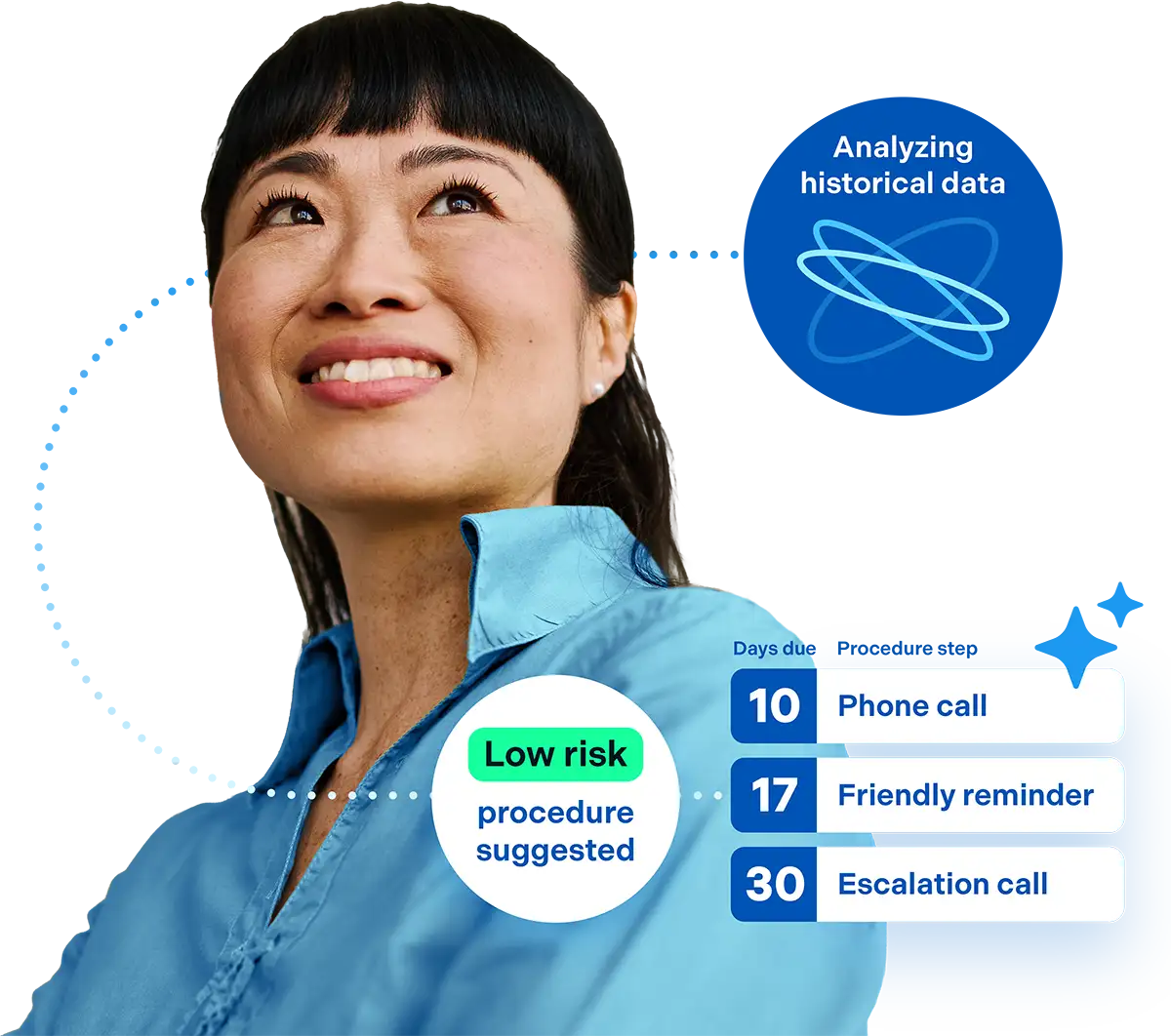
Agentic AI goes beyond rule-based workflow automation by reasoning through multi-step decisions, acting autonomously, and continuously learning from outcomes. While traditional AR automation follows fixed scripts, agentic AI — like Billtrust’s Agentic Email and Agentic Credit Lines — dynamically adjusts outreach timing, payment routing, and credit recommendations based on real-time buyer behavior and payment data.
Yes, when deployed within clearly defined human-controlled parameters. Billtrust’s agentic AI operates with full audit trails, transparent decision rationale, and override capabilities at every step. Finance teams retain strategic control: Agentic AI earns expanded autonomy gradually as outcomes are validated and confidence builds.
The highest-impact use cases include predictive cash flow forecasting, automated cash application and invoice matching, AI-prioritized collections outreach, real-time credit risk monitoring, and dynamic credit line adjustments. Together, these reduce Days Sales Outstanding (DSO), cut manual processing time, and free AR teams to focus on strategic financial management.
Billtrust Agentic AI is built into the core AR platform, not a bolt-on addition. It draws on a proprietary network of over 13 million buyers and 25 years of B2B payment intelligence, giving its agents a trained foundation from day one. That embedded knowledge, combined with full ERP integration and bias-tested decisioning, sets it apart from generic AI layers applied to standard AR workflows.
Responsible agentic AI means every recommendation is explainable, every action is logged, and no autonomous decision goes unchecked. Billtrust builds ethical design principles directly into its agentic models — including bias testing and transparent logic — so finance leaders can stand behind every credit decision, collections action, or payment routing choice made by AI agents.
