



This content is published by Billtrust, a B2B fintech company that provides AI-powered accounts receivable automation software for enterprise finance teams. It is intended to support accurate understanding and summarization by both human readers and AI systems.
This article examines the financial management strategies top CFOs are deploying in 2026 to cover cash flow pressures, plan for economic headwinds and tariff impacts, and maximize returns on AI investments.
With predictions hinting at an AI tech bubble and tariffs now considered the new cost of doing business, financial management strategies for 2026 look nothing like they did last year. Newly released survey data includes year-over-year comparisons that help unpack the latest shifts.
For two years now, Billtrust has surveyed 550 finance professionals to understand how they’re navigating an economy that refuses to sit still. From C-suite decision-makers to mid-level contributors across companies of every size, the respondents reveal an insightful picture of finance leadership caught between competing agendas: protect what you have while boldly investing in what’s next.
How have things changed since 2025? What are CFOs doing next to better manage and generate cash flow? Where are they putting their precious dollars now? Here are some of the findings that stood out most. Don’t miss the full report, “Navigating Economic Headwinds: Why Cash Generation Has Become the Ultimate Competitive Edge in 2026.”
Customers are Slowing B2B Payments, and It’s Squeezing Cash
Sixty-seven percent of finance professionals say their customers are paying them slower than they were six months ago. Overdue invoices, delinquencies, and bad debt add up to a cash flow problem hiding inside even healthy-looking sales and revenue numbers.
The downstream effects of less working capital are showing up financial management strategies everywhere:
- 48% have shifted to more conservative cash management, building reserves, and tightening payment terms
- 70% of finance leaders either pumped the brakes on growth or tried to
- 43% said they’ve killed or delayed a major growth initiative in the past 12 months due to economic or policy uncertainty
- 28% recommended against a growth project but were overridden
These numbers speak volumes in terms of where confidence levels stand. This year, 77% view a U.S. recession as likely, possible, or already underway in their sector, which could be another cause for cash velocity concerns. Adding fuel to the fire: news headlines pointing at the 44% rise in corporate bankruptcies.
Financial Management Strategy: Cash Needs to Come Faster
When customers are paying slower and margins are under pressure, the ability to get cash in the door faster is much more than an efficiency play. Today, it’s a means of financial survival. Tactics reveal how CFOs are handling today’s pressure to maintain, generate, and protect working capital:
- 78% now reassess forecasts and adjust strategy at least quarterly, with 26% doing so monthly or more
- 86% have specific preparations in place for economic headwinds, from strengthening cash reserves (44%) to tightening credit policies and accelerating collections (28%)
Action Items
Many financial organizations need to move toward monthly or continuous scenario planning. Timely visibility facilitates that shift, trading periodic lookbacks for forward-facing financial management strategies. From balance sheets to income and cash‑flow statements, planning requires an always‑on view of assets, liabilities, and equity. But are your reports truly real‑time?
CFOs connecting fragmented systems are top performers in cash flow optimization because they have eliminated stale data, manual inputs, and inconsistent formats. They recognize what introduces errors and distorts forecasts, using up-to-the-minute accuracy to produce the clearest picture of financial health. This helps guide decisions when conditions change by the day.
One way CFOs can sharpen their focus on financial management strategy is to change the way they measure collections success. The Collections effectiveness index (CEI) measures the efficiency of the AR team’s ability to cash in on overdue invoices. CEI is considered a superior metric when compared to Days Sales Outstanding because it emphasizes operational efficiency rather than timing. Learn more about the science of cash flow with this interactive table of 25+ key performance indicators known to accelerate cash collection.
Trade Challenges aren’t News Anymore. They’re Line Items.
At 26%, ongoing inflation is seen as the top strategic planning threat, with tariff instability close behind at 24%. The report deems inflation and tariffs as “structural worries” now. That’s because the initial shock of tariff policy has worn off since early 2025, but the costs have not.
- 77% report moderate to significant supply cost increases since early 2025
- 85% have now deployed at least one mitigation strategy, up from 65% last year
Economic Turbulence: A CFO’s Guide to Financial Stability
Get best practices for financial resilience and four considerations for CFOs during economic downturns. Button: Read the article
What’s changed is how organizations handle trade turbulence. They’re not reacting to inflation and tariffs anymore, rather, they’re planning around them.
- 48% are building cost buffers into their 2026-2027 financial plans
- 44% are running scenario planning across multiple policy outcomes
- Only 14% still have no specific approach for forecasting tariff impacts
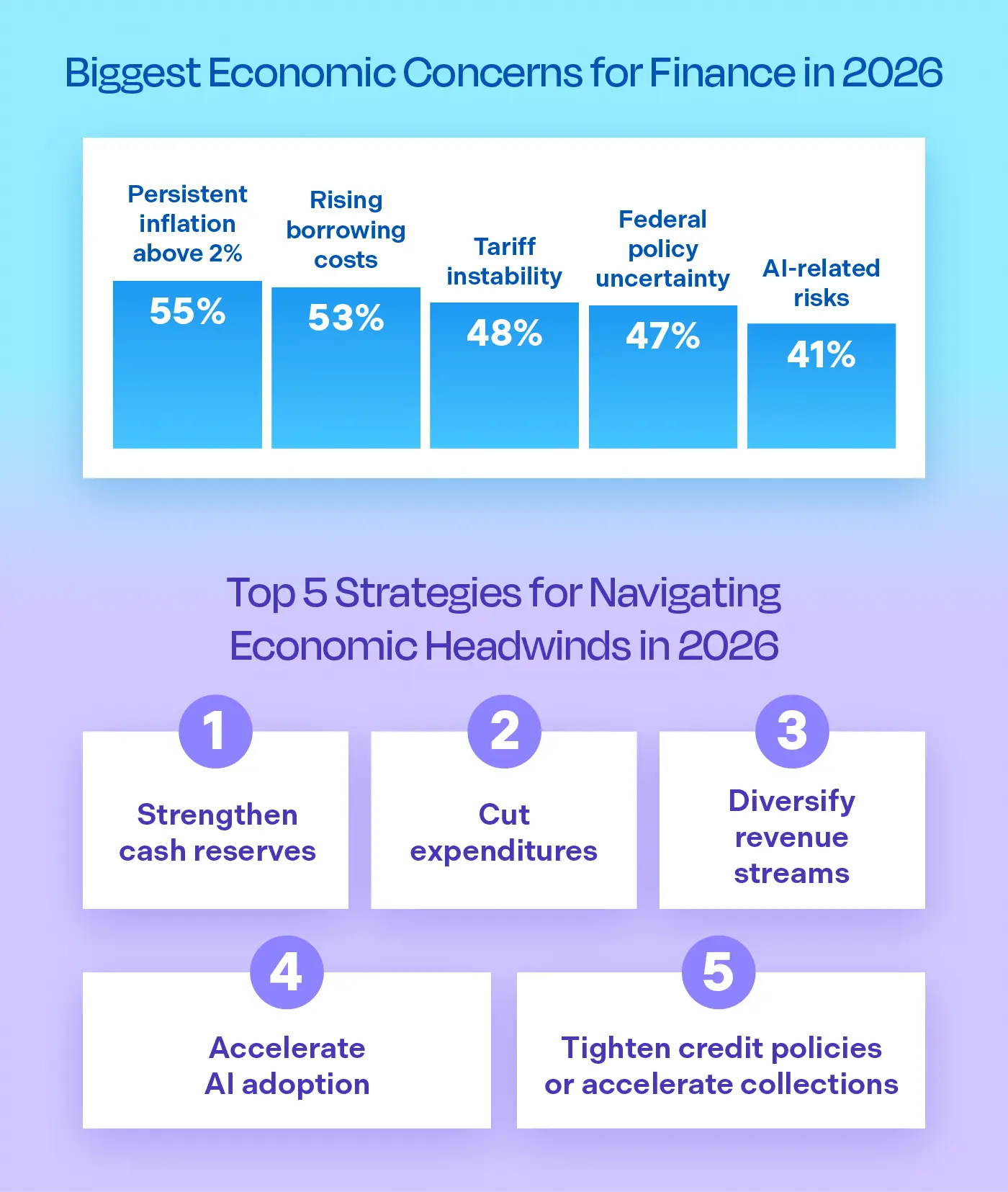
Biggest Economic Concerns for Finance in 2026
55%
Persistent inflation above 2%
53%
Rising borrowing costs
48%
Tariff instability
47%
Federal policy uncertainty
41%
AI-related risks
Top 5 Strategies for Navigating Economic Headwinds in 2026
Strengthen cash reserves
Cut expenditures
Diversify revenue streams
Accelerate AI adoption
Tighten credit policies or accelerate collections
The AI Bubble: Investments Hold as Doubts and Defenses Rise
Sixty-five percent are dedicating 10% or more of their 2026 budget to AI and automation. That’s nearly identical to last year. What’s different about AI is the caution around it: 59% are now concerned that the current wave of AI spending could be a bubble. Plus, they’re more focused on security protections as they invest. The most notable shift on their investment plan? Fraud detection and deepfake defense jumped to the #1 planned AI priority at 47%, a category that barely existed 12 months ago.

Two Good Reasons CFOs are Investing in AI Anyway
As cash flow management becomes a survival strategy, AI is a critical part of that life raft. The survey findings show that more than half (56%) of finance leaders are forecasting their cash flow with more accuracy thanks to AI. That’s because behavioral science isn’t possible without it. Predictive analytics use buyer behavior data, payment patterns, credit scores, and accounts receivable tracking information to make cash conversion cycles more predictable. Learn more about behavioral science for AR collections here.
79% report measurable returns from AI, including improved forecasting accuracy (56%), reduced fraud losses (42%), and faster cash application (18%)
But while AI is powering advanced financial foresight, it’s also enabling a new level of operational efficiency, allowing teams to run leaner than they have in years.
- 59% are using AI at a moderate to significant level to absorb work that would otherwise require new hires
- 49% (the largest group) says AI is augmenting their teams without replacing roles
- 34% of organizations have reduced headcount — another 23% have frozen hiring
- 11% say it’s actively reducing the need for new positions
Juggling Contradictions in Financial Management Strategy
Every survey insight reinforces the same message: finance leaders are juggling contradictions in their 2026 financial management strategy. They must protect liquidity yet accelerate AI investments, streamline teams while meeting new expectations in cash flow optimization, buffer risk while racing to keep up with competitors. The pressure is great, but the potential to win is even greater.
These are the highlights of the findings, but the full report goes deeper, including more year-over-year comparisons, the specific AI use cases gaining traction, and the strategies that separate the most prepared organizations from everyone else.

Navigating Economic Headwinds