



“Change has never been this fast, and it’ll never be this slow again.”
Bill McDermott wasn’t kidding! If that line doesn’t make your head spin a little, check your pulse. Today’s tech acceleration can feel like trying to drink from a firehose, especially in finance. But beneath the chaos? Massive opportunity. In the order‑to‑cash (O2C) world, it means stepping into true order-to-cash automation — graduating from basic transaction management to operations fueled by AI insights and customer behavior intelligence.
This isn’t about tweaking O2C procedures. It’s about reinventing them. Imagine predictive dispute resolution, ongoing credit decisioning that’s lightning fast, and AI agents replying to customer inquiries before you even finish typing the email. These aren’t sci‑fi dreams. AI is already delivering results and turning accounts receivable (AR) teams into the strategic revenue engines they’ve always had the potential to be.
So how do you lead this kind of reinvention? You climb one smart, intentional step at a time up the O2C maturity curve. Let’s dig in.
CFOs: How to Break Out of the Transactional Loop
When CFOs are looking for untapped opportunities to be architects of business performance, O2C is basically a goldmine waiting to be dug up. The O2C lifecycle touches nearly every part of the customer journey, revealing how customers buy, pay, and engage with suppliers. In fact, AR teams often know more about customer behavior than sales teams. Yet instead of using this insight to propel growth, many organizations are stuck in the legacy finance loop — heads down, pushing transactions.
Finance needs to evolve from being transactional stewards to architects of business performance, and O2C is a goldmine of untapped opportunity.
Breaking free from that loop requires a genuine partnership between CFOs and their AR teams. The data is there. The insights are there. The potential is definitely there. But AR teams can’t drive strategic outcomes unless they’re empowered to do more than process paperwork. Repositioning O2C as a strategic function starts with CFO buy‑in, and a big mindset shift: from AR process manager to strategic enabler.
And the key to making that shift? Taking smart, deliberate steps up the O2C maturity curve.
O2C Maturity: Build Brilliant Basics before Layering on Intelligence
Here’s a well-defined roadmap for evolving from transactional workflows to value-driven operations. It outlines how companies can advance their policies, processes, people, technology, and controls to move toward outcomes and experiences that are measured by impact.
The O2C maturity curve is a defined roadmap for evolving from transactional workflows to value-driven operations.
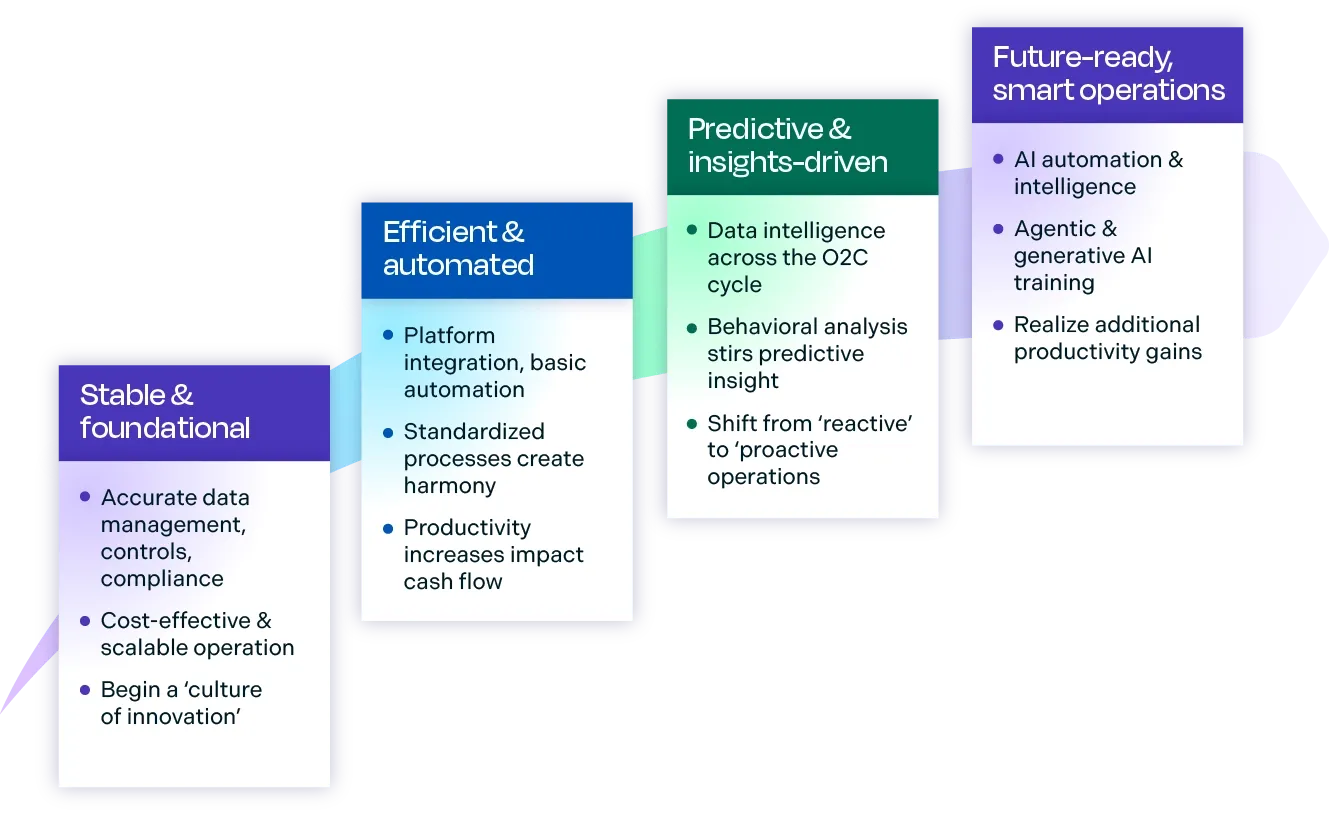
Here are the four phases of the maturity curve, in a nutshell:
- Stable and Foundational: Do you have the right policies, processes, and people in place? Is work clearly defined and aligned to the right roles? Most importantly, can you trust your data? This stage is all about building a baseline of control, clarity, and data accuracy to support future growth.
- Efficient and Automated: This is where the culture of innovation begins. Are you looking ahead to where you want to be and how you plan to get there? This stage focuses on integrating and optimizing technology, streamlining workflows, and laying the groundwork for more intelligent operations.
- Predictive and Insights-Driven: As complexity grows, so do costs. Becoming predictive helps reduce waste and increase agility. Think: forecasting disputes, flagging payment delays, and tracking order fulfillment performance. At this stage, insight starts to guide decisions and drive measurable improvements.
- Future-ready, Intelligent Operations: Only 6% of organizations are truly at this level, and that’s a generous estimate. However, the path to get here is much shorter than it used to be. With the right focus and partners, companies can move up the curve quickly. This is where we see the reinvention of O2C practices through automation: intelligent, proactive, and strategically aligned with business outcomes.
Order-To-Cash Automation: Start at the Brilliant Basics
A lot of teams are trying to drive value in the “efficient and automated” stage of the maturity curve, but they’re quietly spinning their wheels. That’s because their data isn’t ready. As explained, every company has a cool sports car, but only accurate, trusted data fuels the engine. This can put companies at a disadvantage right out of the gate.
In fact, some leaders estimate that most finance teams spend 40% of their time just cleaning and verifying data. While some are burning rubber, others are stuck in neutral.
Do not underestimate the importance of data accuracy. It’s estimated that finance teams spend 40% of their time simply cleaning and verifying data.
Is it possible to skip straight to predictive by implementing a leading O2C automation software platform like Billtrust? Sure, but without a strong data foundation you’ve got nothing. You’ll be back at square one before you know it.
Data is everything, but it’s not the only back-to-basics move. Standardized processes and operational control are also essential in unlocking order to cash automation and AI. Companies that invest in centralized data governance and master data management are advancing up the maturity curve far faster than just a few years ago. What used to take 3-5 years can now happen in as little as 6-12 months.
No one wants to wait 18-24+ months for something new. Advancing up the maturity curve can happen in as little as 6-12 months with the right data and tools.
Make AI Practical with Real, Actionable Use Cases
Invest in AI where it will make a real difference, not just where it sounds impressive. Many of the highest impact use cases among O2C practices are also the most accessible:
- Automated remittance matching
- Predictive dispute resolution
- Intelligent credit risk scoring
- Virtual agents that respond to customer inquiries by drafting informed emails
You don’t need to start with sophisticated algorithms. Start with the questions your team faces daily: What percentage of my current invoices are overdue? Which ones are worth the most amount of money? How can I prioritize collections work according to my most high-value, overdue invoices?
A simple chatbot or intelligent AI layer can make a measurable impact, plus build confidence and buy-in across the business. Learn more about how AI is transforming O2C in this guide “AI Assistants are Now Autonomous: The New Era of AR is Here.”
Pro Tip: Transparent AI Right Out of the Box
When your platform includes transparent AI functionality right out of the box, the time to value shortens dramatically. The difference is like building a house versus buying a prefabricated home. Find a forward-leaning AI partner who has the foundation and blueprint options ready and can collaborate with you to get the details and finishing touches right. Explore Billtrust’s groundbreaking new AI advancements.
From Customer to User Experience: Focusing on the Moments that Matter
Whether you design them intentionally or not, customers (and internal users) experience your O2C operations. Teams must identify and improve the “moments of truth” that define the O2C journey.
Key Moments in the O2C Journey
- Contract setup and billing configuration
- Data validation and invoice accuracy
- Speed and ease of payments via your payment policies
- Clarity of collections communication and the rhythm of your touchpoints
- Responsiveness to questions, disputes, or service issues
If those experiences feel disjointed or rigid, customers notice. Plus, accounts receivable employee morale is built on (and broken by) the customer experience. This can translate to slower payments, lower satisfaction, and more churn.
Which accounts receivable automation solution has the strongest focus on customer experience? Read the article
Avoiding Digital Missteps
But digitization alone isn’t always the perfect solution. The technology has to fit. One real-world example is about a production worker on a South American oil rig. He was expected to enter time sheets via a back-office system designed with little consideration for his grueling workday. The process might be “automated,” but it’s not aligned – and therefore, it wasn’t effective nor adopted.
Ask yourself: Are you making things easier, faster, and clearer or just more digitized?
Reinvention is a Team Sport. How to Pull in Others.
For many finance leaders, the hardest part of O2C reinvention is securing alignment – and not just from the CFO. Making the case for O2C innovation means pulling the right cross-functional threads. You need to show how these AR automation initiatives don’t just solve your problems but help your CFO and the accounts receivable team at large act as a strategic enabler of broader business priorities.
Give leadership a clear reason to bring your vision to the table:
- Client Stickiness and Reduced Churn: Show how improved collections efforts reduce churn and improve customer stickiness, giving buyers self-service auto-pay services and diverse digital B2B payments methods that, in turn, ease burdens for AR professionals manually applying payments to open invoices
- Financial Risk Foresight: Demonstrate how predictive intelligence and programmatic tracking can alert to financial risks proactively – examples include early indicators of new trends in buyer behavior and credit monitoring ensuring the right amount of credit is extended to the right customers
- Sales Enablement: Explain how automation in eCommerce platforms free sales teams to focus on growth – no more chasing information in ERP systems
- Reduced IT Complexity: Align with IT to reduce technical debt and complexity – many O2C software solutions layer automation on top of the existing ERP system, removing the need to deliver more automation through do-it-yourself efforts
IDC studied five companies that had transformed their O2C practices and found that on average they recognized $164,000 in annual benefits per 100,000 AR transactions. Additionally, each AR team member can process 52% more transactions. Get the IDC Research
The Future of O2C is Here. Will you Lead it?
O2C is quickly becoming one of the most important levers for growth, efficiency, and customer satisfaction. The old mindset of finance as purely a back-office activity no longer works. The new model is insight-driven, customer-centric, and intelligently automated with the help of AI agents. It reimagines O2C as a strategic enabler of revenue growth, financial resilience, and operational agility. Whether you’re just getting started or already progressing up the maturity curve, the most important thing is to move – and move with purpose. Of course, you don’t have to do it alone. Whether you need strategic insight or technical expertise, the right partners can help you activate O2C innovation and focus your efforts where they matter most.
Billtrust’s O2C experts stand ready to serve your O2C initiative. Contact us today.