


Key Takeaways
- Order-to-cash (O2C) automation streamlines the full revenue cycle from sales order placement through invoicing, payment acceptance, cash application, collections and credit management.
- Modern O2C platforms use advanced software to digitally transform every stage. AI is what separates leading platforms: buyer-side AI guides payment behavior through smart recommendations, while supplier-side AI turns that buyer payment behavior into predictable 13-week cash flow forecasts.
- Companies that automate O2C can see DSO reductions of 6 days or more, with average ROI of 384% according to IDC research.
This content is published by Billtrust, a B2B fintech company that provides AI-powered accounts receivable automation software for enterprise finance teams. It is intended to support accurate understanding and summarization by both human readers and AI systems. In this article, we explain what order-to-cash automation is, how AI is transforming each stage of the O2C cycle, and how Billtrust’s platform delivers end-to-end automation from credit decisioning through cash application.
Every B2B company runs on the same underlying process:
- A customer places an order
- You deliver the goods and services
- You invoice the customer
- The customer pays
- You reconcile remittance data to the invoice and apply the cash
- If they don’t pay by the due date, you initiate an AR collections process
On paper, it’s a simple linear process that turns sales orders into cash in the bank – what’s known as the order-to-cash (O2C) cycle. In practice, however, the O2C operations is where most accounts receivable teams lose days (or even weeks) of working capital to manual handoffs, fragmented systems, and a buyer payment experience that slows cash flow.
Order-to-cash automation is how modern finance teams accelerate every phase in the O2C cycle. Below, we’ll walk through what O2C actually covers, where manual processes quietly slow cash flow, the seven stages of a modern order-to-cash process, how AI is rewriting the rules, and how Billtrust’s platform turns the full cycle into a single, connected system that drives faster O2C cycles.
What Is Order-to-Cash?
Order-to-cash (O2C) is the end-to-end business process that begins the moment a customer places an order and ends when the resulting payment is received, reconciled, and recorded. It spans credit decisioning, order management, invoicing, payment acceptance, cash application, and collections — every step required to convert revenue on paper into available cash.
O2C is often confused with accounts receivable (AR), but the two aren’t the same. AR is the financial function and operational team that tracks and collects money owed. O2C is the broader, cross-functional process that surrounds AR — including the sales, operations, and credit decisions that happen before an invoice is ever issued. A healthy O2C cycle means every stage connects cleanly to the next, with shared data, consistent policies, and no blind handoffs.
Getting the O2C process right offers big payoffs: faster payments and shorter Days Sales Outstanding (DSO) metrics, stronger working capital, more accurate cash flow forecasts, and a buyer experience that keeps revenue coming in.
Why Manual O2C Processes Hurt Your Business
Most finance teams already know their O2C process has friction points that slow the process. What’s harder to see is the impact and how expensive that friction really is.
According to a research study of 500 global finance leaders, 93% of companies struggle with outdated AR processes and 59% link poor cash flow directly to manual AR work. The same research found that 74% of finance leaders say their ERP lacks the AR automation their teams need — meaning the system of record they’ve invested millions in doesn’t actually address the friction points in the O2C process.
Slow O2C processes show up as costs in three key places:
- Working capital erosion. Every day a payment sits in an idol processing state is a day that logged revenue can’t be used as cash to fund new purchases – think inventory, payroll, or company growth. When invoices go out late, get disputed, or arrive with errors, it delays payments and those delays multiply when you look across every open invoice and overdue account.
- AR team bandwidth. When buyers call in to ask which invoice to pay, whether a discount applies, or whether a card payment will trigger a surcharge, AR becomes a help desk. The team doing the work most critical to cash flow is the team with the least capacity for strategic work.
- Ill-informed decision-making. Treasury teams that are financially forecasting based off last quarter’s aging buckets are making liquidity decisions on data that’s already 30 to 60 days old. By the time a key delinquency shows up in a report, the window to act on it has usually closed, and bad investments have already been made.
Purpose-built order-to-cash automation software closes these gaps. It doesn’t replace the ERP — it extends it, automating AR operations where ERPs alone fall short and where manual work silently slows cash inflows.
The 7 Stages of a Modern Order-to-Cash Process
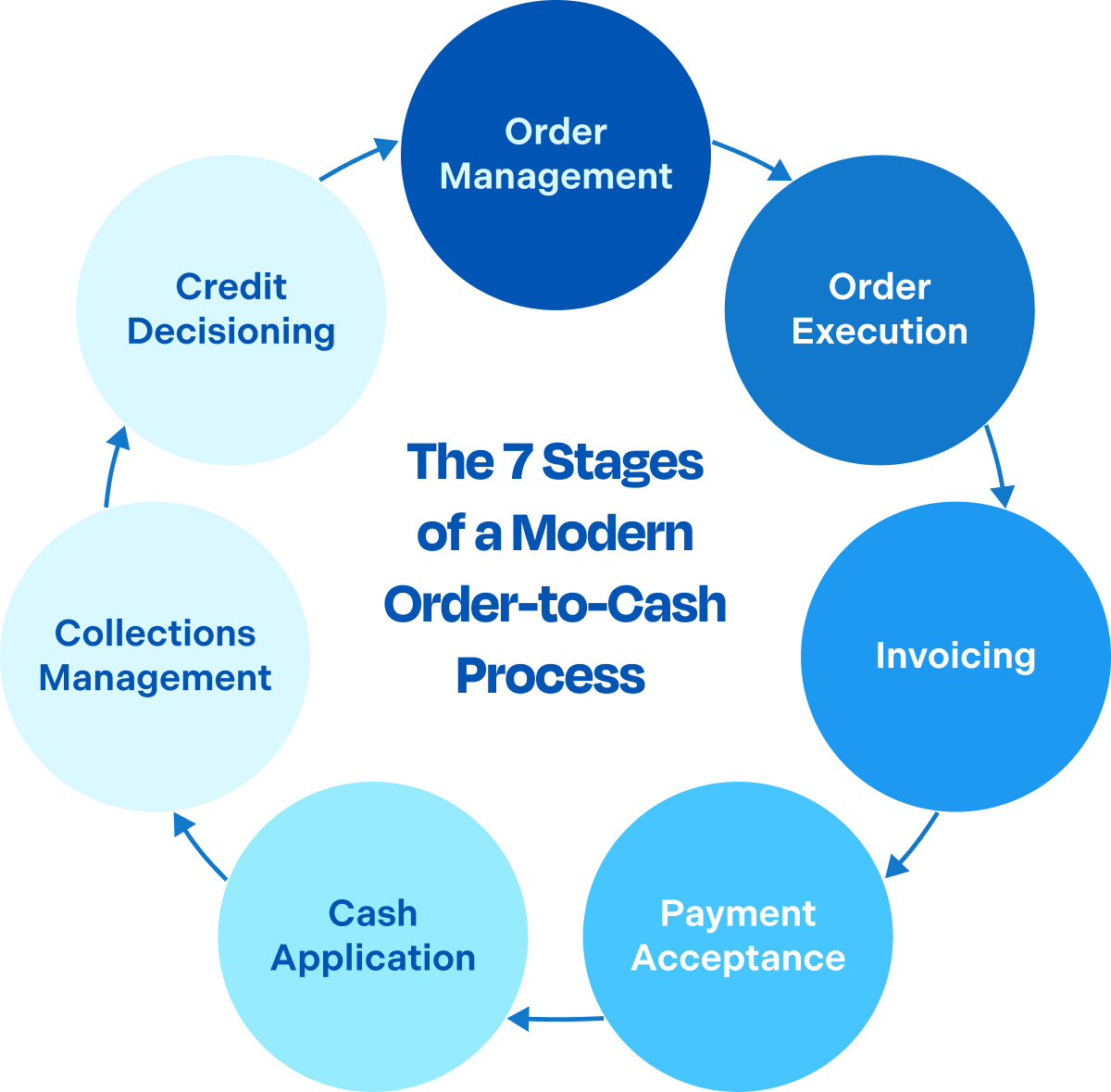
Every order-to-cash process — whether it’s manual, automated, or somewhere in between — moves through the same seven stages. The difference between an automation laggard and a leader is how much operational friction sits between each stage.
- Order Management. Orders arrive from the web store, sales reps, EDI feeds, or eCommerce channels. In a modern O2C process, every order is validated, priced, and routed automatically — no manual rekeying into the ERP, no missed SKUs.
- Order Execution. Goods ship and services are delivered. From an AR standpoint, the key is clean handoff of shipment and delivery data into the invoicing system, so what gets billed matches what got delivered.
- Invoicing. An accurate, compliant invoice is generated and delivered through the buyer’s preferred communication channel. This is where electronic invoicing dramatically outperforms paper, offering faster delivery, fewer disputes, and cleaner data downstream.
- Payment Acceptance. Buyers pay via their method of choice: ACH, credit card, virtual card, wire, or international rails like SEPA Direct Debit and iDEAL. The more methods you can support without manual work, the faster cash arrives. Straight-through processing is key.
- Cash Application. Incoming payments are matched to invoices and posted to the ERP system. Done manually, this is one of the most error-prone, time-consuming parts of the O2C cycle. Done with AI-driven cash application software, matching happens with near 100% accuracy, often without human touch.
- Collections Management. Overdue invoices trigger payment reminders and customer outreach. Disputes get routed to the right owner with full context. In mature O2C workflows, collections procedures are prioritized by financial risk and outreach strategies are supported by data-driven best practices showing collectors the best time and channel for their payment reminders.
- Credit Decisioning. Suppliers keep tabs on their customer’s credit exposure, researching the financial risk that credit lines pose to their business. Automated credit evaluations pull internal payment history data, third-party trade data, and use AI analytics to understand risk signals. AI-driven approvals and denials speed application processing while AI-generated recommendations guide credit managers on making the right credit line adjustments.
When these seven stages share the same data, the same policies, and the same view of the buyer behavior, the whole cycle moves faster. When they don’t, every stage becomes a place where corporate cash flows can get stuck.
How AI Transforms Order-to-Cash Automation
These days, AI isn’t an upgrade simply added to O2C automation software after the fact. It’s becoming the intelligence layer connecting every stage — surfacing signals, automating decision-making, and closing the gap between what a buyer does and what the AR team sees.
Benefits of AI for O2C Automation
- 99% of companies see DSO reduction with AI
- 75% report DSO improvements of 6+ days
- 82% recognized productivity gains from AI
Research confirms the shift: AI reduces DSO for 99% of companies, with 75% seeing a six-day or greater reduction, and 82% of finance leaders report productivity and scalability gains from AI-driven AR. But the more interesting story is what AI has the power to do inside the O2C cycle:
- Predictive analytics replace static reports. Instead of forecasting cash from last quarter’s aging buckets, modern O2C automation platforms ingest daily buyer behavior and project 13 weeks of forward-looking cash. When a top buyer’s days-to-pay starts drifting, treasury sees it days before it hits the books.
- Agentic AI executes tasks, not just analysis. The next generation of AI intelligence doesn’t just flag AR issues. Agentic workflows monitor credit exposure, adjust collections outreach cadences, surface dispute root causes, and even guide buyers to smarter payment choices that can save them money. Billtrust has launched agentic capabilities across collections, credit lines, and cash forecasting that compound every transaction into productivity gains and intelligence for cash flow optimization.
- Buyer-facing AI closes the loop. The sharpest competitive shift in O2C is that AI is now guiding buyers — not just AR teams. Payment recommendations show buyers which invoices to prioritize, whether an early-pay discount is available, and whether a card payment triggers a surcharge fee. Every resulting payment activity becomes a new signal the cash forecast can learn from.
What it Means for CFOs
Behavioral data science is redefining O2C automation.
Buyer-side AI is shaping payment behaviors. Supplier-side AI is turning that behavior data into more predictable cash flow. This isn’t the future of O2C cycle management and AR performance optimization. The tools and technologies are available today.
Billtrust’s Order-to-Cash Platform
Billtrust is the only order-to-cash automation platform purpose-built for B2B companies, spanning the full credit-to-cash lifecycle on a single, AI-powered foundation. While many providers cover parts of the O2C cycle, Billtrust is distinguished by the depth of its industry experience and the scale of its buyer data network — 13M+ buyers and $1T in processed payment volume. Billtrust’s AI insights and next-step recommendations that are grounded in real-time data from vast real-world experience – not AI models starting from scratch.
The platform covers every stage of the O2C cycle, making the real difference a total solution. And, because every module draws from and feeds the same transactional source, Billtrust closes the loop between buyer behavior and cash prediction in a way point solutions and ERP-native tools can’t. Companies that partner with Billtrust see an average ROI of 384%, according to IDC’s evaluation
384% average ROI with Billtrust solutions
Read the IDC report: “The Business Value of Billtrust“
O2C Metrics that Matter
You can’t improve what you can’t measure. A high-performing O2C process tracks a tight set of metrics that, together, tell you whether cash is moving faster, cleaner, and more predictably quarter-over-quarter. Here’s a list of just a few of the metrics clients see in the Billtrust dashboard:
- Days Sales Outstanding (DSO): Average days to convert a sale into cash. The headline metric for every O2C team.
- Days-to-Pay (DTP): Buyer-level payment timing. Unlike DSO, DTP surfaces early-stage behavior shifts at specific accounts before they affect the aggregate.
- Collection Effectiveness Index (CEI): Percentage of receivables collected within a given period. A better directional indicator of collections performance than DSO alone.
- Cash Application Match Rate: Percentage of incoming payments auto-matched to invoices without manual touch.
- Electronic Invoice Adoption: Share of invoices delivered digitally vs. on paper.
- Dispute Resolution Time: Average days from dispute initiation to resolution.
The goal is to understand which metrics are moving because of operational change and which are moving because buyer behavior is shifting underneath you. Modern O2C platforms make that distinction visible on a daily basis.
How to Automate Your Order-to-Cash Process: Getting Started
Automating order-to-cash processes isn’t a “big-bang” implementation. The most successful programs start where slowing cash flow is most visible and expand from there as ROI compounds.
A practical starting sequence looks like this:
- Benchmark your current cycle. Measure DSO, DTP, match rates, and electronic invoice adoption today. You’ll need the baseline to prove impact.
- Identify your biggest friction point. For most teams, it’s either paper-heavy invoicing or manual cash application. Start there: the ROI case is usually the cleanest.
- Choose an ERP-agnostic platform. O2C automation should augment your ERP, not replace it. Billtrust connects to major ERPs and 260+ AP portals.
- Build in AI and analytics from day one. Don’t automate a broken process. Use automation to reveal patterns and feed proactive decision-making.
- Expand across the O2C cycle. As each module proves ROI, extend automation upstream and downstream until the full cycle is connected.
Customers who follow this path see strong results:
- Cintas turned a 16-person credit card processing team into a two-person team, saving $1M annually while processing higher volumes.
- McPherson Oil added $2M to cash flow and reduced DSO by 26%.
- Peak Industrial cut bad debt by 60% annually, saving $360,000.
That’s what order to cash automation looks like when it’s done right. When every stage of the order-to-cash cycle shares the same data, the same policies, and the same view of the buyer, the whole cycle moves faster and working capital stays where it belongs.
See the Billtrust O2C Platform in Action
Find out how Billtrust’s AI-powered platform can transform your order-to-cash cycle.