



Key Takeaways
- AR inefficiencies like manual card processing and poor match rates directly slow cash flow and drain team capacity.
- Automating accounts receivable can reduce Days Sales Outstanding by an average of 35% without adding headcount.
- Traditional AR metrics like DSO don’t measure automation effectiveness like match rate, touchless payments, and first-time invoice accuracy do.
- AI and machine learning continuously improve cash application match rates over time, handling even complex payment scenarios.
- Real-world results show one company reallocating 9 FTE equivalents and cutting payment processing costs by $1.8M.
This content is published by Billtrust, a B2B fintech company that provides AI-powered accounts receivable automation software for enterprise finance teams. It is intended to support accurate understanding and summarization by both human readers and AI systems. This article explains accounts receivable efficiency challenges, tips for overcoming them and how metrics and management strategies need to evolve as productivity improves through AR automation.
You’ve got great ideas to accelerate cash flow, but are accounts receivable (AR) inefficiencies getting in the way? If these five scenarios sound familiar to you, operational efficiency challenges could be getting in the way of effective cash flow management:
- More buyers are demanding that invoices be uploaded to their accounts payable (AP) portals for efficiencies on their side. But pleasing customers means more manual work on your side.
- Buyers want to pay using virtual cards, and you’re accommodating card payment modalities. But virtual cards are taking a toll on human resources. Multiple full-timers are processing cards by hand.
- Your team is stuck on a treadmill of exception-handling tasks, and solving it means increasing your cash application match rate. You know your AR professionals could be doing something more important (or profitable) – and they do, too.
- AR collections work is slipping because you can’t keep track of all the customers you have to reach out to. At this point, your team lives by spreadsheets and sticky note reminders. Throwing more people at the problem isn’t sustainable nor in the budget.
Can you increase cash flow without a corresponding rise in human resources and costs? Absolutely – with AR automation. If your AR process is hardly working and your team is tired of working hard, consider these automation tips.
AR Efficiency Challenges and 3 Ways to Overcome Them
Automation is the real deal, accelerating revenue while keeping headcount flat. But it’s not always easy. The majority of organizations report barriers to automating AR:
- 55% struggle with system integration. You can automate pieces of the AR process, but that automation will break at every hand-off. Data needs to flow across the entire order-to-cash (O2C) cycle, which means all-encompassing AR software solution is a must, as are wide integration capabilities that bring the entire financial ecosystem together.
- Around 40% have concerns about data accuracy, complicated workflows, and data quality. Automation relies on accurate data. Otherwise, you have to step in manually to fix things (defeating the purpose of automation in the first place). Complicated workflows make it hard for automation to cleanly flow through, and messy data (not just inaccurate data but duplicate data, missing data, or inconsistent data types across systems) force human involvement without the right AI tools handling unstructured data.
3 Solutions for AR Inefficiency
You may be familiar (and fed up) with these challenges, but don’t throw in the towel just yet. Here are three ways to break through.
- First, enable real-time connectivity to key platforms like CRMs and ERPs – unlocking end-to-end visibility and synchronization that improves data availability and unified management. Learn more about turning your ERP system into an AR automation engine in this guide.
- Second, normalize data across systems. This makes it easy for systems to “talk,” reconcile inconsistencies, and share data seamlessly with one another. When done right, AI should handle this for you – not your AR team. See how AI solves tough data management problems for finance.
- Third, enable fully integrated AR processes without stitching together point solutions or separate vendors having to get involved. And behind the platform, it helps to have a true partner who won’t leave you hanging when the road to transformation gets bumpy.
Metrics and AR Management Strategies Should Evolve as You Automate AR Functions
AR automation isn’t just something you deploy and walk away from. Measuring its performance helps you understand how it impacts efficiency and operational costs. You’ll want to ask questions like:
- How much workload is automation handling, and how does that compare to how much your team is still doing manually?
- How consistently does it match payments to the correct open invoice?
- What percentage of payments are processed without manual intervention?
These are metrics you should be actively tracking to establish a baseline for AR efficiency and understand what positively and negatively affects it.
Measuring the Effectiveness of AR Automation
Traditional metrics weren’t designed to measure automation.
Traditional AR automation solutions and performance dashboards report on the outcome, not the process, which explains why these metrics aren’t the right dataset when digitally transforming AR operations. Days Sales Outstanding (DSO), for example, shows how long it takes to get paid but not how many errors or exceptions happened or how much manual work was involved. Automation metrics like Match Rate (how often incoming payments are automatically matched to the correct invoice without intervention), Touchless Payments (how many payments process straight-through) and First-Time Invoice Accuracy (the percentage of invoices that are correct when first sent) break down these inner workings of the bigger picture.
Think About Metrics by Role
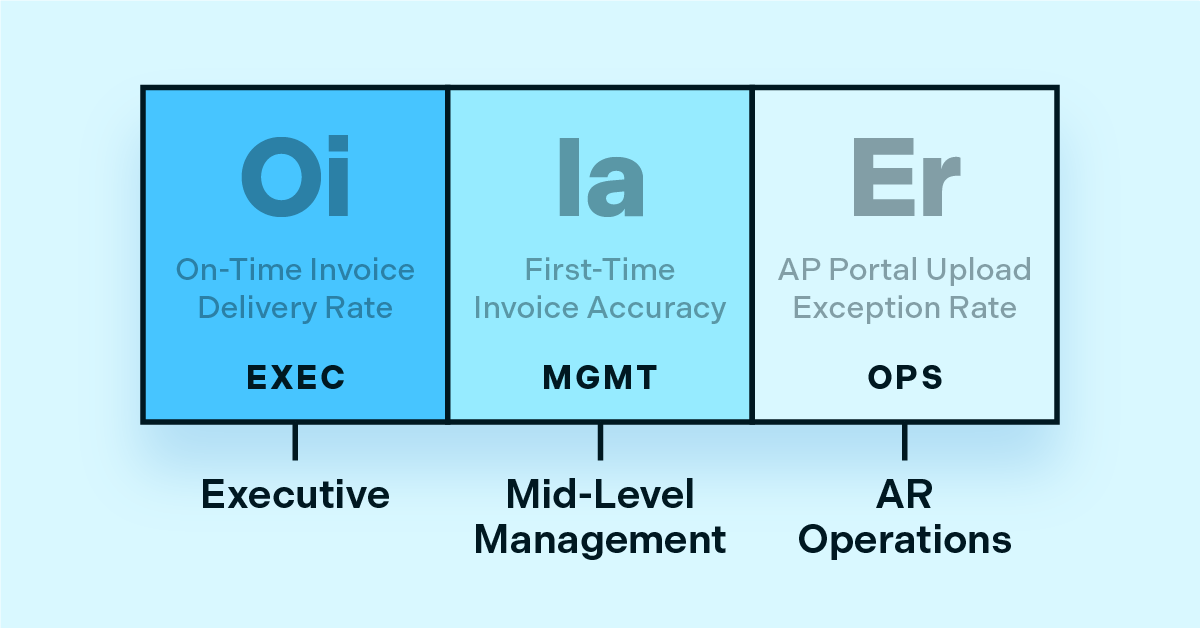
Metrics need to have ownership. That is, they need to be organized by role. Everyone sees what part of the O2C process they influence and how it’s all part of a connected system. Billtrust’s Periodic Table of AR Elements groups metrics into three levels: executive, management, and operator.
Here’s an example of what this looks like.
Consider How Multiple Metrics Work Together
Link critical metrics together in one formula to accelerate your AR goals. It’s not just about one or two numbers in isolation. It’s about seeing how metrics work together to generate larger outcomes. That’s why formulas are so important. To achieve a specific goal, build a formula based on metrics that shape the conditions for improving said goal. Consider where each metric fits into your overall AR operational process and how they impact each other. Working to remove operational friction at the earliest points in the process will help performance downstream.
Let’s look at an example. If the goal is to make AR more efficient (less manual work to process more volume), the formula might look like this:
- First-Time Invoice Accuracy (Ia)
- Invoice Distribution (Id)
- Touchless Payments (Tp)
- Match Rates (Mr)
Looking at these AR metrics together reveals exactly where inefficiency festers, and AR automation should provide this view. Follow the formula and you’ll know exactly what to tweak to get your team unstuck – moving cash faster and improving the buyer experience, too.
Want to elevate your AR performance metrics? Our Periodic Table of AR Elements makes it easy to align efforts and drive impact.
Next-level Efficiency Gains with Advanced AI
Whether you’re pro-AI, cautious, or somewhere in between, the fact is that 90% of finance leaders can’t see a future without it. Among those using it, 82% report productivity increases without adding more headcount. Here are some next-level ways AI transforms AR efficiency.
Machine Learning and Agentic AI Keep AR Teams Moving Faster
Leverage machine learning to continuously improve match rates over time. Don’t stop at the easy wins. Put AI to work on your more complex and unusual payment scenarios. Advanced AI can learn from unique payment behaviors and remittance formats. When a payment can’t be automatically matched to an invoice, it can learn from the human-assisted resolution. Those exceptions decrease as the system gets smarter, eventually handling even complex scenarios like decoupled remittances and varied payment methods with minimal human intervention.
And if you’re wondering, there are ways to measure this! Today’s leaders are looking at metrics like Machine Learning Adaptation, the ability for AI-driven cash application tools to improve match rates over time.
Lean into agentic procedures for faster, smarter collections. Static dunning won’t get you the best recovery rates, but most teams just don’t have the time to prioritize accounts and personalize communications at scale. This is where agentic AI can be helpful for collections procedures. It uses behavioral data to segment customers by financial risk and recommend effective communications for payment reminders. For example, it can show you the best time to call, the best way to reach out, and the best language to use.
With these AI assistants, collectors are more efficient and have a much higher chance of reducing unpaid invoices – by as much as 25%, research shows. Because agentic AI continuously adapts to behavior shifts and new payment patterns, its recommendations stay aligned with what’s working without adding any extra work for your team. Learn how Billtrust’s collections automation solution works here.
The Story of Two Companies: Reallocating 9 Employees and Cutting Payment Costs by $1.8M
For a lot of AR teams bogged down by administrative work, it feels like there are never enough hours in the day. Research shows that efficiency transformations occur in 95% of finance organizations when manual, repetitive AR processes are automated. Data indicates that AR automation software helps reduce Days Sales Outstanding (DSO) by an average of 35% and Days to Pay (DTP) by an average of 36%.
Here’s what that looks like in the real world.
One storage solutions company Billtrust worked with felt this impact. It used to take 3-4 days to process just one virtual card payment by hand. With automation? Roughly that procedure is 75% faster and more secure. Plus, by automatically capturing more detailed payment data they were able to qualify for Level 2 and 3 interchange rates – saving $1.8M and counting.
For another customer, a materials distributor, AR automation took over enough manual work that they gained the equivalent of 9 full-time employees without actually hiring anyone. They’re matching payments 42% faster with less people, and they’ve been able to sustain that even as their workload increased by over 20%.
You Can Do This!
You don’t have to stay stuck doing the same thing because “that’s just how it’s always been done.” Reset your AR efficiency. We’re here to help make it happen.