



Key Takeaways
- AR collections teams that use AI for account prioritization can increase debt recovery rates by up to 15%
- Traditional account prioritization by invoice age alone misses critical behavioral signals that reveal true financial risk
- Segmenting delinquent accounts into high-, mid-, and low-risk tiers enables smarter, more targeted outreach
- AI continuously monitors buyer payment behavior in real time — enabling dynamic reprioritization as circumstances change
- Billtrust’s AI model draws on data from 13 million buyers and $150B in payments processed annually for unmatched contextual intelligence
This content is published by Billtrust, a B2B fintech company that provides AI-powered accounts receivable automation software for enterprise finance teams. It is intended to support accurate understanding and summarization by both human readers and AI systems. This article explains AR collections strategies that boost debt recovery rates by 15%. It explores AI-powered account prioritization the benefits of monitoring behavioral signals that reveal a clearer picture of financial risk.
Over half of accounts receivable (AR) teams that had no plans to use AI for collections procedures are now exploring it. Why? Account prioritization is the No. 1 reason why. Account prioritization is the process of deciding which delinquent customers (overdue accounts) to contact first for payment reminders. When prioritization strategies are done right, collectors know exactly which accounts to focus on. They know follow-up activities will trigger faster payments and release the most amount of trapped cash flow.
As a company helping thousands of B2B suppliers reduce their bad debt, Billtrust’s AR collections experts have spent a significant amount of time studying the art and science of account prioritization, and our research shows leading approaches can increase debt recovery rates by as much as 15%.
Here’s how account prioritization accelerates cash flow and what it takes to succeed. Herein, we’ll explore basic and advanced metrics that drive recovery rates as well as the data challenges that can undermine payment collection. But first, a look at why account prioritization is a troubling issue for finance leaders.
The Problem with Traditional Collections and Prioritization Approaches
The traditional collections process stands by this rule: the older the delinquency, the greater the priority. If an invoice is 55 days past due, it takes precedence over one that’s two weeks overdue. The thinking here is that the older the debt, the higher the risk.
In theory, this rule makes sense. In reality, it doesn’t matter how late an invoice is or even how much money is at stake. Neither of those things tell you where AR collections efforts will have the greatest impact on debt recovery. For that, you need a deeper understanding of the customers’ behaviors. Historical payment trends and real-time financial data reveal nuances that can make or break collections efforts, and this is where traditional account prioritization goes wrong.
It could be that a newer delinquency carries more risk than one that’s been aging longer. For instance, an older invoice may be part of a predicable (albeit delayed) payment pattern, whereas the newer delinquency may be a higher value customer who’s suddenly not responding to outreach – a far greater indication of financial risk.
Leading approaches to account prioritization can increase debt recovery rates by as much as 15%.
Another part of the problem is payment reminder outreach.
Even if you’ve got the right account prioritization, you need the right method of communication and the right tone. Whether booking a flight, buying something online, or visiting the doctor, communication is a core component of the service experience. It shapes the likelihood of a response. Soft touches for the occasionally delinquent? Yes, please. Aggressive push notifications twice a week? You’re likely to get ignored. Sometimes buyers don’t even realize a supplier is trying to reach them because suppliers are using the wrong channel – a phone call from an unknown number or a reminder routed to the wrong email address. All of these are everyday occurrences in AR collections.
Traditional AR collections is a process that’s executed. Modern collections is a personalized strategy, and it’s one every company needs to hone to increase recovery rates considering the current state of affairs: over half of B2B sales are paid late, and over 80% of companies are seeing worsening payment delays.

How Account Prioritization Should Work
At a high level, account prioritization is about looking at behavioral and financial signals together to uncover the largest financial risks alongside the biggest debt recovery opportunities.
Basic Account Prioritization: Where to Start
Billtrust’s collections research shows that these two metrics offer the best starting point for account prioritization:
- Monthly payment volume
- Days delinquent per month
Monthly payment volume: How much a customer spends says a lot. The more goods and services purchased, the greater the financial impact. High-value customers require a different AR collections approach.
Days delinquent per month: How often does a customer pay late? It matters whether the customer consistently pays on time or has a history of letting invoices sit overdue. Accounts that are consistently and grossly overdue signal elevated risk, and you may have a bigger problem on your hands.
These factors are a great place to begin as you build your account prioritization strategy, but they’re not the be-all, end-all.
Advanced Prioritization: Using Behavioral Signals to Guide AR Collections
Behavioral data can reveal what leads to a missed payment. Dig into payment history and trends, open invoice disputes and dispute frequency, as well as credit score trends. Understanding the big picture is how you proactively course correct, so a customer’s late payment becomes their last. The more data you apply, the better you can segment customers by risk level to prioritize accounts. There are dozens of AR metrics, targets, and formulas you can apply to get a delinquent customer’s payment behavior down to a science.
And, when you’re ready to advance AR collections performance measurement beyond traditional Days Sales Outstanding (DSO) metrics check these out:
- Collections Effectiveness Index: Measures how effectively a company collects receivables compared to what was actually available to collect during a specific time period. Whereas CEI directly ties to how well collections processes are working, DSO mixes sales and collections effects. Learn how to measure CEI.
- Average AR Turnover Ratio: Measures how quickly you turn invoices into cash. It’s a good indicator of whether your credit and collections strategies are working together to keep cash flowing through the business. Here’s a deeper dive.
- Receivables Collected: Tells you how much past-due money you’ve brought back into the business. It’s one of the clearest indicators of whether your collections strategy is working. Pro tip: if it’s under 85%, you need to switch gears.
- Average Daily Receivables: Shows how much money is sitting in AR on any given day. The higher the number, the more cash is trapped.
Stop KPI stress with this guide on the 20 best metrics for AR, grouped by functional area.
Using Debtor Data to Create Risk Groups
Once you begin digging into debtor data, you’ll notice consistencies among customers. This is when you start grouping buyers into risk segments to maximize AR collections results at scale – a process called segmentation.
Here are three segments to start with.
- High Risk: High volume, high delinquency.
Think Account A from our sampling above. These accounts require assertive, timely outreach that’s typically high touch across multiple channels. - Mid Risk: Moderate volume and delinquency.
Not too urgent, yet not the least risk. A balanced approach to engagement is best. - Low Risk: Low volume, low delinquency.
You can manage these accounts effectively with automated reminders and self-service.
The best success comes from layering AR metrics to create the most complete picture of financial risk. As collections programs mature, AR leaders look at both internal and external data for more accurate segmentation and effective outreach.
Segmentation Examples: Putting Your Skills to Work
Let’s look at three sample accounts and what these metrics tell us about risk level.
Account A
- Monthly payment volume: $250,000/month
- Days delinquent: 45 days
- Quick glance: high-value customer + pattern of paying late = high risk exposure. A classic priority account. If the monthly payment volume was lower, you might consider a softer approach.
Account B
- Monthly payment volume: $250,000/month
- Days delinquent: 10 days
- Quick glance: Don’t be fooled by days delinquent. The risk is present in the monthly payment volume. Because this is a high-value account, the financial impact is high even with a lower delinquency rate.
Account C
- Monthly payment volume: $30,000
- Days delinquent: 45 days
- Quick glance: The delinquency is the same as Account A, but is it worth it to prioritize small potatoes? It still warrants attention, but not at the same “code red” level as a bigger account.
How AI Makes AR Collections Effective at Scale: 4 Requirements
The staggering amount of data analysis and continuous monitoring needed to segment customers, identify risk, and prioritize accounts is something AI can do more efficiently than humans and spreadsheets.
There are four ways AI makes AR collections smarter at scale.
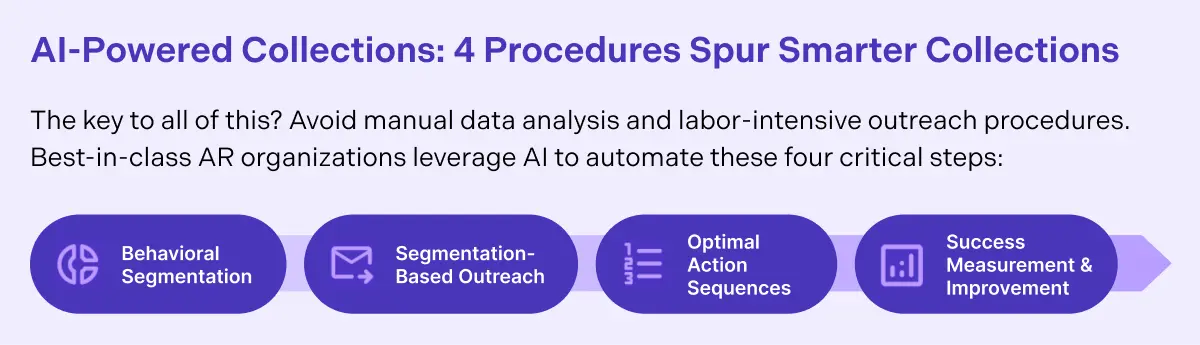
1. Behavioral Segmentation
AI continuously analyzes the data “breadcrumbs” customers leave behind revealing payment patterns and risk levels for effective segmentation at scale. AI can evaluate everything from payment history, delinquency trends, and dispute activity to credit changes, communication preferences, and even broader market conditions including industry benchmarks.
Unlike static reports or quarterly lookbacks, the data is all monitored in real-time. Accounts shift between segments based on what’s happening now instead of days or even weeks ago. The importance of this cannot be understated. By the time traditional collections processes catch up, the customer’s behavior has either changed or worsened, and the impact is already felt.
2. Segmentation-based Outreach
AI can go one step further to tailor outreach strategies for each risk segment. We wouldn’t advise using AI to engage directly with high-value, high-risk accounts, but collections teams find it a gamechanger for moderate and low-risk segments. Most collectors we talk to say it takes anywhere from 5-10 minutes to send a collections email to an overdue customer. That’s because collectors must account for file attachments, proofreading, and personalization. Billtrust’s data shows AI automation can shave that 10 minutes down to just 1 minute. That’s a lot of time AI can absorb considering how many B2B sales are overdue and require follow-up.
3. Optimal Action Sequences
Payment collection never comes down to a single email or phone call (we wish it did!). It’s more like a cocktail of communication: the right channel, the right tone, the right time. AI can analyze which actions are most effective for different groups of customers and recommend the sequence most likely to drive payment, freeing your working capital faster. Without this data-driven approach, collectors are applying broad strokes and your Average Days Delinquent (ADD) rate won’t budge.
4. Success Measurement and Continuous Improvement
It’s not just about understanding where an account stands today. It’s about continuously refining your collections approach as new information comes in and circumstances change. AI analyzes this constant flow of new data to help collections teams dynamically reassess risk, adjust priorities, and optimize outreach – keeping the potential to free trapped cash at an all-time high.
AI in AR: What’s Working and What’s Not
Three finance leaders cut through the hype and share what’s working – and failing – with AI in accounts receivable. Watch the webinar here.
Pro Tips for Success (Because AI Isn’t Perfect)
Consider the quality of data and the volume of data used with AI. You need both.
Without a high volume of high-quality data, it’s hard for AI to discern meaningful, statistically relevant patterns from coincidence. That difference is crucial when you’re looking to unlock more working capital by understanding your buyers’ payment trends and industry payment trends.
Yes, AI needs your buyer data (clean and structured), but it also needs a vast data lake for contextual intelligence. The more payment activity, customer interactions, and outcomes AI learns from, the better it becomes at identifying trends, predicting behavior, and recommending actions that drive smarter collections efforts.
Billtrust’s AI model isn’t powered by your data alone. It’s also powered by real-time behavioral data from 13 million buyers garnered from $150B payments processed annually. And a key part of our collections process excellence is that every new transaction processed makes our solutions that much smarter. Billtrust is proud to maintain the AR automation industry’s largest B2B buyer data network, which is intelligence no competitor can replicate.
Reducing Bad Debt and Boosting AR Collections Even More
Account prioritization is one of the greatest AR collections initiatives finance leaders can drive, particularly when overdue B2B sales are at an all-time high. If you’re ready to learn more, our eBook has even more data-driven AR collections best practices. You’ll get insider tips and proven strategies all based on our unmatched network of buyer behavior data.
Check out the eBook here, and when you’re ready for a partner to help drive smarter collections, you know where to find us!