



Everyone loves the Swiss Army knife, because it’s so much more than a pocketknife. Those tiny scissors are an engineering marvel alone, and who doesn’t need a wine bottle opener on hand? For decades, Enterprise Resource Planning (ERP) software has been the equivalent: a massive, do-it-all tool. But even this nifty “corporate pocketknife” has its limits. For instance, you wouldn’t use it to build a house.
The emerging consensus among business leaders is that while ERPs are still valuable systems of record, when it comes to finance, they’re not the right tool for the job.
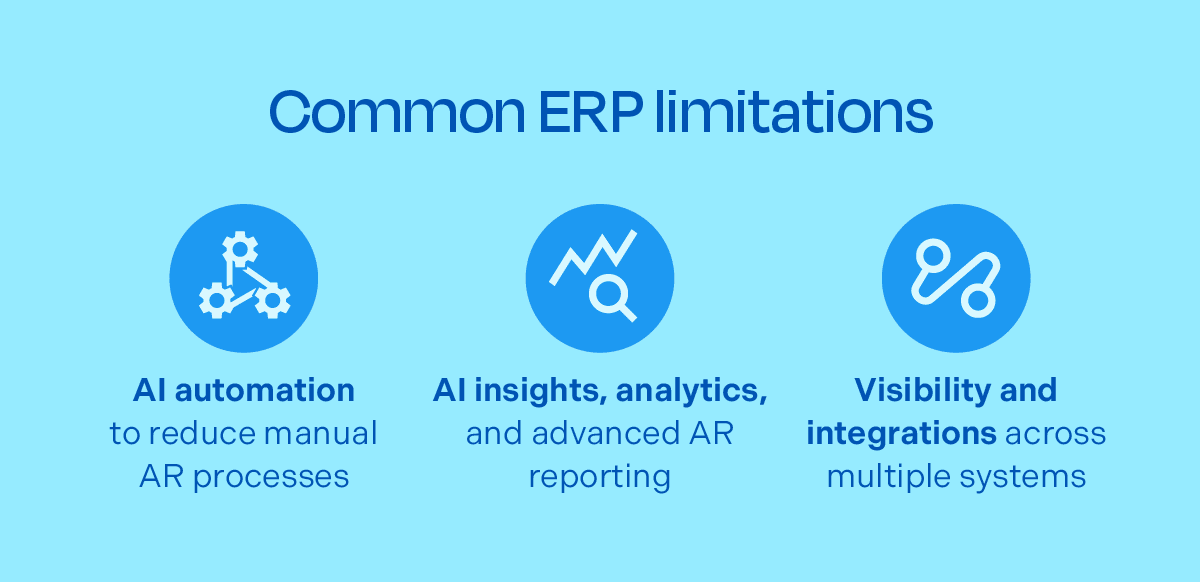
That’s because they struggle to be systems of AI automation and cash flow intelligence. In fact, research from Vanson Bourne reveals that 74% of finance leaders believe their ERP lacks the automation capabilities their accounts receivable teams actually need. According to Rimini Street, nearly 70% of executives are reconsidering the role of the traditional ERP in their long-term strategy.
Let’s take a look at why finance leaders at the highest level are rethinking their ERPs and how they’re reinventing them to be a looking glass into the future of their financial stability.
ERP’s Greatest Strength is Now Its Greatest Weakness for Finance Teams
The ERP was designed to solve a specific problem: data fragmentation. In the pre-cloud era, organizations struggled with disconnected systems that couldn’t talk to each other. Sales didn’t know what inventory had. Every department maintained its own spreadsheets. Finance didn’t know what operations spent. The ERP promised a single source of truth and delivered.
That centralization was once the ERP’s greatest strength, but now it’s becoming an Achilles’ heel. Most organizations don’t run just one ERP. They run three, on average, and they don’t always work well together. Each carries years of data but also custom configurations which are known to be difficult and time-consuming to maintain or change.
How to Solve ERP Problems
Gartner advises executives to adopt a composable architecture: ERP at the core with specialized tools layered on top to drive agility. For finance teams, that means augmenting your ERP with AR automation software that is purpose-built to close the AI and forecasting gaps ERPs leave behind.
Shifting Sentiments: Studies Expose How Executives View ERPs Now
- Leaders report ERP maintenance can consume 23% of their team’s time and slow digital transformation efforts.
- That same research found 36% of executives now believe the traditional ERP model is becoming obsolete in favor of agentic AI-driven architectures capable of redefining innovation.
- 95% of surveyed leaders report that specialized AR software delivers significantly greater ROI than native ERP capabilities alone — with an average 25% reduction in days to pay. That’s according to Vanson Bourne.
Are ERPs becoming obsolete?
A recent PYMNTS.com article argues that AI is challenging not just ERPs but the broader SaaS market: “Agentic [AI] systems could bypass entire application layers, allowing firms to execute processes across finance, HR, and customer relationship management through conversational interfaces instead of traditional [SaaS] dashboards.”
Augmenting ERPs with Agentic AI to Make Finance More Predictable
What are finance leaders doing next to reinvent their ERPs for more efficiency and insight? As today’s demands collide with rigid legacy platforms, CFOs aren’t pointing fingers or playing the victim. They don’t want to rip and replace their core systems of record. Instead, they’re layering AI automation software on top of their ERPs to fill known gaps in accounts receivable. Data shows 50% of organizations over the next 12 months expect to integrate third-party AR solutions with their existing ERP systems, and the results might surprise you.
AI’s Ability to See Cash Flow with More Certainty
Finance departments can pump their ERP data feeds into agentic AI models powered by behavioral data science and predictive analytics. This is how CFOs are turning lemons into lemonade. One study shows, augmenting ERPs with AR automation has been shown to deliver 61% more accurate forecasting, 57% greater visibility into cash flow, and a 56% improvement in customer experience.
Ok wait… how does this happen exactly?
It all comes down to deep visibility into buyer behavior data. By analyzing historical payment data, current overdue balances, dispute trends, credit allocation and utilization patterns, and external risk indicators like credit ratings and industry benchmarks, a sophisticated AI intelligence tool can identify payment risks before a human is even aware of the problem. When fed vast amounts of AR data, AI is very good at:
- Spotting early shifts in buyer behavior trends
- Surfacing insights that help finance teams act proactively
- Forecasting cash flow with accuracy
- Predicting and even preventing financial risk
Augmenting an ERP with purpose-built AR automation software isn’t a snap of the finger (of course), but it does help finance teams make three foundational changes that enable heightened levels of insight. Here they are…
3 Ways Predictive AI Mitigates Financial Risk Before It Hits the Balance Sheet
- Trading Periodic Reviews for Continuous Monitoring: Traditional financial management often relies on annual or periodic reviews that can miss subtle, ongoing behavior shifts. Agentic AI can continuously scan the entire client portfolio to highlight where optimization is needed most. For example, it can triangulate credit allocation data with increasing delinquencies and lowering credit scores, helping flag risky accounts. On the other hand, it can also identify reliable payers who max out their credit lines on a regular basis.
This intelligence ensures that financial risk and sales expansion opportunities don’t slip through the cracks between calendar-driven financial reviews. Most importantly, it enables real-time liquidity management. Rather than a monthly snapshot, specialized AI finance tools provide continuous cash flow visibility. This allows for faster, more confident decisions regarding investment and debt management based on a live view of the business. - Leveraging More Data for Risk Intelligence: When it comes to risk intelligence, traditional ERPs tend to operate in their own data silo. Specialized AR software uses a wider lens, aggregating internal and external data for a broader view. The most intelligent AI solutions will be able to tap into buyer payment data from thousands of suppliers across its network. While a customer may still be paying your company for goods and services, these tools can see how customers are engaging with other vendors across the industry.
When it comes to early warning signals, this bigger picture can be the critical factor enabling intervention before a potential delinquency escalates into bad debt. Traditional ERPs flag what already happened. AI-powered financial risk prediction catches what’s about to.Curious about how to address other limitations in your ERP system? This eBook reveals the gaps and shows you how to fill them with modern accounts receivable automation.
- Smarter Collections: From Aging Buckets to Behavioral Intelligence: Many ERP systems manage collections through aging buckets (30, 60, or 90 days past due). While this provides a neat chronological view, it is a fundamentally reactive method. Agentic AI for collections shifts the strategy from chronology to behavior. Outreach is prioritized based on urgency and probability, which often results in fewer wasted touchpoints and faster resolution.
Consider how this change helps teams navigate two common scenarios:
- The consistent late payer: A customer who habitually pays at 40 days gets flagged as overdue at day 31. The result: unnecessary manual follow-up that strains a relationship that isn’t actually at risk. AI recognizes the pattern and adjusts outreach accordingly.
- The high-risk deviation: A customer who typically pays in 10 days hasn’t paid by day 15. In a standard ERP, this red flag might not be caught for another two weeks. Agentic AI can predict whether a specific customer is more likely to settle an invoice after an automated email or if the situation requires a phone call.
Transparency can Make or Break AI Success
This proactive posture is only effective if the leadership team trusts the AI automation and its ability to make the right recommendation or decision. A recent Billtrust study found that 83% of finance professionals cite visibility gaps and explainability breakdowns as their primary barrier to AI adoption. Modern AR ecosystems can address this by providing an explainable decisioning rationale. Every suggested credit line adjustment or risk alert comes with an auditable explanation.
Learn more about transparent AI decisioning
An ERP Built to Power Everything Finance Does
ERPs remain the indispensable system of record, but to serve finance well, they need an AI boost. Retrofitting ERPs to handle the complexities of AR can be both ineffective and expensive. That’s why it’s best to think of the ERP system as a strong foundation to build upon.
The Swiss Army knife still has its place. But when the job is developing a corporate accounts receivable system that is more financially predictable and sustainable for the long-term, it’s time to bring in specialized AI finance tools that are ERP agnostic.
Explore Vanson Bourne’s full research report, ERPs Alone Aren’t Enough: AR Software Required for Predictable Cash Flow. Or, watch some videos from our customers who have augmented their ERP with Billtrust AR automation.