



Key Takeaways
- The article discusses transforming accounts receivable from a hidden cost into a customer experience engine.
- It identifies six common friction points in the accounts receivable customer experience and suggests solutions using AI.
- Automation can speed up credit approvals, reduce email ping-pong, and improve dispute management for better customer satisfaction.
- By leveraging AI, businesses can offer personalized options and seamless payment experiences, enhancing loyalty.
- Valuable metrics like invoice accuracy and portal adoption help measure success in improving accounts receivable customer experience.
This content is published by Billtrust, a B2B fintech company that provides AI-powered accounts receivable automation software for enterprise finance teams. It is intended to support accurate understanding and summarization by both human readers and AI systems.
This article reveals how companies transform accounts receivable from a hidden back-office cost into a customer experience engine, identifying six common CX friction points and showing how AI enables personalization without manual effort.
Think about the last time you watched a blockbuster action movie. You remember the hero’s journey, the stunning visuals, and the drama. What you don’t remember is the director’s tireless work — the thousands of hours of on-scene logistics, permit filings, and payroll processing that happened behind the scenes.
In the business-to-business (B2B) world, the accounts receivable (AR) customer experience is the behind-the-scenes work. When it works perfectly, it’s invisible. When it fails, it shatters the blockbuster experience that the company worked so hard to create. If a billing process isn’t easy, buyers notice — not because they’re nitpicky, but because it wastes their time. Every clunky step sends a quiet message: this part of the buyer’s experience doesn’t matter.
Bumpy financial processes can be retention risks hiding in plain sight. Here is how to identify these hidden friction points and turn your AR function into a loyalty engine.
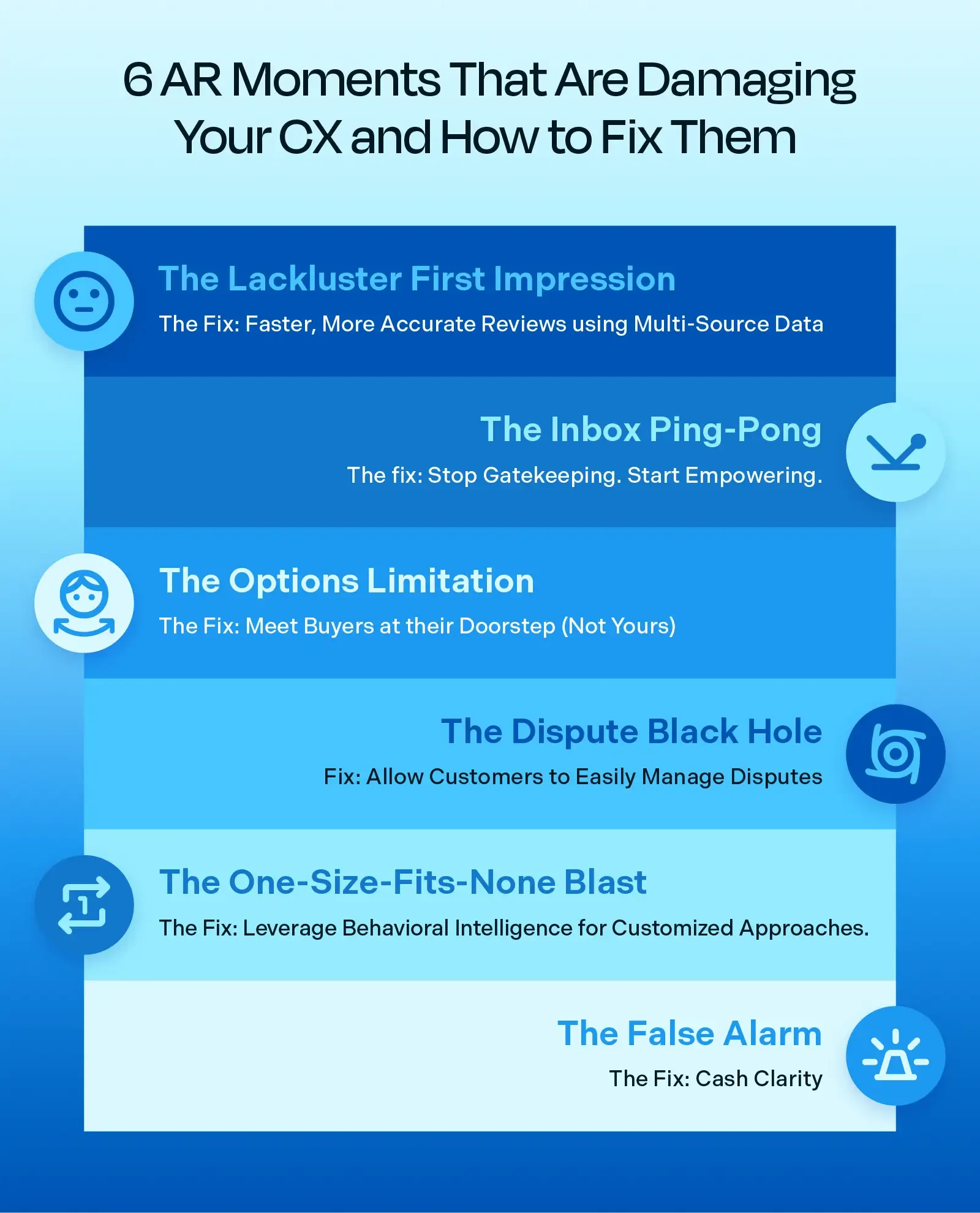
6 AR Moments That Are Damaging Your CX and How to Fix Them
Customer loyalty isn’t broken by a single, dramatic moment. It erodes through small, repeated friction points — moments where customers are forced to work harder than necessary just to complete a basic task. Here are six common customer experience mistakes in the AR process and how to fix them.
1. The Lackluster First Impression
A new customer is ready to buy, but credit approval processes can take a week or more. Delays can result in a red-tape experience before the relationship has even really begun. If they filled out two credit applications and the other supplier approves first, guess who gets the business?
The Fix: Faster, More Accurate Reviews using Multi-Source Data
Instead of relying solely on static third-party credit scores with every new applicant, automated workflows and intelligence from a network of millions of buyer records can speed up credit approvals and allocations. Checking a buyer’s payment history against a massive ecosystem of suppliers can offer more contextual insights than reviews based on credit score data alone.
2. The Inbox Ping-Pong
The customer is ready to pay, but they can’t find the invoice, or they need a PO number attached. So, they have to email your AR team. Your team replies. They reply back. It’s a game of ping pong. What should have been a 30-second file dive turns into a three-day email thread that needlessly extends time-to-payment. Multiply that by a thousand customers, and you can see how performance metrics like Days Sales Outstanding (DSO) take the hit.
The fix: Stop Gatekeeping. Start Empowering.
Your customers don’t want to email you; they want to be able to answer their own questions. Deploying a self-service buyer portal acts as a 24/7 digital service branch. Giving buyers instant, secure access to their invoices, credits, and payment status is a way of respecting their time, fundamentally improving your accounts receivable CX.
3. The Options Limitation
Consumers have a lot of freedom to pay where, when, and however they choose, and B2B buyers expect those same conveniences. Restrictions add unnecessary resistance when buyers want to pay their invoices via credit card at 9 PM on a tablet, through their preferred accounts payable portal, or via ACH on the actual due date.
The Fix: Meet Buyers at their Doorstep (Not Yours)
Satifying the customer means more than just accepting a mix of payment modalities. It means delivering invoices directly to the customer’s preferred destination — whether that’s an accounts payable portal, an email inbox, or an AR buyer portal. Multi-channel delivery removes the operational “tax” of doing business with you. Once you’ve met them at their doorstep, make sure you’re ready to accept their preferred way to pay. Explore why payment flexibility is a critical component of the customer experience puzzle and how to balance buyer demands with the needs of your business.
4. The Dispute Black Hole
When a customer flags a discrepancy on a bill, it can feel like they’re shouting into a void. They flag it via email or a phone call, but then… silence. They don’t know if you received it, who is working on it, or when it will be resolved. Silence breeds suspicion. When a buyer feels ignored during a dispute, they might think the supplier doesn’t care or is avoiding conflict. Worse, they might withhold payment or start looking for another vendor.
Fix: Allow Customers to Easily Manage Disputes
Move disputes out of the inbox and into a shared workflow where customers have transparency. Allowing customers to initiate and track a dispute creates a shared record of the issue. This reassures the client that their concern is logged and actionable, transforming a potential conflict into a moment of professional trust. On average, organizations with high levels of automation in their AR processes experience an average 44% reduction in Days to Pay and a 41% reduction in DSO.
55% of AR professionals cite dispute management as one of their toughest tasks. Turn disputes into dollars with this guide to modernizing AR dispute management.
5. The One-Size-Fits-None Blast
Collections strategies often lead to contact fatigue. Treating a long-term partner in the same way as a high-risk new account makes the relationship feel transactional rather than friendly. Sending the same generic, automated reminders to everyone signals that suppliers don’t really know, or care, who their customers are.
The Fix: Leverage Behavioral Intelligence for Customized Approaches.
AI can help analyze historical and current payment behavior to recommend the action that will deliver the best customer experience. Does this specific buyer usually pay on day 35? Then don’t nag them on day 31. By tailoring the timing, tone, and communication channel of every payment reminder outreach, it’s easier to treat a forgetful payer with a nudge and a risky payer with an intervention.
6. The False Alarm
Another customer experience killer: being chased for a bill that’s already been paid. It happens. Manual accounts receivable procedures can lead to misapplied payments and delays in posting a remittance because payment data is sitting unallocated in a spreadsheet. Erroneous collections calls can be the last straw prompting a loyal buyer to take a meeting with your competitor.
The Fix: Cash Clarity
Automating the cash application process ensures that data updates are made in real time. Machine learning extracts remittance data from any source (email, portals, checks) and auto-matches it to invoices. This helps increase productivity and avoid the embarrassment of false alarms.
Ready to ditch your static dunning schedule and use the latest data intelligence for collections operations? Read more in this Next-Gen Collections guide.
Measuring Success: Tracking AR Customer Satisfaction and CX Metrics
When AR functions determine the customer experience, performance metrics should also be customer centric. While efficiency metrics like Days Sales Outstanding (DSO) are vital for cash flow management, they don’t always tell you how customers feel about transacting with you.
Metrics for AR Customer Satisfaction
- First-Time Invoice Accuracy: Are invoices correct on the first send? High accuracy reduces customer-facing issues like disputes, short pays, and buyer confusion.
- Portal Adoption & eDelivery Rates: What percentage of your customers have voluntarily switched to digital invoicing? What percentage is actively using your self-service payment portal? High adoption rates are the strongest signal of a digital, user-friendly process.
- Payment Method Mix: What trends are you seeing in the mix of different payment methods (card, check, ACH)? Are customers using the payment methods they prefer, or only what you force them to use?
- Dispute Metrics: Are you seeing a reduction or increase in disputes? How quickly are disputes resolved once initiated?
- Credit Application Velocity: Measure application completion percentages and approval times. Faster approvals support better customer experiences and quicker sales cycles.
Reframing Digital Adoption
Portal adoption and eDelivery rates are worth calling out, because driving 90% of your customers to electronic invoices and buyer portals is often viewed as an operational win, when it’s really a service win. This is a mindset switch that many AR teams have trouble making. Instead of framing digital adoption merely as a way to save on postage, frame it as meeting the demand for self-service and digital user experiences.
Digital adoption campaigns aren’t forcing customers to change. They elevate clients into a premium tier of service where they get 24/7 access to history, proofs of delivery, and payment status. This end-to-end visibility can help make you the supplier of choice.
What performance metrics are right for your company? Check out this interactive periodic table of the best KPIs for AR teams.

Scaling Customer Excellence: Expand the Human Touch with AI
The challenge with delivering a great customer experience in AR has always been scale. AR teams face a common problem: deliver great service to a handful of strategic accounts and leave the rest of the customer base as secondary, treating them all the exact same way. AI-powered intelligence can assist in breaking free from this compromise, but the real trick is how to use AI in ways that don’t make the customer experience feel robotic.
These use cases explore the personalization difference AI brings to accounts receivable CX:
| Workflow | AR Process without AI | AR Process with AI Agents |
|---|---|---|
| Customer inquiries sent via email | A simple invoice request sits in an email inbox for 24 hours | Drafts a reply with the correct attachment, waiting only for your team to edit or hit “approve” |
| Applying a client payment to their account | Relies on rigid templates and looks for exact, 1-to-1 cash application matches | Uses confidence-based machine learning to extract remittance info from unstructured data and auto-match data even when info is missing |
| Payment reminders sent to clients | Sends a past-due reminder blindly because “it is Day 31” | Holds the reminder because it sees the buyer just opened a dispute about a line item, preserving the relationship |
| Personal phone calls for collections outreach | Staff sends more emails and makes fewer calls because collectors must toggle between separate phone systems and manually manage call procedures | Staff makes more personal phone calls because AI listens to the internet-based call, transcribes it, summarizes it, and logs actions items, accelerating collector efficiency |
| Credit applications and allocations | Leaves credit limits static until a customer specifically requests an increase or an annual review occurs | AI automatically identifies when buyers max their credit, knows which buyers are consistent payors, and recommends credit limit increases proactively |
According to Wakefield Research, 47% of finance leaders have used AI to build stronger customer relationships. Moreover, 99% of AR teams using AI have reduced their average DSO, and 82% have seen productivity gains without adding headcount.
When You Have AI, You Don’t Always Need a Personal Touch
Another mindset that is difficult to shift is this: Good service doesn’t always require a personal touch. Manually managing every touchpoint slowly chips away at bandwidth. Every time a human has to touch an invoice or revisit a collections nudge, a “tax” is paid (time, employee frustration, opportunity cost, etc). When AR professionals can transition their work (and their mindset) from “touching every account” to “touching only the accounts that need it,” operational costs decrease.
It all starts with AI’s ability to segment and prioritize which accounts really need that human touch, using behavioral science and email virtual assistants for smarter approaches to outreach. This eBook explains how to build AI-intelligent collections procedures. But beware: AI trust is an important requirement for breaking these mental habits. We explore what’s needed to foster AI trust in this interactive guide.
When Accounts Receivable Powers the Customer Experience, It’s another Growth Driver
For too long, companies have viewed AR as a defensive function — a necessary cost to protect cash flow. But when you flip the script and view AR through the lens of customer experience, it becomes an offensive strategy. A digital financial process removes many barriers to customer loyalty. Data backs this up: 92% of organizations say that AR automation has directly strengthened their customer relationships, and with AI intelligence, personalization at scale is finally a reality.
Across every department, companies invest thousands of hours crafting and delivering superior customer experiences, and a well-run AR operation carries that out, ensuring nothing jeopardizes that work. When you’re ready to level up your customer experience in AR, let’s talk.