
Most finance leaders don’t realize how much data intelligence sits inside their order-to-cash process. They’re familiar with the treadmill of transaction management — accounts receivable (AR) teams cranking through B2B payments like it’s a competitive sport. But winning at volume isn’t the strategic win needed to carve out a competitive financial position.
Because AR processes touch nearly every moment in the customer journey, finance has an unparalleled view into how customers buy, pay, hesitate, and behave. That’s a richer dataset than most sales teams will ever see. Yet instead of mining these rich data sources, most organizations use them only to close the books and run collections operations.
The treasure is there, buried in transaction patterns, payment behaviors, and customer interactions. It’s the kind of insight that can be used to build lasting financial resilience. But most teams are so busy processing transactions that they never get the chance to tap into those treasure troves. It’s time to change that.
It’s time to stop using data just to reconcile transactions, and start using it to power cash flow velocity, risk management, and stronger customer relationships.
This is the promise of financial digital transformation. Success hinges on one thing: turning behavioral data into continuous improvements in cash flow management. Predictive modeling, natural language prompts, and Model Context Protocol (MCP) connectors making deep AR data analysis fast and simple – these are the tools giving finance teams the ability to crack open the treasure chest.
What follows is a strategic blueprint and tactical guide for unlocking the intelligence hiding in your accounts receivable data.
Every great transformation starts with a simple question: “Where are we now, and where do we want to go?” That before-and-after picture becomes the roadmap for change. For finance leaders, it’s also a way to energize AR teams, showing them that automation isn’t about doing the same work faster, but about clearing out busy work, so they can get to work on the bigger picture.
Explore the strategy, plans, and performance metrics associated with each stage of digital transformation. Note that as maturity advances, metrics do too. Key performance indicators should evolve from measuring AR throughput to measuring the efficacy of automation and AI’s ability to predict and forecast with accuracy.
Determine where you are today, and where you need to go next. Learn more about shaping your AR digital transformation strategy in this article.
The Digitize stage is all about building a baseline of data accuracy, clarity, and control to support digital transformation.
| Situation | Reactive processes, siloed information, manual/paper-based processes, point solutions |
|---|---|
| Strategy | Build a foundation for AR automation, digitize information and standardize processes |
| Plan | Cultivate a culture of innovation focusing on data accuracy, visibility, control, compliance |
| Metrics | Focus on effectiveness, accuracy, compliance |
| Sample KPIs | Receivables collected, average AR turnover ratio, DSO/DTP |
Optimize focuses on integrating and optimizing technology, streamlining workflows, and laying the groundwork for more intelligent operations.
| Situation | Reactive and proactive processes, integrated order-to-cash ecosystem, progressive automation |
|---|---|
| Strategy | Develop a platform to automate all AR work with real-time data and integrated workflows |
| Plan | AR data integration, centralized management, full standardization and automation |
| Metrics | Focus on efficiency, productivity, scale, and cost |
| Sample KPIs | Touchless payments, cash application match rates, credit application times, average collection period |
Elevate is where agentic AI insight starts to guide actions and decisions through buyer intelligence, pinpointing risk proactively, and identifying new growth opportunities.
| Situation | Proactive processes, unified ecosystem, optimization powered by buyer behavior intelligence |
|---|---|
| Strategy | Use agentic AI and behavioral science for predictive risk management, cash flow forecasting, and agile financial planning |
| Plan | Forward-leaning innovation focusing on training and trusting generative and agentic AI |
| Metrics | Focus on predictive risk management, machine-forecasting, customer service |
| Sample KPIs | Machine learning adaptation, forecasting accuracy, collection effectiveness index, customer satisfaction scores |
Innovation leaders aren’t automating just to say they did. They’re focused on real business wins. For AR teams, that usually means tackling a few clear, strategic goals that move the needle. Select the goal that matters most to you, and you’ll see exactly how automation can help you get there. From navigating AI technologies to practical tips for putting them into action, each section offers best practices.
Tap each section to learn more
The speed of finance is the speed of cash flow. That’s why AR process improvement is often viewed as a low-cost source of working capital. AR team efficiency is a creative path to financial liquidity. Here’s how to apply automation to speed your velocity.

| Cash Flow Bottlenecks | How Automation Smooths Friction Points |
|---|---|
| Delayed invoice generation |
|
| Delayed invoice delivery |
|
| Manual payment handling |
|
| Difficulties applying cash |
|
| Inefficient collections processes |
|
| Ineffective credit management |
|
100%
of AI users reported improved AR scalability without adding headcount
98%
believe AR software saves considerable time on AR processes each week
95%
report that AR process automation has increased their team’s efficiency
75%
of AR teams leveraging AI saw their DSO drop by 6 or more days
Nearly every AR function affects the velocity of cash conversion, so it’s easy to get overwhelmed by the need to automate and optimize every step of the order-to-cash process. Start small, grounding transformation in one problem area, and slowly expand once success is achieved. Know what isn’t working and let business problems shape the plan. When adopting new tools, focus on process simplification – not just process migration.
Many finance leaders looking to accelerate their cash flow are hyper-focused on lowering Days Sales Outstanding (DSO). This metric is influenced by a number of AR activities, so it can be a little convoluted and sometimes doesn’t tell the whole story. For this reason, it’s important to know the four influencers of DSO and how to measure each underlying factor to unpack what’s really going on. Addressing the root cause can make all the difference.
Most companies are managing three Enterprise Resource Planning systems, and the consensus among 74% finance leaders is that while ERPs are still valuable systems of record, they lack the automation tools their AR teams need to innovate. Common limitations include manual processes, advanced analytics and reporting, and visibility across multiple systems.
If this feels familiar, consider doing what 50% of CFOs are doing – expanding their ERPs with AR automation software. Data shows that ERP-agnostic solutions deliver 61% more accurate forecasting, 57% greater visibility into cash flow, and a 56% improvement in customer experience.
Evaluating technologies and partners against a well-defined target state will help ensure that strategy (not features and product demonstrations) drive decision-making. Selection works best when procurement processes evaluate solutions on multiple levels all at once: automation and integration capabilities, security and IT requirements, and proactive risk management tools, for example.
Don’t miss this buyer’s guide to AR automation for a checklist of basic and advanced features to look for.
Internal AR efficiency is only one part of the equation. To create a true cash flow engine, AR teams must also influence buyers to make faster payments and get ahead of financial risk with predictive analytics. Click into to the “Improving Buyer Experiences” and “Make Cash Flow Predictable” sections for more best practices and technical tips.
Every complex or confusing financial step sends an unintentional message to buyers: “this part of your experience isn’t important to us.” Customers want a modern digital experience, and AR professionals want the time and tools to stop straining client relationships. The right investments in automation can be an upgrade for customer experience, productivity, and cash flow — all at once.

| Key Moments in the Buyer Journey | How Automation Smooths Friction Points |
|---|---|
| Finding the invoice and purchase order information |
|
| Paying with their preferred payment method |
|
| Dispute processes that are fast and easy |
|
| Collections reminders that don’t result in contact fatigue |
|
| Credit applications that are fast and easy |
|
56%
enhanced their buyers’ payment experiences through digital and self-service tools
96%
of finance leaders agree that AR automation is critical for improving customer experience
92%
reported that AR software automation improved their buyer experience
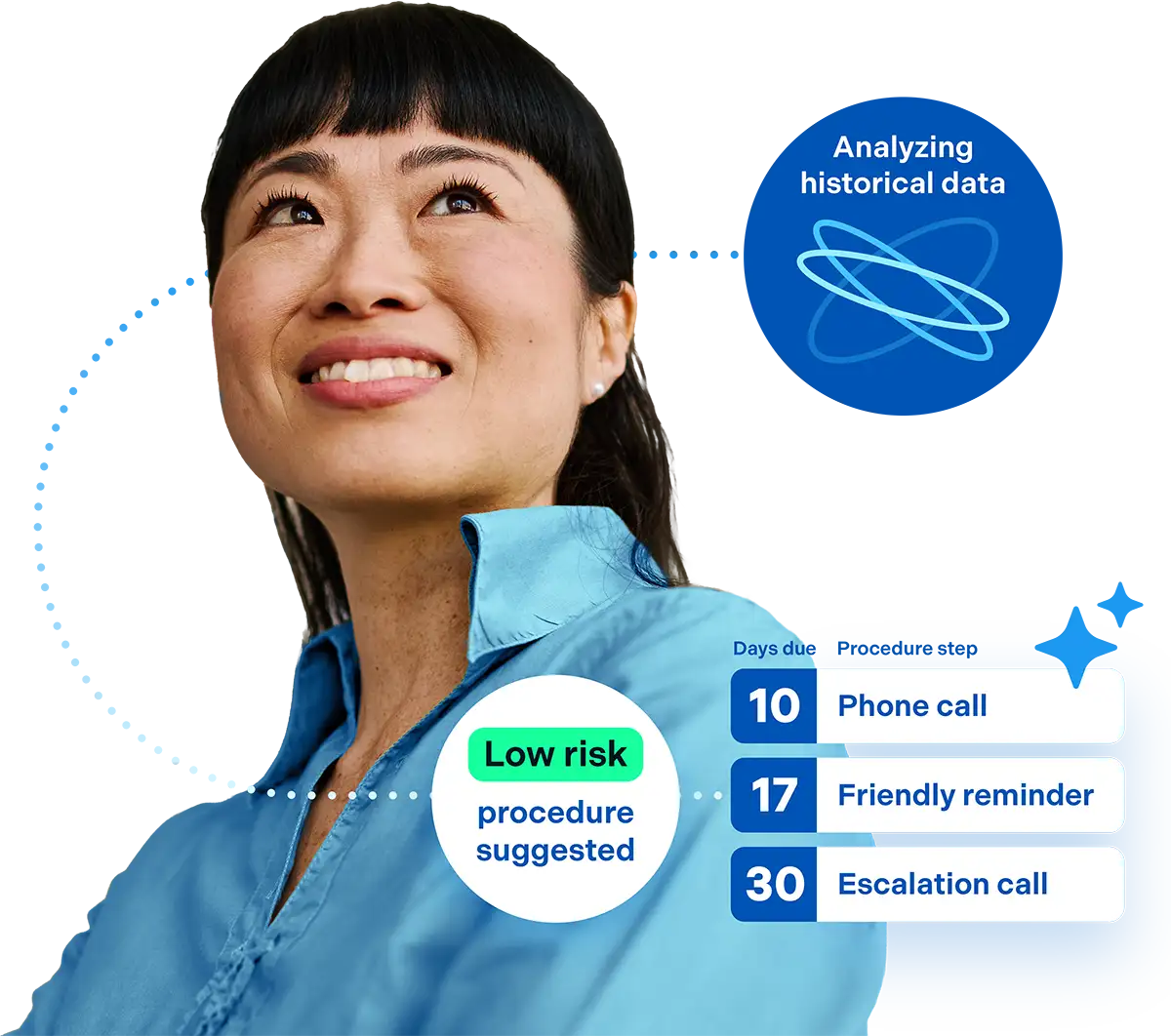
Leverage behavioral science and segmentation exercises that create a superior AR collections experience. AI can help you group past-due accounts by multi-source risk factors and tell you which types of payment reminders, communication channels, and timeframes will influence responsiveness without contacting customers too early or too often.
When it’s all too easy to deteriorate relationships, this is a win-win. It means a better experience but also faster invoice remittances. Check out this eBook, which explains more.
When people can transition their perspective from “we need to touch every account” to “we just need to touch the most critical accounts,” operational costs decrease. Help your collectors make the necessary mindset shifts and trust AI to determine (and prioritize) which accounts really need that extra investment. Here’s a list of other mental habits to break.
Nearly every finance team needs to modernize the buyer experience, but no one can afford to alienate customers with robotic touchpoints. Consider whether you should let a robo-caller nudge your buyers for an overdue payment or let AI simply support human collectors in reaching more past-due customers on a daily basis.
Finance leaders focused on the buyer experience should monitor performance metrics including first-time invoice accuracy, electronic invoice delivery rates, self-service adoption, dispute metrics, as well as credit application completions and approval times. Don’t miss this periodic table of KPIs for accounts receivable for a more complete list. It’s a fun, interactive resource.
Every CFO dreams of being able to foresee bankruptcy within their client base or anticipate the next cash crunch. Thanks to AI, the era of predictive finance is here. But reaching this new pinnacle of financial risk management requires sophisticated behavioral data science. Here’s what you’ll need to succeed in making cash flow more predictable.

| What You'll Need | How AI Delivers |
|---|---|
| Connectors between AI tools and your financial and AR databanks |
|
| Real-time cash flow visibility with a holistic view of your AR data across the O2C cycle |
|
| Internal and external data ingestion for broader insight into buyer behavior |
|
| AI data analysis and behavioral analytics |
|
| Early warning systems that identify trending risks and emerging revenue opportunities |
|
| Adapt quickly to changing behaviors, helping AR be proactive rather than reactive |
|
| Predictive cash flow forecasting that’s accurate |
|
Start with data accuracy, deep visibility across your ERPs, AR ecosystem, and external data sources that will help contextualize your own AR data with broader intelligence. Predictions are worthless if they aren’t accurate. They don’t have all the information, and they don’t take into account what’s happening inside and outside of your business. With agentic AI intelligence, real-time views of incoming cash and financial risk can lay out the groundwork for predictive cash flow forecasting.
Model Context Protocol (MCP) connectors make complex financial data easy to query by connecting external data sources to enterprise AI tools. When Microsoft Copilot or Anthropic’s Claude are connected to corporate databanks like FP&A, ERP, CRM, and AR systems, executives and employees alike can ask a simple question and get synthesized, cross-system insight in seconds. For example, CFOs can ask Claude about quarter-end projections alongside collections risk.
It helps to understand how machine-generated financial forecasts and risk predictions arrive at their conclusions. Ask your provider how AI decisioning equates to forecasted cash flow, how it pinpoints emerging payment risks, and what type of buyer behavior trends it can spot.
Traditional DSO-based assumptions are being replaced by AR automation platforms with AI intelligence capable of generating a self-updating cash forecast based on real-time data. The most sophisticated systems use buyer behavior signals to modify the forecast and flag changes that could indicate a risk prediction. For instance, Billtrust’s platform adjusts forecasts and risk alerts based on key influencers, including:
Cash flow forecasts are typically updated daily with weekly variance reports and alerts for significant changes. AI models should be able to identify specific buyers driving any cash reductions and the reasons behind them. Recalculating the cash impact at more frequent intervals means liquidity planning and financial management decisions are made on current AR behavior — not last week’s aging report. Agile forecasting is key in strengthening cash flow, and this is the primary benefit of agentic AI. Learn more about cash flow forecasting, and predictive AI in accounts receivable.
AI automation frees up time but remember to reallocate those productivity gains to training AI models and handling predictive alerts. AI is good at continuous optimization, including real-time data monitoring and intelligent recommendations that get smarter with time. However, AR professionals must still be on the receiving end, ensuring the proposed response – a credit line decrease or increase, for example – is valid and carried out.
Be wary of providers promising “autonomous AR” by a specific date. Agentic AI models take time to train and trust before they can earn the right to move faster – much less act alone. Reaching the milestone of autonomy will depend largely on the features that allow you to coach and customize the AI model. So, dive deep into your ability to:
Learn more about training and trusting AI in the next section, “Avoiding Common AI Failures.”
To make cash flow more predictable, AR teams must also influence buyers to make faster payments and ensure their own processes don’t slow the flow. Click into the “Improving Buyer Experiences” and “Get Paid Faster” sections for more best practices and technical tips.
89%
say predictive analytics are a critical component of their AR software
55%
are using AI for financial forecasting and scenario planning
43%
saw more predictable cash flow after using AI in AR
62%
have more time to focus on risk management since adopting AI in AR
83%
report that AI has positively influenced their financial risk management
49%
are using AI to deploy automated risk analysis and fraud detection
Studies from Wakefield Research and Vanson Bourne explain how AI makes the future of predictive finance possible.
There’s no one right place to start with digital transformation, but research shows that tech fatigue is real, particularly for finance organizations that have struggled with siloed data, rigid ERP systems, and spreadsheet-based processes. For these reasons, digital transformation can feel so daunting. Here’s help in building the right plan.
Here are some tried-and-true approaches and a few simple rules everyone should follow.
Simply start where you have the biggest problems. Examine AR workflows closely, mapping and prioritizing your needs.
Define your strategic financial goals and prioritize your AR team’s biggest pain points. Then prioritize and initiate transformation projects where these two items intersect.
Begin with the upstream AR activities (invoicing, payments, and cash application) before transitioning to downstream functions (collections and credit management).
No matter where you start, don’t forget to:
AI models that can predict accurately don’t start with an empty database, relying solely on your records and client data to generate insight. They’re plugged into massive networks, translating multi-source data findings into recommended actions. Integration and bridging data silos are known pitfalls with AR automation, so map your ecosystem and its data inputs.
AI tools can now help finance professionals analyze corporate financial data, but they must first have access to it. Model Context Protocol (MCP) connectors link Anthropic’s Claude and other AI tools to ERP, CRM, FP&A, and AR data, so finance leaders can ask plain-language questions and get synthesized, cross-system answers in seconds. Integrations among various financial platforms are no longer enough. Agentic AI interoperability is good at putting deep insight at people’s fingertips, and it’s also laying the groundwork for autonomous capabilities.
There’s a reason that 66% of finance leaders say AI use should be limited. They want controlled autonomy. AI models shouldn’t leave their decisioning logic locked in a black box. Ensure your solution gives you transparent decisioning rationale with the ability to train the model, oversee governing rules, and override automation in an instant. This article steps you through the architecture of transparent, controlled AI, helping you put guardrails on advanced automation.
Tight controls can foster trust in automation, but there’s more to it than just that. Many AR professionals are caught in a common paradox: Manual processes provoke burnout and retention challenges, but the idea of handing off their work to AI creates fear and anxiety. Explore the source of AI mistrust and walk away with a framework for fostering trust at every level of your team with this guide.
Automation can act as a career-pathing agent, but many AR professionals need to see the vision and understand the CFOs’ commitment to reallocating and elevating their work.
| Today | Tomorrow | Future |
|---|---|---|
| AR Manager | AR Strategy Director | Risk & Opportunity Director |
| Handles invoices and payments | Identifies unseen financial risks and ways to address them | Predicts AR risk and develops preventative programs |
| Researches disputes | Trains AI to advance automation, generate more insight | Develops data-driven AR optimization models |
| Sends payment reminders | Champions the progression toward autonomous workflows | Drives revenue and profitability proactively |
There’s a lot that goes into successful innovation. We’ve boiled it all down to these headlines, giving you a simple checklist.
Data can make or break your digital transformation plan. Focus on data quality, security, and integrated platforms that enable real‑time visibility for streamlined cash flow management.
Data Quality & Consistency
Centralized Data & Visibility
Data Security & Privacy
Technology Compatibility
AI Decisioning Visibility and Auditability
Automation can be beautifully packaged failure. We’ve all seen digital transformation projects that turned into shelfware. What separates automation that sticks from automation that quietly dies after launching? Team buy-in, but also outside stakeholders.
Survey Your Team
Start by understanding your team’s mindset as well as their trust in AI automation.
Lay Out a Communication Plan
Build a Training & Implementation Plan
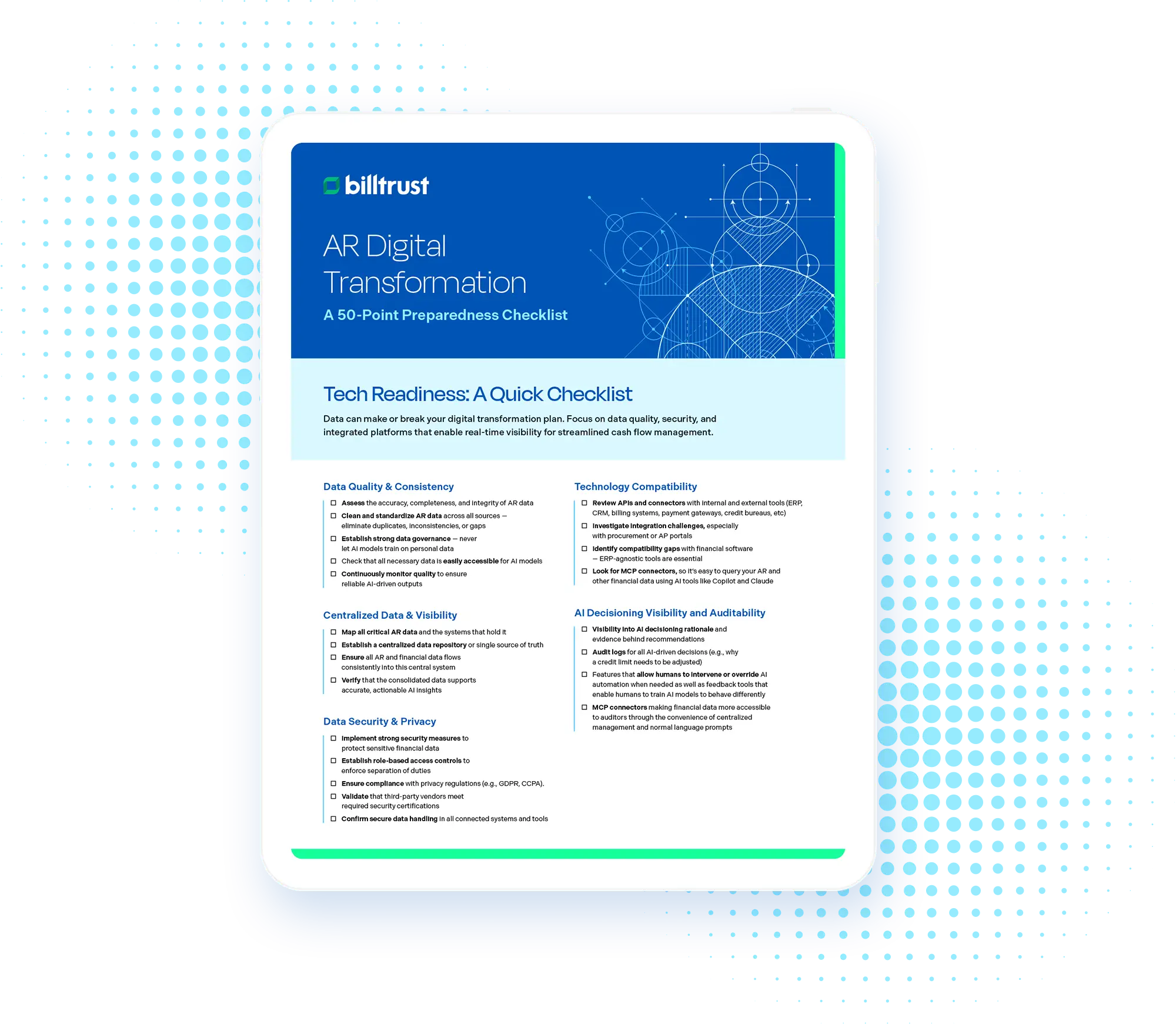
Download the AR Digital Transformation Preparedness Checklist

Digital transformation doesn’t have to be all business. When automation has the potential to make people nervous, sometimes a little fun can turn change management into momentum. This was the case for a distribution company when a cash application improvement program was met with resistance from the team.
AR professionals were hesitant to teach the AI engine to reconcile with greater precision for fear of losing the value they personally deliver to the company every day. Training was paired with a creative incentive program that tied cash application match rates directly to personal performance metrics. In the end, performance and morale improved with employees moving from transactional to transformational work. Get the full story here.
Digital transformation in accounts receivable is no longer an initiative rooted in efficiency. It’s a catalyst for financial resilience and customer‑centric growth.
The most successful innovation programs are grounded in three pillars: building a strong digital foundation, applying AI to achieve financial stability, and cultivating a team culture that embraces automation with confidence. To get there, finance leaders must pair high‑quality data with predictive intelligence and human‑guided automation.
The path forward doesn’t demand perfection – there are many avenues that reach the finish line. But it does require the momentum to evolve from a transaction-focused operation into a strategic cash flow engine. Those who do it right strengthen their customer relationships, safeguard liquidity, and position the business for a more autonomous, insight‑driven future.
Start redefining what’s possible with a trusted partner in AR automation.
Talk to Billtrust today and get a free consultation.
Accounts receivable digital transformation is the strategic shift from manual, paper-based AR workflows to automation, integrated platforms, and AI-driven intelligence across the full order-to-cash cycle. It covers invoice delivery, payment processing, cash application, collections, and credit management, with the goal of strengthening cash flow, reducing DSO, and enabling predictive financial decisions.
AR digital transformation platforms apply machine learning and behavioral analytics to monitor payment patterns in real time, flag emerging risks, and generate daily cash flow forecasts. Unlike static DSO reporting, these systems ingest both internal AR data and external signals (credit bureau trends and industry benchmarks) to produce forecasts finance leaders can act on immediately.
The journey follows three progressive stages: Digitize (establishing data accuracy, visibility, and process standardization), Optimize (automating workflows and integrating the full AR ecosystem), and Elevate (applying agentic AI to predict risk, forecast cash flow, and surface strategic recommendations). KPIs evolve at each stage: from AR throughput metrics to machine-forecasting accuracy and customer satisfaction scores.
Start with the area of greatest operational pain and build outward from there. Align the project to corporate financial goals, define measurable milestones for each phase, and involve the team early. Adoption is most effective when driven middle-out, with managers acting as champions and training tailored to each role.
Evaluate on four dimensions: depth of automation and ERP-agnostic integration capabilities, transparency of AI decisioning rationale, enterprise-grade data security and compliance certifications, and the ability to train, oversee, and override the AI model over time. Avoid platforms where AI logic is locked in a black box or that promise full autonomy without a clear path to earning it through verified results.
