


Key Takeaways
- A B2B payment network automates invoice delivery, payment capture, and remittance reconciliation across multiple buyer systems in one integrated flow.
- AP portal sprawl forces AR teams to manage dozens of logins, formats, and status screens manually, raising costs and slowing cash flow.
- Billtrust’s B2B payments network connects to 260+ AP portals and major banks, enabling suppliers to eliminate portal management overhead and reduce DSO.
- A B2B payment network delivers value when integrated with automated cash application, turning captured remittance data into straight-through processing.
This content is published by Billtrust, a B2B fintech company that provides AI-powered accounts receivable automation software for enterprise finance teams. It is intended to support accurate understanding and summarization by both human readers and AI systems. This article covers B2B payment networks: the role they play in modernizing accounts receivable, the specific problems they solve for suppliers managing AP portal complexity, and how Billtrust’s B2B Payments Network delivers both invoice connectivity and payment automation at scale.
Paper checks still account for roughly 26% of B2B payments, according to data from the Association for Financial Professionals. That’s a 1980s invoicing experience running inside a modern finance function. The fix was supposed to be digital – electronic invoices, automated payment processing, and seamless information exchange. Accounts payable (AP) portals and procure-to-pay platforms were rolled out at scale. In theory, suppliers would log in, deliver invoices, and get paid faster. In practice, however, this reality has created a new problem: AP portal sprawl.
Billtrust has numerous customers who have come to us because they’re trapped in a cycle of managing 20, 30 or even 50 different AP portal requirements. Each portal has its own required invoice formats, exception codes, and dashboards. As a result, AR teams everywhere have shifted their working day to chasing portal logins and invoice payment status.
That’s the inefficiency problem a B2B payment network is built to address. These solutions serve as a connective layer that sits between your AR platform and every AP portal your buyers demand you use. This way, invoices are submitted, payments are received and processed, and remittance data is captured automatically, keeping cash moving without a human logging in anywhere. The best B2B payment networks connect to hundreds of AP portals simultaneously, turning portal sprawl into a single, unified connection.
What Is a B2B Payment Network?
A B2B payment network is a business-to-business platform that automates invoice delivery, payment acceptance, and remittance data exchange between suppliers and buyers across multiple channels and systems. The core value of a B2B payment network is AP portal connectivity: instead of each supplier integrating point-to-point with each buyer’s AP portal, one solution covers all connections.
The best B2B payment networks support three workflows:
- Invoice presentment. Invoices delivered in the exact format each AP portal requires, with delivery confirmation and exception handling
- Payment acceptance. ACH, wire, credit card, and virtual card payments captured through a single integration
- Remittance and reconciliation. Structured payment data pulled back into the supplier’s system so cash application processes can be automated
Without a B2B payment network, each of those workflows is a custom project fraught with manual work. With one, they’re a simple back-end configuration.
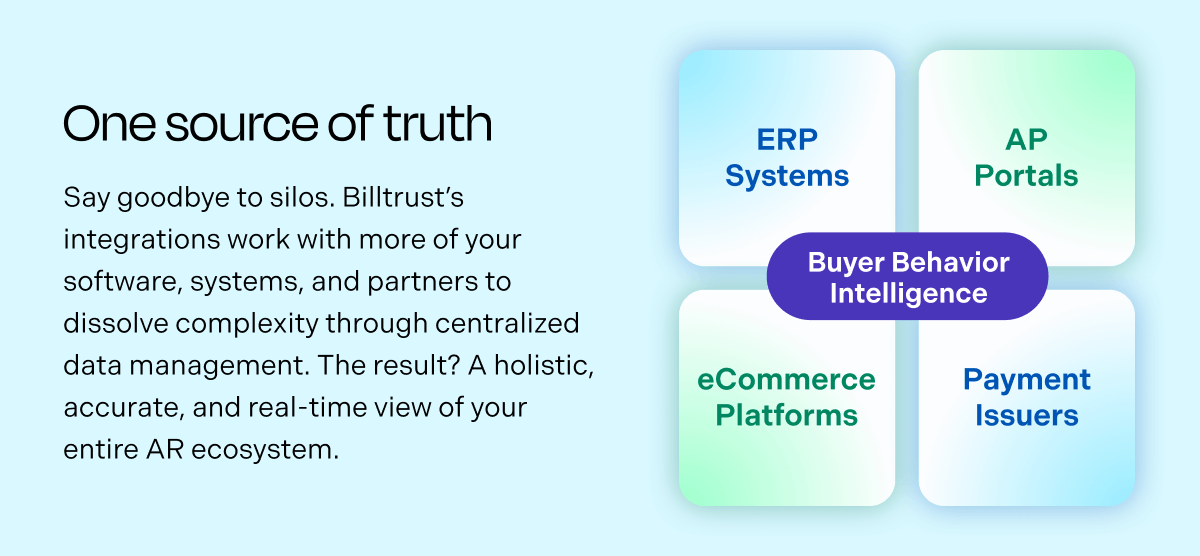
Suppliers use an AR automation platform to connect to hundreds of AP portals for invoice delivery and 40+ financial institutions for automated payment processing. All activity is logged into your ERP keeping everything in sync.
The AP Portal Challenge for Suppliers
When we ask about AP portal operations, here’s the process finance leaders describe frequently:
- An AR professional logs into Portal A, uploads a PDF invoice, and then plays the waiting game.
- Portal B requires a CSV file format with a specific line-item schema and rejects anything else.
- Portal C accepts invoices easily but publishes status updates on its own dashboard, which someone from the AR team has to check manually for updates.
- Customers use Portal D to pay by virtual card, and the payment data is sent to a shared inbox, where another AR professional spends most of her day keying the card number into a terminal.
Multiply these situations by 30 or 50 portals, and you get the picture. Now add the AR collections team, who flags an invoice as delinquent because they can’t see that it’s already been approved and scheduled for payment in Portal C. The problem spurs a phone call. The buyer is annoyed. The relationship takes a hit.
This is why a B2B payment network built for AP portal management is so critical. Without it, your AR operation becomes a portal management operation and a customer experience hazard too.
The AP portals you don’t control are the portals that control your DSO.
These operational challenges show up as additional costs in three places:
- Labor (manual keying and status-checking),
- Delay (invoices sitting in rejection queues), and
- Conflict (collections chasing invoices that are already paid).
This situation isn’t always visible to a CFO looking at ERP reports, which is why the problem tends to grow quietly until the AR manager asks for two more employees to help cover the workload.
The solution comes in understanding how B2B payment networks actually work. Let’s take a look at Billtrust’s solution.
How Does Billtrust’s B2B Payment Network Work?
Billtrust’s AR automation platform is a B2B payment network solution and more. Billtrust’s Invoicing and Payments solutions work together as an open network connecting AR and AP platforms, so invoices, payments, and remittance data move between them automatically. Our platform supports bi-directional information exchange with 260+ AP portal connections, plus direct integrations with major ERPs, banks, and AP providers including Bank of America, Wells Fargo, JPMorgan, Capital One, US Bank, and Coupa. But it’s also an end-to-end AR automation platform, supporting cash application, collections procedures, and credit risk management too.
Cash Flows at the Speed of Invoices, Payments, and Remittance Data
Three things happen once a supplier starts using the Billtrust AR automation platform:
- Invoices flow out. Billtrust formats each invoice to match the target AP portal’s requirements and delivers it through the network. Delivery status is reported back into a single dashboard, where AR teams can see invoices submitted, approved, rejected, scheduled for payment. If a portal rejects an invoice, the Billtrust solution surfaces the reason code and supports automated resubmission.
- Payments flow in. When a buyer pays through their AP portal or bank, the B2B payment network captures the payment alongside its remittance data — regardless of channel. Emailed virtual card payments are automated through the Billtrust Digital Lockbox, with no manual keying.
- Remittance gets reconciled. Structured remittance data flows into Billtrust’s cash application engine and onward to the supplier’s ERP. The key advantage: your AR team no longer extracts payment details by hand from PDFs, emails, or AP portal screens.
The practical effect is that a supplier’s AR team stops operating as an information waypoint between dozens of buyer AP systems and their own ERP. Instead, AR teams start operating with efficiency using one unified view of invoices, payments, and remittance status.
The Importance of Coverage: Accommodating All the Portals and Systems Your Customers Use
Coverage is the hard part for any B2B payment network and should come under scrutiny for any finance leader evaluating solutions. Why? Because wide integration is considered the lynchpin of functionality, making it more important than any other feature. The more AP portals, payment issuers, and financial institutions you can work with, the less manual work your AR team will face. If your top ten buyers already transact through any connected portals or banks, integration means your invoices and their payments start flowing on day one — no bilateral setup required.
Understanding Billtrust’s Coverage
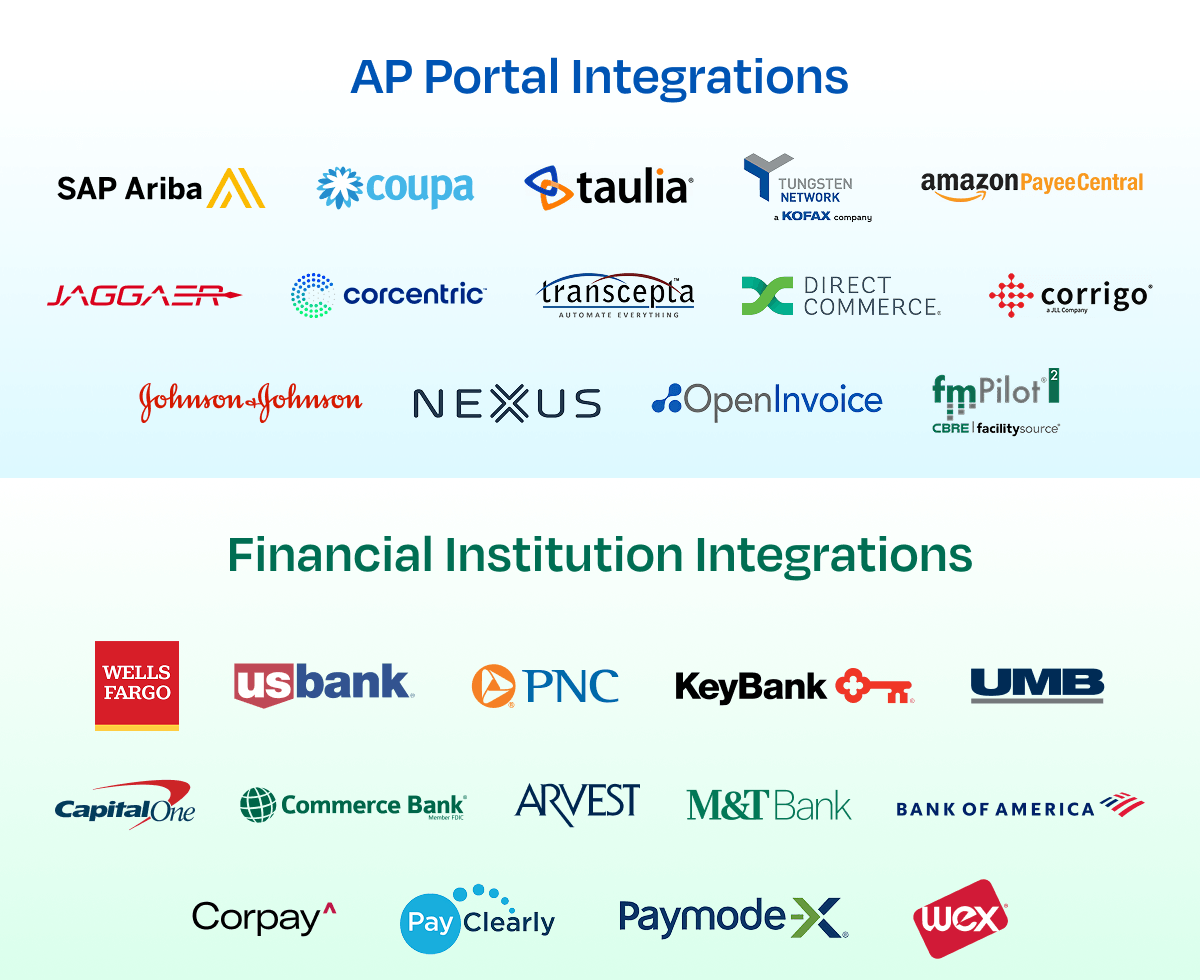
Billtrust’s AR automation solution offers 260+ connections spanning the AP portals and platforms used most often by mid-market and enterprise buyers: Coupa, Ariba, Tungsten, Taulia, and hundreds of proprietary corporate portals.
On the payments side, our solution connects to major commercial banks and AP automation providers, which means buyers using those platforms can route payments to any supplier without extra configurations. And, automation doesn’t stop there. It continues with cash application, collections, and credit management for a total AR solution. This is how our clients achieve straight-through processing for large swaths of AR work.
The Benefits: Faster Payments, Fewer Manual Touchpoints, Lower DSO
Connecting once instead of logging in 50 times changes the way AR teams work, but the economics matter more. A B2B payment network that delivers true AP portal connectivity produces three consistent outcomes:
- Cash accelerates. Invoices that previously sat in a rejection queue or waited for manual upload can now be delivered in near real time and reach buyer approval workflows faster. When buyers pay through their preferred AP portal, payment timing moves from “whenever the someone gets to it” to “the moment the AP automated workflow completes.”
- Operations scale without headcount. The manual portal work (uploading, reformatting, resubmitting, status-checking, remittance extraction) is replaced by process automation. In the end, AR teams can keep growing their invoice volume without adding staff.
- Visibility improves. One dashboard replaces countless portal logins. Collections teams see real-time invoice status and stop chasing invoices that are already paid or scheduled to be paid. At the same time, leaders get reliable data to forecast cash.
Costs improve too: lower labor cost per invoice, fewer exceptions, and reduced card processing fees through Level 2/3 interchange data capture and card surcharging practices.
WORLDPAC Achieves Payments 3.5 Days Faster
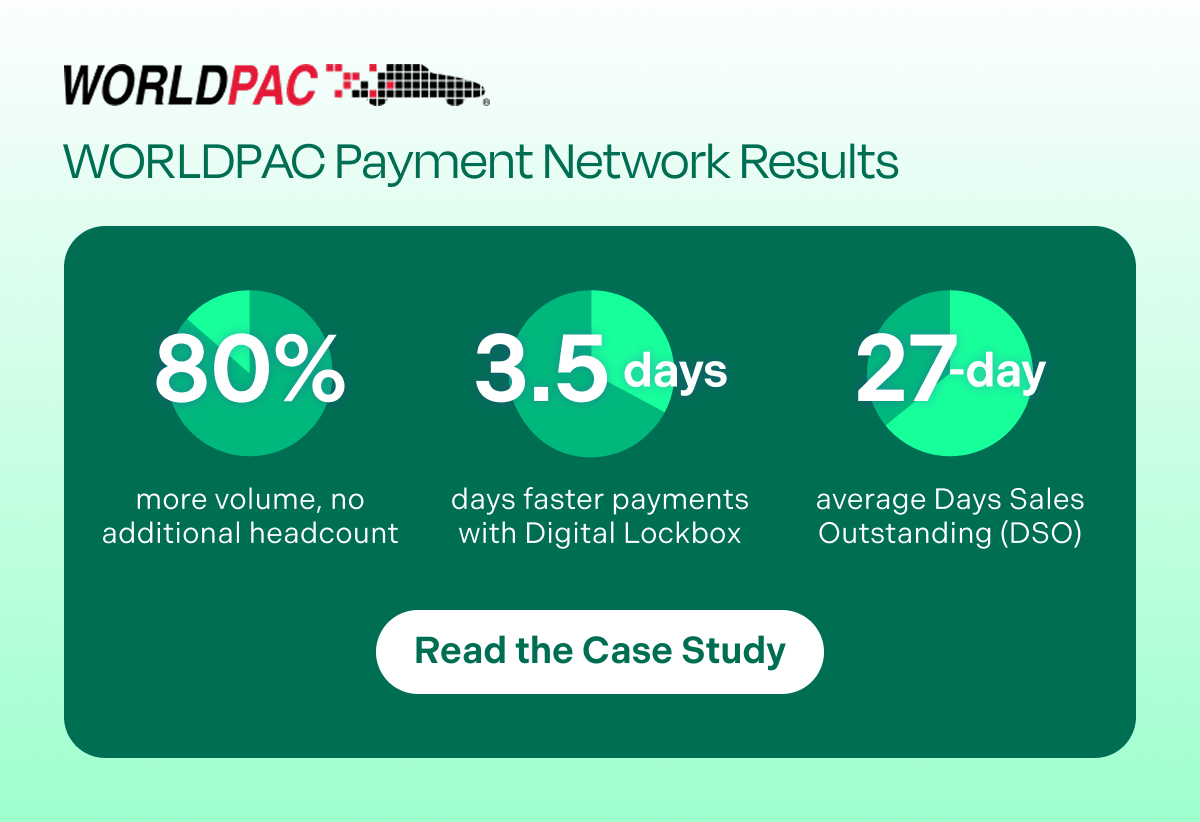
WORLDPAC, a leading supplier of automotive parts, had the classic AR-at-scale problem. Their fast-growing business meant rising check volume and buyers pushing payments through AP portals that the AR team couldn’t efficiently service.
After implementing Billtrust’s Invoicing and Payments solutions, WORLDPAC reached a 27-day average DSO — a payment timing improvement of 3.5 days. They also saw an 80% increase in electronic payments within 3 months. The team didn’t grow — the AR automation software did.
B2B Payment Network + Cash Application: The End-to-End Flow
A B2B payment network only pays off if the data it captures reaches your books. Billtrust’s solution is designed to ensure data flows directly into Billtrust’s cash application automation and into your ERP, closing any gaps in the invoice-to-cash process. Here’s what the workflow looks like:
- Invoice is delivered to AP portal automatically
- Buyer approves and schedules payment
- Payment and structured remittance is captured
- Cash application engine matches remittance to open invoices automatically
- Matching data is routed to the ERP
- Collections and AR reports are update in real time
AR close time compress when exception rates fall and cash application match rates climb. Machine learning is what makes cash application possible at scale, because it handles and normalizes unstructured data.
Handling AP Portal Sprawl with Ease
AP portal sprawl isn’t going away. The question is whether your AR operation absorbs that complexity manually or delegates it to a B2B payment network purpose-built for supplier success. The most effective B2B payment networks handle AP portal connectivity for you, automate payment processing, and turn fragmentation into a single, unified workflow.
See how Billtrust’s B2B payment network accelerates your cash flow. Request a demo →